




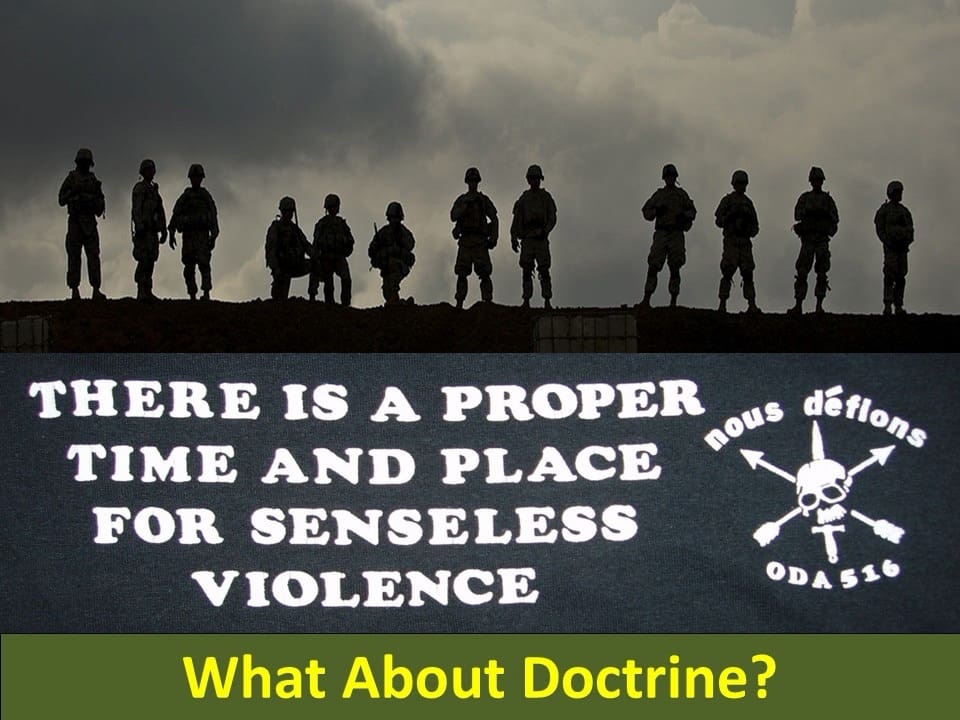
“Doctrine is the Army’s expert body of knowledge. It serves as the starting point for organizations and leaders to think about and conduct operations based on current capabilities and executable by forces currently in existence. It is dynamic and continuously evolves based on lessons learned in current operations and training, adaptive enemies, and shifts in force structure, technology, and social values. Doctrine is the language of the Army professional.”
– U.S. Army Combined Arms Center
I want to talk about doctrine. I intend to focus on current and future challenges for U.S. Army doctrine specifically, and will provide a couple of examples of past doctrinal successes and failures for additional context. I agree with the Army’s official definition above. However, in my experience, that is the description of an ideal and is not often reflective of the reality. My only direct involvement in making doctrinal “sausage” was when I was selected as the ARSOF representative and designated member (1999-2000) of a seven-person writing team for what became the 2001 edition of FM 3.0 Operations. We were assigned to the School of Advanced Military Studies (SAMS) at the Combined Arms Center, Fort Leavenworth, KS. Granted, my personal experience is both brief and outdated, and I welcome anyone with more up-to-date knowledge to correct me if the methodology has changed significantly. I am under the impression that it has not. Still, for what it is worth, here is my experience.
There is a hierarchy to doctrine. All manuals are not createdequal. FM 3.0 is considered an important “cornerstone” of Army doctrine. Other manuals in the series are expected to “nest” their descriptions and guidance within the tactical, operational, and strategic constructs outlined in FM 3.0. Before us, two other teams had worked for a year each and submitted their final products to the Army. Both drafts were rejected, and both teams were disbanded. We became the third team constituted to rewrite/revise the doctrine using the previously approved/published version, and the two earlier drafts as our starting point. To be clear, the problem was never with the writing teams; the issue was with the Army. The Cold War had ended a decade earlier, yet students at Leavenworth and rotations at the Training Centers were still wargaming Fulda Gap scenarios and Soviet surrogate opponents. It was well past time for the Army to force itself to change. Our real-worldenemies had enhanced their capabilities and were still evolving dramatically, but we were standing still doctrinally.
The Army knew that, but the senior leadership had not reached a consensus on HOW we needed to evolve. A few wanted bold change; most wanted only cautious, incremental, and modest adjustments. That became obvious to the writing team I was part of almost immediately. One by one, all the senior Army leaders, Corps Commanders and above, visited us to personally delivertheir perspective and guidance on what HAD to be in the manual and what should NOT be in the manual. We kept a running list. Rarely did any two leaders emphasize the same points. Yet they would all have a veto on what we wrote, just like they had on the two earlier attempts. As a practical matter, that meant that we were not going to be able to present or incorporate any bold departures from the status quo. Period. Furthermore, it had to clearly be an ARMY manual. That meant only a brief nod to SOF, Interagency Partners, and Joint Forces. Likewise, it wassafe to use Vietnam examples of U.S. Army “maneuver warfare” while largely avoiding any mention of “counterinsurgency.” No way was the conventional Army ever going to do that frustrating crap ever again! We were encouraged to frequently use “Unified Action” to describe the Joint fight, but always with the other players in a supporting role to the (Army) ground forces.
In the end, we hammered out a vanilla consensus version that could get rubber-stamped and published. I owned four of the chapters myself. Was it doctrinally sound? Sure. In the sense that it was simply a scene-for-scene “reboot” of earlier doctrineand could still be applicable in scenarios similar to those we had already faced. Assuming history would do us the favor of repeating itself. Did the writing team think that was good enough? I certainly did not, but that was all we were allowed to do. Was that intellectually dishonest? Sure. I left just before the “final draft” hit the street. Toward the end of my time there, a retired fellow who had been on the first writing team came on board to do some final polishing of the text (so it would not be so obvious that multiple people had written the chapters). He shared his thoughts on doctrine writing. He called it “staff masturbation” and said that doctrine writers should always follow the three rules of masturbation. I had to ask, “What rules?” He replied: “It should only be done behind locked doors, it should never be talked about in public, and one should always wash their hands afterwards.” I think he was spot on.
9/11 happened about the time the approved version of my FM 3.0 was distributed in 2001. No one noticed. Few read it outside of a classroom. It was obsolete out of the gate. And so much for the idea that the Army was never going to do counterinsurgency again. Irony is not dead. As history has shown time and again, an Army NEEDS to be ready to fight and win any war that it gets – and not waste time hoping for the war that it WANTS. Eventually, the 2001 version was superseded by newer versions. Did it have some doctrinal nuggets of wisdom that were of any practical use to the warfighters in Afghanistan or Iraq? Not a damn one that I can remember. It was too little and too late. Neither timely nor relevant. Much like the majority of doctrine tends to be.
On paper, we had a fair chance of giving the Army something it needed and could use. After two failures to launch, a real effort was made to bring in some reasonably experienced subject matter experts (SMEs) in various disciplines like Intelligence, Logistics, Fire Support, and SOF. Fresh eyes. However, like the earlier efforts, disjointed micromanagement killed everypotential doctrinal initiative we proposed. Those modest changes that survived were those deemed non-threatening to the status quo. Truthfully, most doctrine writing doesn’t get nearly as much support or attention – positive or negative. Much as soldiers joke that our equipment is made by the lowest bidder, most doctrine is written by soldiers who are not necessarily SMEs in the subject that they are tasked to write about at all. They do their duty, but dearly wish they were doing something else. No one that I know of ever fought to get a doctrine writing job, and Promotion Boards don’t see it as favorable experience.Yet the Army claims doctrine is very important.
I say doctrine is critical – if done right. The process I experienced provided little value added to the Army’s “expert body of knowledge.” It does not have to be that way. To get more value out, you simply must put more value in up front and make it a priority. So how can the Army do that? Let me use some historical examples to illustrate. As the Army prepared itself to enter World War II and win a global conflict, it had little if any doctrine on Airborne Operations, Joint Operations, Amphibious Operations, Strategic Bombing Operations, and only an outline of Armored Operations. It had never been called on to do any of those things before – or required to do them right now and to scale. Their solution was to give the task to the best and brightest they had. Folks like Captain (later Lieutenant General) Yarborough, who was involved in building the American paratroopers’ kit from the skivvies out. Every jump from the Test Platoon on was reviewed, and lessons learned were shared immediately across the Airborne enterprise (including the Airlift assets who had to deliver the jumpers and their gear to the Drop Zones). Best practices were captured and became the Army’s Airborne doctrine. They did it right, and they did it fast.
In March of 1945, Operation Varsity, the last major parachute operation in the European Theater, was conducted. The American 17th Airborne Division and the British 6th Airborne Division were delivered across the Rhine River to enablefollow-on Allied operations deeper into Germany. Elements of the 17th had been involved in combat during the Battle of the Bulge, but had not yet made a combat jump. However, the Airborne training they received had directly benefited from the doctrinal lessons learned from combat and shared by their predecessors in the 82nd, 101st, and 11th Airborne Divisions. The 17th captured all of its objectives in just 4 hours after being dropped. Sound doctrine did not guarantee their success, but it was definitely value-added. I suggest that the Army today needs to follow that example and do doctrine faster and better than we have been.
There are a couple of doctrinal axioms that are useful to remember. One, doctrine is most helpful when it is descriptive and not prescriptive. Doctrine provides guidelines, but is not meant to be a checklist. Two, even the soundest doctrine cannot take the place of a clear strategy. If our National Leaders cannot articulate a desired/achievable strategic endstate, then doctrine cannot be expected to provide a miracle remedy. So, what about a case of doctrinal failure? I can think of several that I saw during my career. The Army’s Counterinsurgency doctrinewould be an obvious example. For one thing, FM 3-24 Counterinsurgency is too prescriptive in my professional opinion. Indeed, many leaders in theater took it as a checklist. Yes, we won “all the battles” in Vietnam, and in Afghanistan, and in Iraq. Thanks to the valor, fidelity, and professional excellence of our troops – not because of our doctrine. I would suggest that even if we had perfectly executed ourCounterinsurgency doctrine as written, it would have made no difference to the outcome. Ultimately, we achieved nothing but strategic failure.
We have to do better. We have been wrestling with Information Age challenges like drones, robots, AI, Cyber, and Space, et al, for some time now. Doctrine is too slow and simply not keeping up. It needs to be developed early and delivered to the force before we spend billions on hardware and software. That is not my opinion alone. In all the professional forums I am privy to, that is a constant topic of discussion. Much of what I am reading is frankly alarming. The Army is buying a lot of drones – and has yet to clearly articulate how our formations will fight with those tools, and in those emerging domains. I seriously doubt that making every other soldier in our formations a drone operator is the final answer – or even a good answer. And what about Large Scale Combat Operations (LSCO)? Don’t get me started. I see lots of buzzwords being strung together but damn little clarity. Frankly, LSCO seems to be a convoluted and evasive way of describing the kind of war the Army hopes to fight rather than the real wars we will need to fight.
I have been studying war and the profession of arms for half a century. The more I know, the more I realize how little I know about war. I may have this all wrong. My information is anecdotal and unscientific. Maybe Army doctrine is dynamicallymeeting all the needs of the current generation of warfighters on firewall-protected platforms I am not able to access. I am just too far out of the loop. That would be great if it were true. I just don’t think that is the case. Too many people are asking questions. Too many are confused about where we are and where we are going. Lots of individuals are out there doing the big-brain thinking that is needed, and they are sharing their thoughts in the professional journals, The Harding Project, and Line of Departure. My only complaint is that the writing on those platforms often comes off as academic rather than practical. In any case, an opinion piece – no matter how well researched and written – does not equal doctrine. But it is a good start.
I have a few suggestions that could cut down on drag and make the process a little more aerodynamic. I am thinking of those WWII doctrinal pioneers who figured out bold new ways of war on the fly and disseminated the information as fast as they could. Why can’t we do that? Let’s “go live” with Army doctrine. They got it out at the speed of the printing press. We can go at the speed of the internet. We should be able to do it in near real time. Do we even need doctrine to be organized in legacy book form of hundreds of pages each anymore? I am thinking of something more like the Wikipedia model – an easily searchable encyclopedia of doctrinal information organized to highlight relevant points with brevity and clarity, along with links to additional information if needed. As a unit or individual figures something out through experimentation or trial and error, they can post it for peer review, comment, and approval. Ideally, who should be the authors of our doctrine? How about the people who are doing the job? They would know better what works and doesn’t work than some pick-up star chamber of commissioned officers.
I certainly think we can do without some of the excessive wordsmithing in our doctrine as well. It need not, and I would argue should not, be written like a doctoral thesis. Who are we really trying to impress? Read some of the WWII doctrine. It is clear and concise with a lot fewer obfuscating buzzwords and semantic padding. Probably at the High School senior reading/writing level of the day. I’d say that is more than good enough. How about we give our sharpest soldiers, junior NCOs, Warrants, and Company Grade Officers some ownership and agency in the sausage-making business? Why not? That is probably enough talk about doctrine for now. It is not fun or high-speed, but it is important, and the Army is better served if we get doctrine right as rapidly as humanly possible – and well before we have to pay for mistakes with blood. Now I am going to wash my hands.
De Oppress Liber!
As readers can see, I have come back to writing. I was enjoying my time focusing on leadership mentoring of younger folks and not writing. Still, questions and issues related to confusing doctrinal gaps and omissions keep cropping up in discussions. I am looking at you, LSCO! There was also a lot of interest in capturing and sharing old-school tactical lessons learned. That seemed to go out of style during GWOT. Individual and small group mentoring was not going to scratch either itch. I am exploring options to do some of that myself here on SSD, and perhaps get others involved. More to follow.
LTC Terry Baldwin, US Army (Ret) served on active duty from 1975-2011 in various Infantry and Special Forces assignments. SSD has been blessed by his friendship and role as, reader, contributor and mentor. It‘s great to have him back!
You can skip to the end and leave a response. Pinging is currently not allowed.
Read the full article here