




MAXWELL AIR FORCE BASE, Ala. —
Air Force Chief of Staff Gen. Kenneth S. Wilsbach recently delivered a clear message to the global defense community: “The most effective airpower is combined airpower.”
Speaking at the Global Air and Space Chiefs Conference in London, Wilsbach stressed that when allied and partner air forces operate in unison, they create “options, dilemmas, and effects that no nation can generate independently.”
His vision for the future of global deterrence is clear. The U.S. and its allies are actively forging a united front, backed by an increasing presence of high-end platforms like the F-35. But as Wilsbach pointed out, true interoperability isn’t just about exquisite hardware or compatible data links. It is fundamentally about how quickly a coalition can process information, make unified decisions, and take decisive action.
“Future conflict demands that we expand our thinking, to include how we share information, make decisions, and how quickly we can translate awareness into action,” Wilsbach said. “In an increasingly contested environment, speed is critical. The force that can understand a situation, make better decisions, and act first will possess the advantage.”
But how does a coalition rapidly understand a shared operational picture when the forces looking at it speak different languages and view the world through different cultural lenses?
The answer sits at the very core of Air University’s Air Force Culture and Language Center’s (AFCLC)mission: Interoperability hinges on Language, Regional Expertise, and Culture (LREC) in all things left of “GO.”
Before a single engine turns, before Koku Jieitai refuelers in Japan can perform hot-pit refueling on U.S. aircraft, and before forces can rapidly mobilize across European borders during exercises like Steadfast Dart, there has to be a baseline of human understanding. You can’t share information at the speed of relevance if you cannot communicate effectively with the partner beside you.
This is exactly why Air University is heavily invested in building joint coalition warfighters through the Language Enabled Airman Program (LEAP). To solve big Air Force problems and drive enterprise integration, AFCLC developed a new form of Language Intensive Training Events (LITEs): the Language Enabled Airmen Postured for Agile Combat Employment (LEAP-ACE) course series.
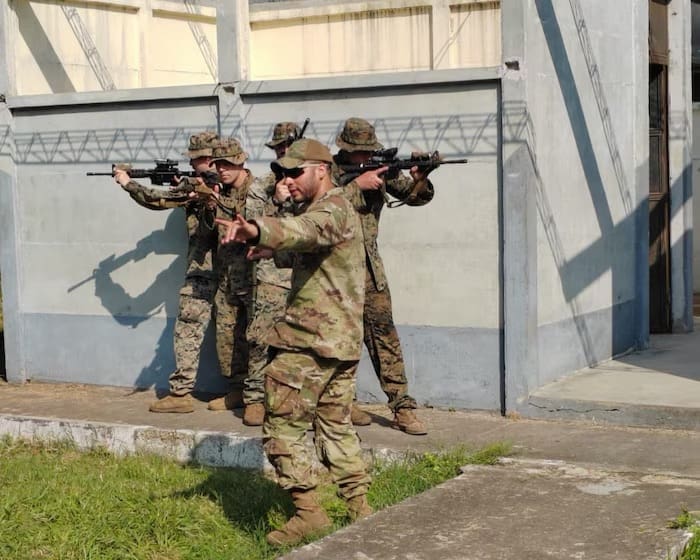
LEAP-ACE teaches advanced-proficiency LEAP Scholars how to express complex ACE concepts in a target strategic language. We become highly effective as a combined force when our Airmen can understand exactly what our partners are saying, especially when utilizing highly technical, mission-related vocabulary in the heat of an operation.
To understand what Wilsbach means by translating awareness into action, look no further than a recent Airfield Damage Repair (ADR) exercise at Morón Air Base, Spain.
During the exercise, 1st Lt. Aliyah Brown, a Logistics Readiness Officer, participated in LEAP-ACE by embedding directly at the airfield repair site as a Portuguese interpreter alongside Portuguese and Spanish Air Force civil engineers.
“My role was critical in facilitating accurate, timely, and mission-focused communication between U.S., Portuguese, and Spanish forces,” Brown said. “Given the complexity of the multi-phase operation with moving equipment, evolving objectives, and coordination between three countries’ engineering teams, precise communication was vital. We ensured that Portuguese personnel understood what was needed, when, where, and why—helping prevent confusion and delay in a highly dynamic and fast-paced environment.”
But LREC is more than just translating words; it is about cultural intelligence and team integration. Brown found herself actively managing the human element of the mission to maximize operational flow.
“Being an interpreter in that environment is not just about utilizing your fluency, but also actively participating in getting the right people in the right place to leverage the full extent of what they bring to the operation,” Brown explained. “There were times when we identified that a Spanish engineer, for example, had a high level of proficiency with a certain technique or process that a younger Portuguese Airman could benefit from learning. You’re out there constantly recalculating who needs to be where and how to team people up.”
This friction-reducing integration helps make combined airpower lethal. Tech. Sgt. Camilo Guzman, a Requirements and Optimization Section Chief with the 31st Civil Engineer Squadron who also participated in the Morón Air Base exercise, noted that LEAP-ACE is a direct force multiplier.
“This program educated me as a LEAP Scholar by providing advanced knowledge to proficiently articulate Agile Combat Employment paradigms in a selected strategic language,” Guzman said. “This training enhances my effectiveness in coalition and multinational operations while improving my understanding of potential adversaries.”
To create the operational “dilemmas” Wilsbach emphasized, the U.S. military must deeply understand how its adversaries think, communicate, and perceive actions. Adversary understanding is the second side of the LREC coin, ensuring that we are not only united with our allies but a step ahead of our pacing threats.
“One of the most powerful deterrent signals we can send is demonstrating that free nations are united, capable, and prepared to act together,” Wilsbach said.
That unity doesn’t happen by accident, and it can’t be achieved by technology alone. It is forged by Language Enabled Airmen who are equipped to bridge the gaps between nations. As the Air Force relies on allied contributions for global defense, the strategic imperative is clear: combined airpower is the vehicle, but LREC is the key that turns the ignition.
By James Brown, AFCLC Outreach Team
You can skip to the end and leave a response. Pinging is currently not allowed.
Read the full article here