




The argument can be made that the Germans make the world’s best engineers. By way of evidence I would submit the StG44 assault rifle, the Me 262 jet fighter, and the Panther tank. While, in each case, the exigencies of around-the-clock bombing certainly took a toll on these revolutionary weapon systems, one cannot help but be impressed with the sheer mechanical elegance of the things. However, sometimes those German engineers, bless their hearts, got a bit carried away with the details.
I once read that German engineers coming of age in the interwar years had a rite of passage. They would be issued with a small block of steel and a series of hand files. Prior to graduation that block had to be a sphere. I don’t know if that story was apocryphal or not, but it would certainly produce some meticulous thinkers.

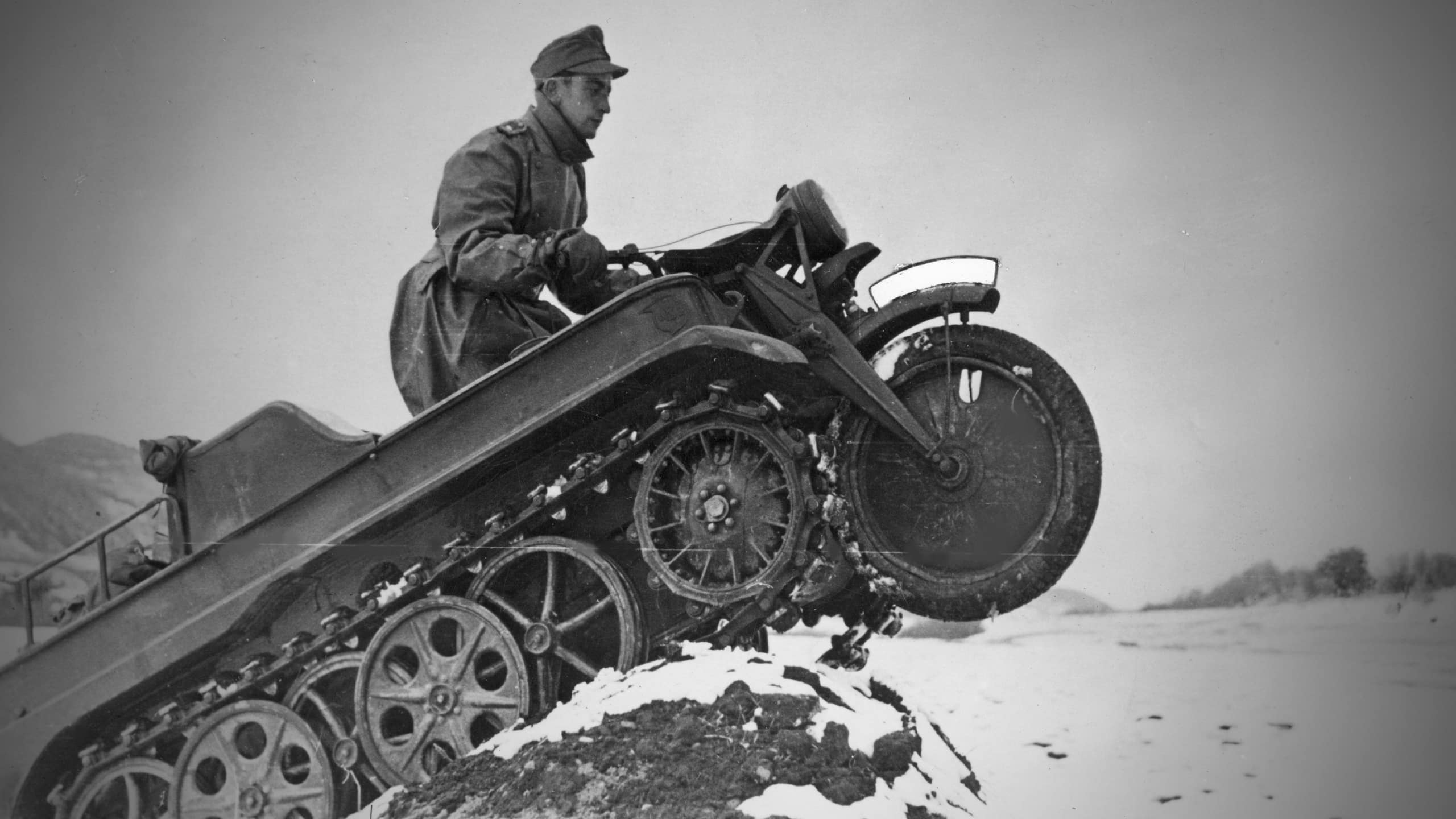
In few places is the German tendency to over-engineer things put in more stark relief than in the Sd.Kfz. 2 Kleines Kettenkrad HK101 halftrack motorcycle. This elegant beast was both exceptionally capable and lyrically complex. The end result was cool and weird in comparable measure.
The Mission
In the leadup to World War II, the overwhelming majority of German logistics was still equine. One shocked German officer who was watching Allied forces pour ashore during the D-Day landings purportedly exclaimed, “Where are the horses?” All the way up until the end of the war, a great deal of German tactical transport was powered by hay rather than petrol. Regardless, German military planners appreciated early on that there would be a requirement for a compact motorized vehicle to move critical loads across rugged terrain. The end result was the Sd.Kfz. 2 Kleines Kettenkrad HK101.

The Kettenkrad was intended to be a light tractor for use by airborne troops. The original design specifications were for a petrol-powered machine small and light enough to be airlanded in the three-engine Ju-52 transports of the day. The Kettenkrad could not be deployed via parachute, but it would fit inside an airplane. The term Kleines Kettenkrad literally translates to “Small Tracked Motorcycle.”

Designed by the NSU Motorenwerke and patented in 1939, the Kettenkrad first saw action in 1941 during Operation Barbarossa, the German invasion of the Soviet Union. 10% of the total production of 8,345 Kettenkrads was contracted out to the Stoewer Company. NSU built the rest. By war’s end, the Kettenkrad was a fairly common finding across war-torn Europe.

Details
The Kettenkrad consisted of a heavy tracked chassis to which was mounted a front wheel and a pair of handlebars. Power came from an Opel water-cooled four-cylinder inline engine producing 36 hp. This engine was slaved to a transmission offering three forward gears along with one reverse in two different ranges. Top speed over flat terrain was an unsettling 44 mph.

The Kettenkrad was just shy of ten feet long and weighed 2,700 pounds. It would carry a driver and two passengers. The Germans also made an adorable little trailer for it that increased its hauling capacity. The trailer was rated to pack some 770 pounds of equipment.
The Devil is in the Details
Most of Germany’s military equipment used during WWII was markedly more complicated than its Allied counterparts. The Tiger tank, as an example, was a fearsome weapon. However, these behemoths were essentially handmade and were subsequently slow to produce. You see some of that same complex mechanical ethos in the Kettenkrad.

For starters, the suspension on the Kettenkrad used the same interleaved road wheels seen on the Panther and Tiger tanks as well as the Hanomag halftrack. The Germans called this the schachtellaufwerk system. When slaved to wide steel tracks, this design produces a smooth ride and low ground pressure. However, replacing damaged wheels often involved removing several healthy examples unnecessarily just to get to the broken stuff.

Live The Armory Life. The latest content straight to your inbox plus an automatic entry to each of our monthly gun giveaways!
The running gear on the Kettenkrad was also incredibly complicated. When taking turns, up to a certain point simply turning the front wheel was adequate. However, past that point, there was a mechanism built into the handlebars that gradually applied the brake on the inboard track. This sharpened the turn and enhanced mobility but at a massive cost in mechanical complexity. When moving slowly over truly rugged terrain, German troops were trained to remove the front wheel and steer the Kettenkrad manually using differential braking of the tracks.

For all its Rube Goldberg mechanicals, the Kettenkrad was undeniably capable. The machine could tackle a 24-degree grade in soft sand. It was did even better on firm ground.
Applications
German troops used the Kettenkrad anyplace they needed a little cross-country muscle. In Russia, they used the spunky little machines to lay communication wire, move heavy stuff, and help troops get themselves and their equipment through the sticky Russian mud. The Kettenkrad was a common sight in both North Africa and Western Europe as well.

In addition to general utility use, the Kettenkrad was utilized by the Luftwaffe as an aircraft tug, particularly in austere, unimproved airstrips. In the case of the radically-advanced Me 262 fighters and Arado Ar 234 jet-powered bombers, precious engine time and fuel shortages meant that Kettenkrads typically pulled these planes out onto the runway before the pilots spooled up their powerplants. Using the little halftrack motorcycles preserved critical resources when compared to taxiing the machines under their own power.

The Kettenkrad featured prominently in the epic Steven Spielberg movie Saving Private Ryan. Ingenious American paratroopers used a captured example as bait to draw attacking German forces down a desired route and into an ambush. This is a good demonstration of the vehicle’s innate agility.
Ruminations
The Germans produced a couple of subvariants of the Kettenkrad, but these never amounted to much. A larger five-seat version didn’t make it past the prototype stage, and the mittlerer Ladungsträger Springer Sd.Kfz. 304 was used as a remote-controlled demolition weapon. The smaller Leichter Ladungsträger Goliath Sd.Kfz. 302 tracked remote-control mine saw much more use in this application.

The last wartime Kettenkrad rolled off the lines in 1944. By then, the Germans had bigger fish to fry, and Allied successes made their supply lines much shorter. After the war, NSU Werke AG produced a further 550 examples for agricultural use, but a modest conventional tractor was cheaper and more effective. The Kettenkrad ended up being a curious mechanical footnote to the global hemoclysm that was the Second World War.
Editor’s Note: Be sure to check out The Armory Life Forum, where you can comment about our daily articles, as well as just talk guns and gear. Click the “Go To Forum Thread” link below to jump in!
Join the Discussion
Read the full article here