




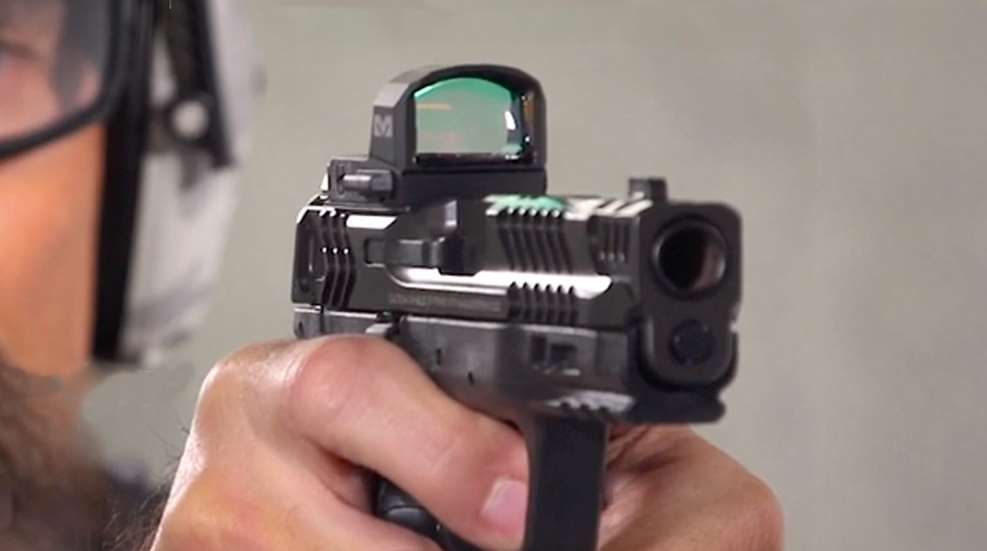
Shooters who want to hit a point-of-impact (POI) based on point-of-aim (POA) align the muzzle with the target—that is getting the barrel’s axis, sights/optic, and trajectory to the same place at the same time—can apply eight pro tips geared to optimize their alignment.
Natural Point of Aim (NPOA)
It’s work enough to find rapid alignment from the holster or in recoil recovery, the last thing you need is to wrestle with your own anatomy. Your body, when fighting to maintain alignment, introduces structural (tendon and muscular) tension which can move the muzzle inducing vertical or lateral misses.
NPOA for a pistol is structural alignment of your shoulders and grip starting from when you present the muzzle to the target. The three key checkpoints are a durable grip, firm but flexible elbows and shoulders, with no added body torque from the hips or legs.
Grip Consistency
No two grips are ever the same. Unlike rifles, pistols rely on hand/forearm geometry (grip height, thumb position, web of hand, trigger finger placement) to lock the sights to your eye. A consistent presentation (how you bring the gun from holster/low ready to eye line) fixes the sight-to-eye relationship.
We have all experienced bad grip and have consequentially fought through it to make it work anyway. Make no mistake a poor grip directly affects your ability to both find and maintain alignment. The answer is dryfire your presentation focusing on hitting your precise waypoints along your draw-stroke path.
Pistol Zero
Common pistol zero choices: very close (7 to 10 yards), mid-range (15 yards), and 25 yards. Each shifts the POA/ POI window of minimal holds. Lower zero distances make close, immediate hits intuitive but produce larger relative vertical shifts at longer distances; farther zeros (25 yards) minimize hold-over for a wider band of distances. Defensive pistol instructors generally favor 15 to 25 yard zeroes for red-dot pistols.
Mechanical Offset
The carry optic or iron-sight plane on a pistol sits above the bore axis. Although the offset is much smaller than on rifles—typically a few tenths of an inch up to a half-inch for many red-dot setups—it still produces a measurable vertical displacement at close ranges that changes with distance. That means a pistol zero that looks perfect at 25 yard can read as low or high at 5 to 10 yards simply because of the sight-to-bore height and the ballistic arc.
Measure your height-over-bore, confirm your zero from a stable rest, then record POI at representative close distances so you know the exact holds to use in practical application.
Red-dot Pistol Mounts
Carry optics marketed as “parallax-free” still show practical POI shift when the dot is off-center in the viewing window or when the shooter’s eye is significantly off the optic’s sweet spot. Proper mounting height, a centered dot at your chosen zero, and verifying the zero with the dot in the center of the glass reduce these errors.
Under stress your head/eye position will vary—on pistols, where engagement distances are short, that variability produces the largest POI deviations. Bench-zero the optic with the dot centered, then verify unsupported in your normal presentation; if head-position tests show movement of POI, re-mount or change the optic.
Trigger Press and Follow-through
The trigger press must be straight to the rear with no lateral movement; follow-through means holding the sight picture and visual focus on the front sight (irons) and/ or target (dot) through recoil and while the slide cycles. A poor trigger press during rapid recoil moves the muzzle before the shot is completed.
A missed shot can be trigger-induced if the press in any way impacts your POA hold. What separates the professional from the amateur is their ability to work that trigger at nearly mechanical limits with negligible muzzle movement.
Support Structure
Consistent stance (anatomical support structure, natural or trained cant, grip pressure, etc.,) reduces rotational error and ensures predictable POI relative to the target.
Untrained cant rotates the sight plane vs gravity and can introduce errors exacerbated at longer pistol distances or when transitioning to secondary targets. It also matters for rapid-response close defensive ranges for follow-up shots.
Practical Validation
If you want to take it to the next level you can map your POI, distance and build a simple reference.
After you’ve set sights/optic and practiced your fundamentals (reducing human error), map POI at key distances you care about (3, 7, 10, 15, 25 yards) and chart the required holds (e.g., center-dot, 2-inches high, slight offset). For duty/EDC pistols, know your “no-adjustment” window and where to hold for close/extended shots.
Under duress you won’t rationally calculate trajectory—you’ll rely on muscle memory (subconscious competence) and visual confirmation. A tested POI map removes guesswork and mitigates unknown variables when your sight height and zero interact with real ballistics.
Consider these eight alignment optimizers as mechanical engineering controls. Establish a documented zero, measure height-over-bore, and bench-zero from a stable rest; then verify unsupported from your operational stance and holstered presentation. Working in all or even some of these can help transform your alignment from approximation to accountable engineering.
Read the full article here