




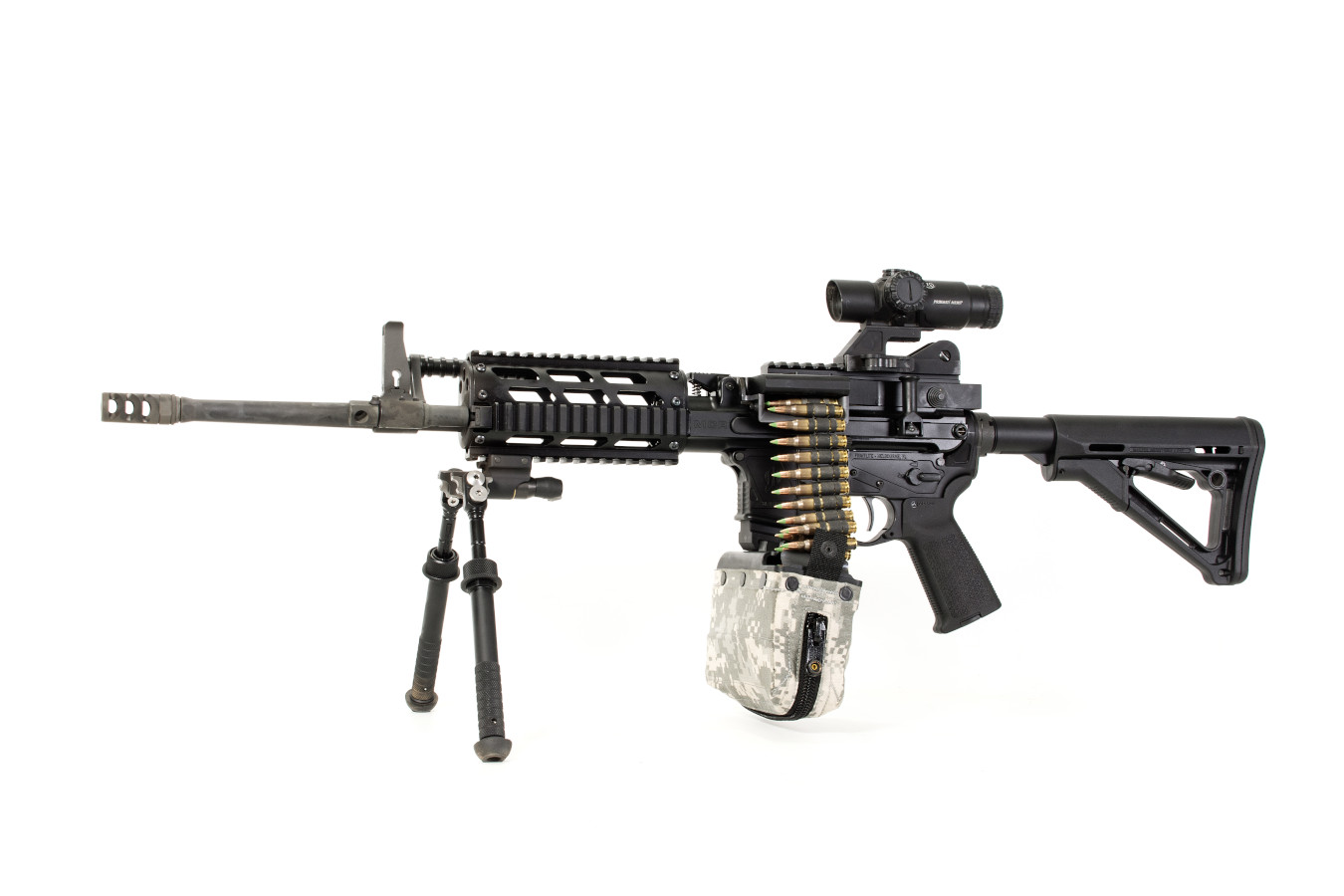
Photos by Kenda Lenseigne
While the AR-15 has been subject to just about every modification imaginable, the quest for a belt-fed AR upper version took longer to come to fruition than anyone imagined.
Way back in 1998, rumors started circulating of an AR upper that could be fed from either box magazines or M27 links, like the FN Minimi or its apple pie offspring, the M249 SAW. For anyone with an M16 lower, this would be an easy way to add a belt fed to the collection, and for those of us who had to content ourselves with semi-autos, well, a belt-fed semi was (and is) still pretty damn cool.
The concept generated a lot of buzz, but actually getting from prototype to production proved to be a long and frustrating process, taking longer than anyone anticipated. The good news is that it was worth the wait, and since achieving widespread availability, the FightLite MCR has been subjected to extensive consumer testing.
Now, it could be argued that for civilian use, a belt-fed 5.56 is both overkill and subject to the manifest drawbacks of the petite NATO round, but we posit that, A) when it comes to firearms, there’s no such thing as overkill, and, B) shut up, commie.
BELT-FED AR UPPER DESIGN CONSTRAINTS
Using an AR lower receiver as the basis for what is essentially a light machine gun imposes severe restrictions on the designer’s ability to address the differences between rifle and MG use cases.
Putting aside the legal issues, the biggest drawback is that while automatic fire can be achieved through either M16 fire control components or a RDIAS, open bolt operation is a bit trickier, in the U.S., at least. As a result, the potential for cook-offs and a runaway gun is ever-present, and to mitigate this risk, frequent barrel changes are necessary. A second drawback concerns the AR’s receiver length, or rather, the length of its operating stroke.
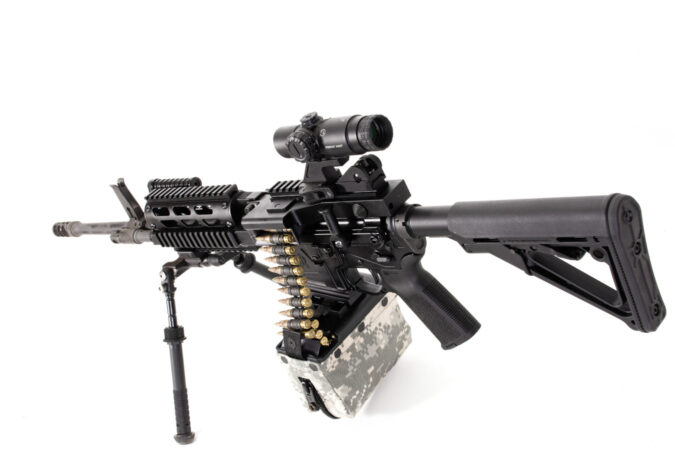
Machine guns must be designed to fire thousands of rounds in an engagement, so to cope with the associated heat stress, carbon buildup, and dirt ingress associated with running a belt, they use heavy springs to drive massive bolts and carriers, tap off comparatively large amounts of gas, and allow the moving parts plenty of runway to allow for sufficient dwell time in order to get things where they need to be.
The AR-15 has a notoriously short operating stroke, which can be the source of feed-related stoppages and the driving factor behind the development by Jim Sullivan of the SureFire-optimized bolt carrier group. While it might be tempting to lengthen the stroke by shortening the bolt carrier (and in the case of the OBC, moving the carrier key forward), this inevitably leads to failure of the comparatively weak bolt catch as the BCG slams into it.
When these shortcomings are considered, it’s a small miracle that the MCR works at all — but work it does.
OPERATION
The MCR uses a short-stroke gas piston to drive an operating rod, which in turn pushes against an extension on the bolt carrier to drive it rearward and unlock the action. Think in terms of an HK 416 BCG but turned on its side.
The piston itself is a simple cylinder with integral gas rings, riding inside a side-mounted gas block which also serves to mount the carry handle and front sight tower. A FAL-esque, three-position gas plug allows the user to adjust the amount of gas entering the system and account for both suppressor use and fouling.
Instead of just retaining the firing pin like in an AR-15, the MCR cotter pin also holds a separate piece which contains a roller bearing, used to drive the belt-feed mechanism. Any student of small arms will recognize the cam track and feed pawls in the MCR, which traces it lineage to the granddaddy of all of modern light machine guns, the MG42 — and copied in the M60, MAG58, Minimi MG5 etc., etc.
Although the MCR’s bolt looks like an AR-15’s, there are several improvements intended to increase its strength and reliability.
The number of lugs has been reduced from seven to six, and their width has been increased from 0.10 to 0.145 inch. Rather than having square roots and tips that create stress risers in both the bolt and the corresponding spots in the barrel extension, these are rounded to eliminate the problem. This version fires from the closed bolt, as the BATFE is notoriously shy about allowing open bolt guns onto the civilian market. There is, however, an open bolt variant that uses a sear surface cut into the bottom of the bolt carrier, but you can’t have it, serf.
Both the charging handle and catch for the top cover are located on the left side of the upper receiver, and like all good Western machine guns, the MCR feeds from the left side also. It could really use a right-side bolt catch, as locking back the bolt for a barrel change, or dropping it after loading a new belt is more awkward than it needs to be.
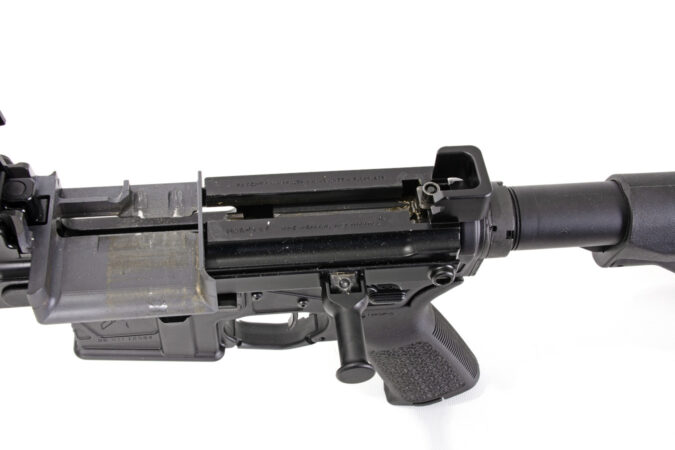
If you want to use, say, an ADM lower that does offer this feature, then you’re going to have to swap out your bolt catch for the FightLite version in order to clear the wider upper receiver. FightLite also include a heavier buffer and buffer spring with their conversion kit, along with a buffer spacer to reduce the amount of BCG travel and the wear and tear this has on the bolt catch.
Two standard barrel lengths are offered — a 16- and a 12.5-inch. To mitigate some of the effects of heat buildup, they measure a full inch in diameter from the chamber to the gas block, then slim down after that.
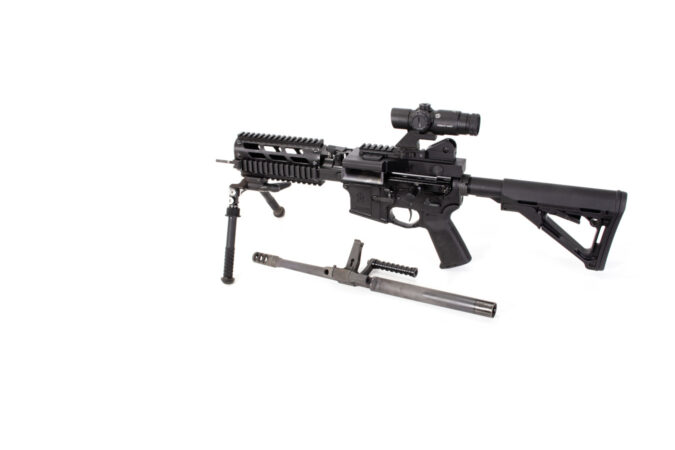
Two sets of feed ramps are present in the barrel extension, a pair of M4 cuts are at the usual 5 and 7 o’clock positions for use with box magazines, with a third at the 12 o’clock to feed founds from a linked belt. Barrels are secured to the upper receiver by means of a spring-loaded catch forward of the top cover. Barrel change is fairly straightforward — lock the bolt to the rear, press down on the barrel catch, and pull forward using the carrying handle, with installation being the reverse of this.
ROUNDS DOWNRANGE
After adding an Atlas bipod and Primary Arms 2x prism sight to the MCR, we grabbed a few mags and some linked M855 and headed to the range, where we were met by the best kind of buddy, namely one with an SOT and an RDIAS. We broke in the gun according to the manufacturer’s instructions, firing a couple of magazines in semi-auto mode to both zero and loosen things up before switching to full auto, belt-fed operation, and shot the first 200 rounds with the belt laying on the bench next to us. Next up was another 100-round string, feeding from a cloth “nutsack,” followed by a barrel swap and a further 200 rounds fed from a boxed belt, or pork chop, both of which clip to a magazine well adapter. Due to the length of the AR-15’s magwell, when adding SAW feed devices, you’ll need to add a few clicks to the bipod’s legs, which raises the height of the gun (and increases exposure of the operator).
The rate of fire in rock ’n’ roll mode felt fast — around 850 rpm — and the light weight of the MCR required the shooter to keep a firm grip on the weapon, loading the bipod more than usual. It’s very easy to burn through a lot of ammo with the MCR, even in semi-auto mode, so long as you have a decent trigger with a short reset.

Because of its closed bolt operation, it’s probably better to think of it as an automatic rifle, rather than a machine gun, and if you use it with this mindset you’ll probably never encounter a cook-off, no matter how many belts you push through it.
Drop in an auto sear, or mate it to a three-pin lower, and you’ll be forced to change barrels every 400 rounds or so.
In this role, the MCR offers the user all the ergonomic benefits of a lightweight carbine based on AR-15 architecture, but if it’s necessary to increase the number of freedom seeds going downrange to fight off a zombie horde or invasion of DPRNK paratroopers, then it can change quickly to belt-fed operation and lay down an impressive amount of hate, albeit for a shorter duration than a real LMG.
We ran a few drills, engaging targets from a barricade with the gun feeding first from a magazine, then proning out and swapping to a belt, and it’s possible to make the transition in about 15 seconds.
Is it worth the eight grand asking price? For most people, probably not. You can certainly buy all sorts of premium carbines and handguns for that kind of money and leave plenty of change for ammo. But if you’ve already built out your collection and want something that none of your buddies have or foresee dark clouds on the horizon filled with the best Korean paras, then go for it. This is, after all, America, and there ain’t nothing wrong with a little overkill.
SPECS
FightLite Industries MCR
- Caliber: 5.56 NATO
- Capacity: 200-round belt, 30-round magazine
- Barrel Length: 16, 12.5 inches
- Overall Length: 33 inches
- Weight (as featured): 11.3 pounds
- MSRP: $8,400
- URL: fightlite.com
FREEDOM ORDNANCE FG-15
Wallet feeling a bit light after buying an MCR upper? Can’t afford to drop another 30K on a transferable M16 lower receiver, but still want to take advantage of some rapid belt-fed goodness? Freedom Ordnance would like a word.
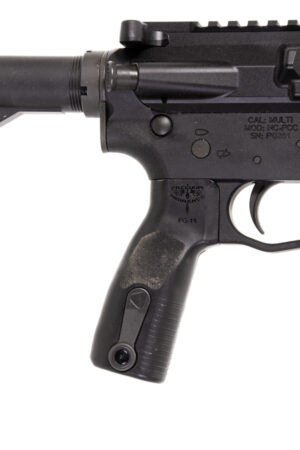
Swap out the grip on any AR-15 with their FG-15 and it turns your semi-auto carbine into a hand-cranked Gatling gun-hybrid through some nifty engineering. A pop-out crank handle in the right side of the grip activates a cam that drives a rod to push on the tail of a standard trigger (or indeed some aftermarket triggers, too).
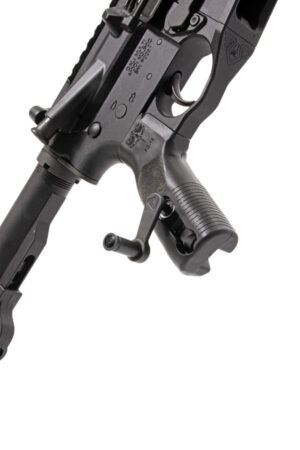
Each revolution of the crank produces four trigger activations, speeding up the rate of fire to near-full-auto rates, which is guaranteed to cause Gavin Newsom to soil his underoos. As a side note, it’s banned in the usual collection of pearl-clutching nanny states.
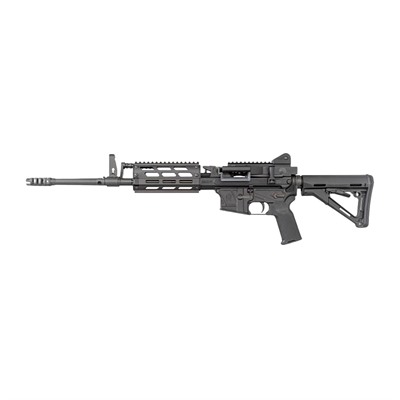
Fightlite Industries Mcr Dual-Feed Mcr Dual-Feed Picatinny
$6,899.99
While it’s tempting to dismiss this gadget as merely a gimmick (and yes, when firing from offhand, it’s pretty difficult to get consistent hits), when used from the prone in conjunction with a bipod, we were able to dump a D60 in short order and land shots in the vicinity of an IPSC steel target at 200 yards. Machine guns are area weapons, right?
With options so limited in this space, there isn’t a “bang-for-the-buck” recommendation. Choose the upper you want based on the features it has, bite the bullet, and pay the cost.
Standard 55gr 5.56/.223 or M193 is great for blasting. If you want to get fancy, linking ammo gives unlimited options for combinations.
Use lube! Cleaning is required, and maintenance is mandatory.
Read the full article here