



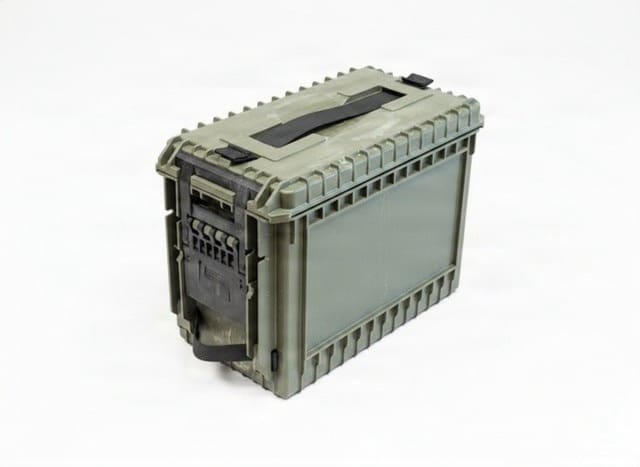
PICATINNY ARSENAL, N.J. — Blending lightweight polymers with a rugged steel shell, the U.S. Army Combat Capabilities Development Command Armaments Center’s new SixPAC system marks a groundbreaking leap in small?caliber ammunition packaging, one intended to reshape how munitions are used by Soldiers.
The SixPAC, named as such because it was intended for 6.8mm, is comprised of two lightweight polymer ammunition containers — or PACs — contained within a steel outer pack. Following successful implementation with 6.8mm, the system is planned for adaptation across multiple legacy small caliber ammunition production lines.
This initiative serves as the first major overhaul of small caliber ammunition packaging since World War II. Supply chain vulnerabilities, rising costs and a need to prepare for tomorrow’s military operations in varied climates necessitated a re-evaluation of current munitions packaging. The SixPAC is designed to have a lighter tactical inner pack, which will widen its manufacturing base and increase logistical efficiencies.
The SixPAC is highlighted by the lack of a traditional wood wirebound box overpack, which frequently required remediation, had to be assembled manually and was susceptible to mold. It also removes reliance on chemical wood preservative treatments, thus reducing environmental impacts and the possibility of a supply chain disruption.
The SixPAC’s polymer inner pack provides a reduced weight, easier transport, and is also more efficient to manufacture using automation. The steel outer pack reduces the logistical footprint by allowing more containers and ammunition per pallet and has a notably larger supply base than its legacy wood counterpart.
According to the project’s tech lead, Senior Scientific Technical Manager for Packaging Jason Runell, SixPAC was partially derived from a desire to do away with the wirebound box but was above all done in pursuit of modernization to face present-day logistics, portability and supply chain challenges. His team tested several materials and received feedback from various user communities before landing on a polymer inner pack and a steel outer pack.
This decision, he added, comes out of necessity — polymer isn’t yet as proven in the U.S. military as it is in other countries. Uniquely however, the U.S. must be ready to engage at any time and fights in various climates, all with their own difficulties and needs. In order to meet military standards, polymers have to hold up no matter the locale, even after years of storage.
The specific polymer developed on earlier container efforts has considerable potential, noted mechanical engineer and polymer designer Edward Lucas, but the team will keep the door open if anything more advantageous is developed.
“It’s a developing field, and polymers are unique — you can modify them, include additives that improve impact performance, stiffness or dimensional stability. You can add more ingredients to the cauldron and your potion will come out different trading some characteristics for others,” Lucas said.
Several designs are in development, with inner tactical polymer containers expected to weigh about half of the legacy steel M2A2. This weight savings on the tactical pack will result in a reduced load for an already weight burdened soldier.
The weight decrease will also be advantageous particularly on weight-sensitive platforms such as light watercraft and aircraft. Weight affects whether these platforms can launch to begin with and plays a part in its agility should the platforms be forced to engage.
Beyond this, the injection molding process for these inner packs will offer supply chain advantages. More than 800 injection molders within the United States are likely capable to create these packs, creating competition, slashing costs and lowering barriers to entry for new suppliers.
Additionally, polymer inner packs can be produced largely through injection molding, where most components are formed in a single custom mold and do not require large dedicated fabrication lines. Because the same press can be used for other products simply by swapping molds, polymer production requires a much smaller footprint and less dedicated tooling.
Soldiers got their hands on the SixPAC for testing throughout 2024 and 2025 and gave valuable feedback, much of which was positive. Several pointed out how when aboard watercraft or aircraft, “every ounce counts,” and the SixPAC will allow them to carry more ammunition.
The polymer inner pack design is currently undergoing refinement, with ongoing evaluation of options including the patent-pending polymer rectangular container, or PRC. The Armaments Center plans to continue investing into multiple PAC designs, and will share pertinent information, such as performance requirements, dimensional constraints, and lessons learned, to foster innovation within the industry.
Runell gave his thanks to everyone who helped see the PRC through to this stage, including Lucas, Program Lead Andriy Vasiyschouk, Lightweight Steel Outer Pack Lead Designer Nick Baxter and Small Caliber Packaging Supervisor Karl Weiss. He also expressed gratitude to Director of Special Projects Robert Kowalski for helping the team secure funding.
“It’s close to my heart, and I want to do everything I can to see this through, and every time we do a test and tweak a design, it still looks like it’ll be feasible. This project is very important to me,” he said.
Both Runell and the Armaments Center assert that the SixPAC system will represent a critical step towards modernizing ammunition logistics and will allow the U.S. Military to more easily take on its future challenges and demands.
By Tyler Barth
You can skip to the end and leave a response. Pinging is currently not allowed.
Read the full article here