



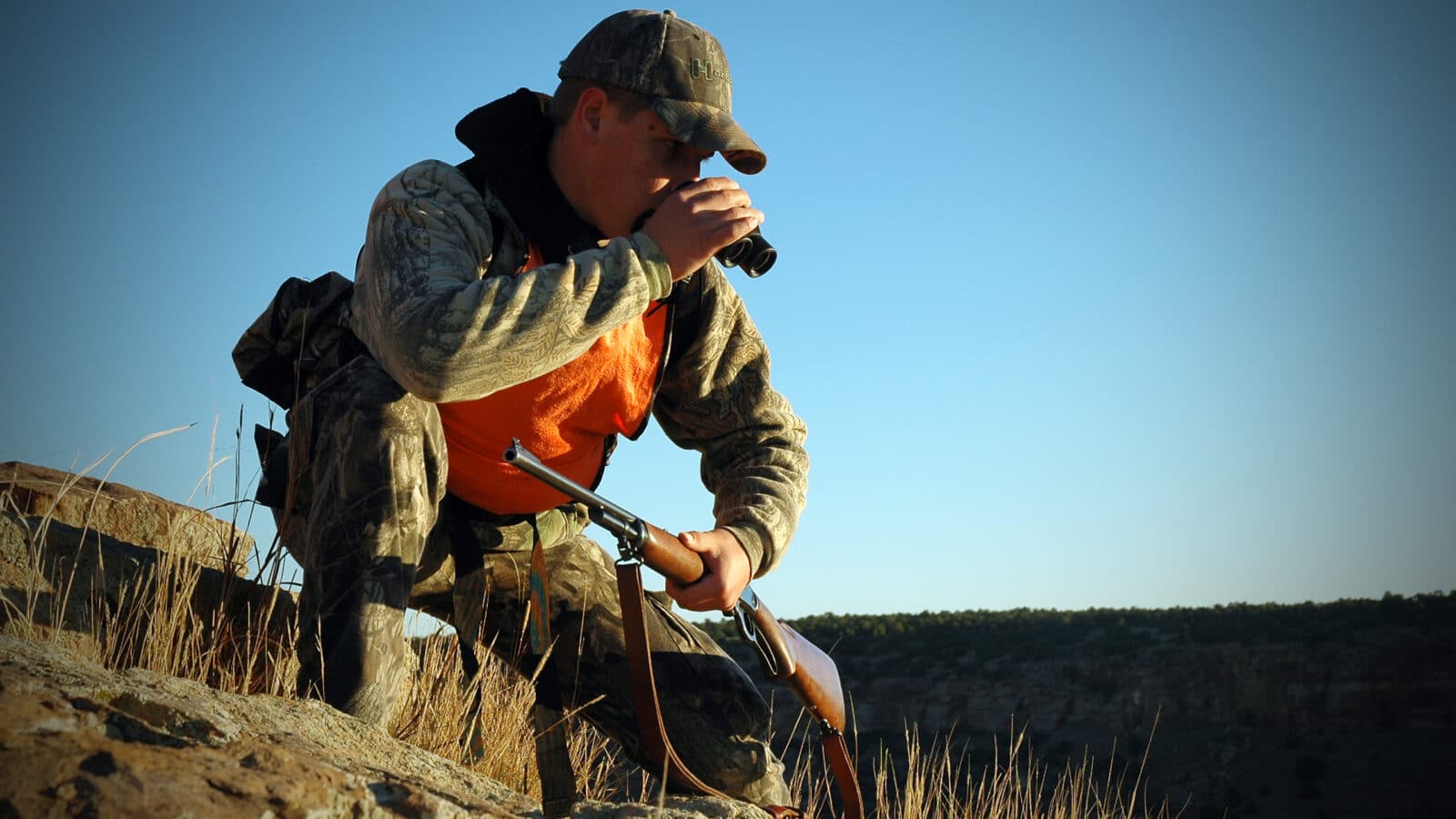
Charred lodgepoles scratching a gunmetal sky reflected my mood. This morning the elk had won. No plan in mind, I climbed beyond where they’d scattered. Probing the slope’s crest from the sit with my binocular, I saw it. Among ranks of black boles with low-arcing limbs, a branch curved up. The lenses of my 7×35 Bausch & Lomb resolved it. Antler! A 4 o’clock tangle became the bull’s hump — all but hidden by the bead on my .32 Special. After the carbine spoke I scaled the scarp and found blood on hoof-gashed snow. The elk lay 50 yards on.
To see better afield, you need a binocular. (Yes, binocular. Singular. Bi refers to its two barrels. A pair of binoculars serves no purpose unless you have four eyes.)
Animals meet the hunter’s eye as patches of non-reflective earth-tones, bone and muscle melding texture with shadow. All pass as background unless they present something unusual: sun’s glint on eye or nose, motion in the flick of an ear. A binocular distinguishes what matters from what you’ll dismiss.
A craving to see stars and read print fueled early work on lenses. Legend has it that in 1608, Dutch spectacle-maker Hans Lippershay accidentally aligned two lenses on a weathercock. Result: a giant fowl. The next year Galileo Galilei built his first telescope, its focal point behind the rear lens. Johannes Kepler followed with convex ocular glass that placed the image inside. That it was upside down perplexed none of the era’s astronomers: There’s no top or bottom to a star.

With apologies to enthusiasts who tweaked optics for two and a half centuries, we’ll skip ahead to 1854, when Ignazio Porro patented an image-erecting system. Zeiss efforts in the 1890s yielded what we call Porro-prism binoculars, their barrels offset from the eyepieces. As front (objective) lenses in a Porro design are farther apart than the oculars, they enhance “binocular vision” that helps us perceive depth and distance. Another Porro plus: There’s no phase shift — the imperfect meeting of split, polarized light in the roof-prism binos now defining the market. So there’s no need to correct it with dielectric coatings. My old B&L “Zephyr” was a top Porro hunting glass of the 1950s, albeit optically it can’t match new (heavier!) roof-prism champs.
Likewise, center-focus binoculars have shoved individual-focus models off-stage. A CF binocular has a middle wheel and a focus (diopter) ring on one eyepiece, usually the right-hand. To set this bino for your eyes, cover the right-hand objective glass with your palm. Both eyes open, bring a distant object into sharp focus with the wheel. Next, cover the left-hand barrel and focus the right-hand barrel on that object. Now a nudge of the center wheel will send crisp images to both eyes at any range.

Individual-focus binoculars have an adjustment on each eyepiece, no center wheel, so focusing is slower than with a CF glass. Dismiss as the purest baloney ads for “permanent focus” binos that promise sharp images with no focus adjustment.
The Details
Binocular frames are made of lightweight polycarbonate or lightweight metal alloy, magnesium, the industry standard. I prefer an open frame, hinged fore and aft of the wheel, so my big fingers can wrap the barrels. Rubber “armor” quiets and protects the binocular and affords a sure grip.
Assessing lens quality and collimation (alignment) begs factory instruments, but an optometrist’s eye chart can help you gauge resolution — how well the binocular defines detail. You can use billboards and fences too. Are letters and wires sharp? Do lines stay straight as you pan? Does the bino sift a distant bush into a crisp lattice of leaves and twigs? Moving your eye slowly off-axis so a black crescent enters the field, do colors separate (color fringing, minimized by ED — “extra-low-dispersion” — glass). Peer into shadows to check brightness.

A first-line bino from Leica, Zeiss or Swarovski and some lesser-known but laudable sources can fetch four-figure sums, quite a bump from the $75 I paid for my used B&L 50 years ago! Why do crack military units, big game guides and the keenest hunters dig deep for exceptional glass?
The success of a costly safari may hinge on a last-evening glimpse of a piece of one animal. It did for a young lady whose bullet felled one of the most impressive kudu bulls I’ve seen. My 8×42 Zeiss had turned it up at the edge of night. Of what value the binocular that brought its horn tip to eye? By the same logic, a perilous military mission can ill afford the compromise of mediocre glass.

Another reason the best binos bring high prices is that they’ve become expensive to make. In the 1930’s, a Zeiss engineer named Smakula added a rung to the cost ladder by coating lenses with magnesium fluoride. Images became much brighter. (Naked lenses lose up to 4 percent of incident light to reflection and refraction at each lens surface!). After WWII, coated lenses became standard on field-worthy binos. They’ve been upstaged by “fully multi-coated” lenses, whose layers of rare earths nix light loss by wavelength. “Fully” means all lenses, inside and out, are treated. Scratch-resistant coatings now bless exterior glass. Other coatings bead or sheet water and snow, so they slip off before distorting your view.

Live The Armory Life. The latest content straight to your inbox plus an automatic entry to each of our monthly gun giveaways!
Production costs increase with magnification, partly because aberrations are magnified with the image. Given development costs and rejection rates, flaw-free lenses boost prices. To ensure bright, high-resolution images, powerful binos also need bigger objective glass — a costly component. The common measure of brightness is exit pupil, or the diameter of the shaft of light reaching your eye. EP = objective diameter/magnification.
A healthy human eye dilates to about 7mm at night. Figure 6mm at dawn and dusk. You get a 6mm EP with a 7×42 binocular — handier than the 7x50s and 8x56s traditionally used at sea, where weight and bulk don’t matter. For a useful weight/power compromise on the mountain, 8×42 glass with a 5mm EP makes sense. Some sheep hunters accept 4mm to get the magnification of 10x42s.

A second, too-often-overlooked measure of brightness is the twilight factor. Get it by multiplying the square root of the product of power and objective diameter. So for an 8×40 binocular TF is the square root of 320, or 17.9. Hike magnification to 10x, and TF becomes the square root of 400, or 20 — while EP falls from 5mm to 4mm. The added power more than offsets the drop in EP to improve vision at dusk. Make the objective 50mm, and TF at 8x is 20; at 10x it’s 2.3. To sum, for better dim-light viewing, the objective must be 25 percent bigger to match a 20-percent jump in magnification.
How Bright?
Ignore boasts of 100-percent light transmission; binoculars approaching the mid-90’s are brilliant. “Few people can see a difference between 91 and 94 percent transmission,” an engineer told me. “And at that level, bumping brightness by 2 percent can force compromises elsewhere.”

Example: Zeiss’s Victory SF binocular engineer Gerald Dobler showed me at its 2014 debut. Its broad field begged a field flattener, adding weight. So instead of the Abbe-Konig prisms used in its HT hunting model, Zeiss chose compact Schmidt-Pechan prisms, trimming front lens heft 35 percent. Result: the SF’s seven-lens ocular assembly is half again as heavy as the HT’s, but overall it scales less, and it feels lighter. Both models boast fluorite glass with Zeiss T* coatings for the brightest images. The SF passes over 92 percent of incident light, the HT hunting bino nearly 95. Each is a superb glass for a specific use.
Weighted Choice
Even on the prairie or above timberline, I prefer a binocular of modest size, power and weight. Field of view grows as magnification shrinks. An 8x glass offers a field of roughly 400 feet at 1,000 yards, big enough to show animals at the herd’s edge that, at modest ranges, a more powerful glass might miss. Field, by the way, has no link to the size of objective lenses. It is affected by ocular design.

Besides yielding a generous field and bright images with small front lenses, modest power offers other advantages. It limits apparent shake, so while not enlarged, detail can be easier to see when you’re winded or steadying the glass against a blow without a brace. It also boosts depth of field, extending the range of acceptable focus shy of and beyond that place of tack-sharp focus. A friend showing me a lovely old 6×30 Porro-prism B&L mused, “I wish this bino could be revived, with modern lenses.” Catching the glint in my eye, he added: “I’m not selling this one.”
Also, here’s a tip for you. You won’t see “wide-angle” describing the best binoculars. But the term persists, a tag for binos with an apparent field of 65 degrees or greater. (Calculate AF by multiplying true field measure in degrees by magnification. A 7x bino with a 9-degree field has an AF of 63 degrees, just shy of “wide-angle.”) As one degree at 1,000 yards equals 52.36 feet, that glass has a field 471 feet wide. Field measure in feet at 1,000 yards is the industry standard for comparisons.

How you carry a binocular affects its utility. A case, dry-bag or saddle-bag makes sense if you’re simply traveling. Afoot, hunting, you’ll want the bino handy. Many hunters use harnesses to distribute the load. I don’t. Most harnesses carry the glass quite low, and their elasticity (to absorb shock) lets it bounce.
Stretched straps leave even a lightweight bino banging my belt buckle. Also, when shedding or donning clothes, I must escape that harness. A short leather strap on my neck is more convenient and comfortable under the weight of the 21- to 24-ounce 8x32s I often carry. The glass can be tucked quickly into my shirt during a squall or to clear the earth during a crawl. For heavy glass, in or without a case, I favor a single strap slung from my right shoulder to just above my left hip.
Modern Tech
Among recent refinements in binoculars, none is more useful than laser ranging. First to feature it was Leica’s Geovid. In 1990, it cost a bucket of bullion and weighed almost as much. Smaller, lighter, more capable and less costly versions followed. The current Geovid Pro line, from the 29-ounce 8×32 and 10×32 to the 8×42, 10×42, and 8×56 — are powerful mini-computers. They range to 2500 yards and yield a wealth of data that bring hits at distance. Pick a bullet arc from a microSD card, or use your own data.

The Geovid drew a response from Zeiss with its Victory RF and Swarovski with its EL Range The 8x42s and 10x42s weigh about 32 ounces, little more than their forebears without lasers. The Bluetooth-friendly Victory RF, with onboard ballistic calculator, comes in 38-ounce 8×54 and 10×54 versions too. The EL Range — 8x, 10x or 12x with 42mm glass and 24-ounce 8×32 and 10×32 models — has fast-pitch focusing to bring objects from far to near in just two spins. Prisms are flat to within .0001 mm. Like the Geovid Pro, the EL Range is of open-bridge design. Leupold’s new 10×42 BX-6 Range HD weighs more than its competition, but also ranges to 6,000 yards. It incorporates Hornady’s fine 4DOF Ballistics tool, and Precision Cut archery software as well as peerless optics and more digital assists than I can list here.
Meopta and other brands peddle laser-ranging binos as well. They’re more convenient than pocket devices that occupy a hand better applied to glassing. With the touch of a button, you know where to aim — or that game is too far for a sure first-shot kill. Result: fewer lost animals, more successful hunts.

With or without a ranging option, a binocular costly enough to make you wince is an investment you won’t regret. It helps you see what you’re looking for.
Editor’s Note: Please be sure to check out The Armory Life Forum, where you can comment about our daily articles, as well as just talk guns and gear. Click the “Go To Forum Thread” link below to jump in and discuss this article and much more!
Join the Discussion
Read the full article here