




Picture this: you drive out to the range with a rifle you know is zeroed. You spent good money on a scope, so you have a crystal-clear, parallax-free view of your target. You get your rifle set up on a good rest, chamber a round, and pull the trigger to the rear. You are rewarded with a perfect center-punch. Two more rounds follow closely behind it, carving out a ragged hole.
Let me ask you this: is there anything missing from the story?
Indeed there is! The savvy marksman knows that even with a surplus of talent and an excellent firearm to work with, printing a tight group also depends on using good ammo. Collectively, it’s the guns, glass, and gear that tends to consume a great deal of our attention — at least according to most of our YouTube algorithms — but quality ammunition is a non-negotiable element of what allows us to place bullets where we want them to go.
A good variety of shooters, however, find themselves flummoxed when it comes to explaining why that is. Today, let’s look at the interesting particulars of how the consistency of your ammunition translates to downrange performance.
When Push Comes to Shove
Likely you’ve heard shooters remark that one cartridge shoots “flatter” than another. What they’re really talking about is that as velocity increases, the bullet is in flight for a shorter amount of time. In turn, the force of gravity has less of a chance to pull the bullet downwards. As a result, if two rounds are fired from a level barrel, the faster round will strike higher on the target; the slower one will impact farther downward.

For that reason, one of the chief components of controlling accuracy is ensuring that velocity is consistent from shot to shot. Most obviously, this implicates the amount of powder used in the cartridge. A hobbyist might be fine with a variation of a few tenths of a grain up or down; the guy trying to win a long-range match likely cares a great deal about ensuring every bullet leaves the barrel at the same speed!

But, as Hornady’s Seth Swerczek told me, it’s not simply the quantity of powder that’s important, but also the quality. According to Seth, the chemistry behind the powders available to an ammunition manufacturer have gotten better and better, allowing for uniform and consistent ignition across a variety of environmental conditions. At a company like Hornady, ballistic engineers have also tested a bewildering number of combinations of primers and powders to determine what combinations of components will work best together to maximize ignition uniformity.
Getting a Grip
Following from our previous discussion, neck tension also plays a critical role in the chemical reaction that takes place when smokeless powder is ignited. Because it determines precisely when the bullet begins moving, it influences the volume in which the reaction takes place, and as a result, the pressure exerted on the projectile over time.

While it’s an oversimplification, think of a cartridge’s neck tension as not unlike a good handshake: it shouldn’t be crushing, nor should it be weak and loosey-goosey.
Supposing that the neck is really crushed into the cartridge, pressures can become more “spikey,” and the bullet itself might suffer from deformation that can affect its flight characteristics. However, a weak crimp can result in the bullet moving prematurely, dropping pressures and leading to a loss of velocity. And, supposing that the bullet is non-concentrically supported by the neck, there’s a real chance it could enter the rifling misaligned.
Bullet Points
“Hornady is a bullet company first,” Seth told me proudly. When the firm was founded back in 1949, it was the quality and consistency of its projectiles that put it on the map. Hornady has done little to rest on its laurels in the 77 years since. “A bullet needs to be made true,” Seth explained, “And that process is the heart of accuracy.”

In truth, I’d had an interesting “ah ha” moment as a reloader several years before I had the pleasure of speaking to Seth. Once I started weighing and measuring a box of bullets — even from a manufacturer I trusted — I found that all of the dimensions and weights were very close, albeit not exact. (Yes: even among a box of projectiles that were all marked “150gr”.)
Though SAAMI specifications dictate projectile dimensions, in reality a .308-caliber bullet might actually measure out at .3083”, or .3074”. In my own realm of experience, I’d found variations of as much of a thousandth of an inch in diameter to be pretty routine among the bullets I’d purchased.

Live The Armory Life. The latest content straight to your inbox plus an automatic entry to each of our monthly gun giveaways!
By comparison, Seth told me that Hornady’s limits cup runout to two tenths of a thousandth of an inch or less. The way they’re able to achieve this objective, he explained, was by making sure that each bullet is drawn out and shaped in its entirety on one press.
Why is all of this important? Consider that a larger, longer bullet will more deeply engage with a larger part of a barrel’s rifling. In turn, we can theoretically expect an increased level of friction, which could lower expected velocity.

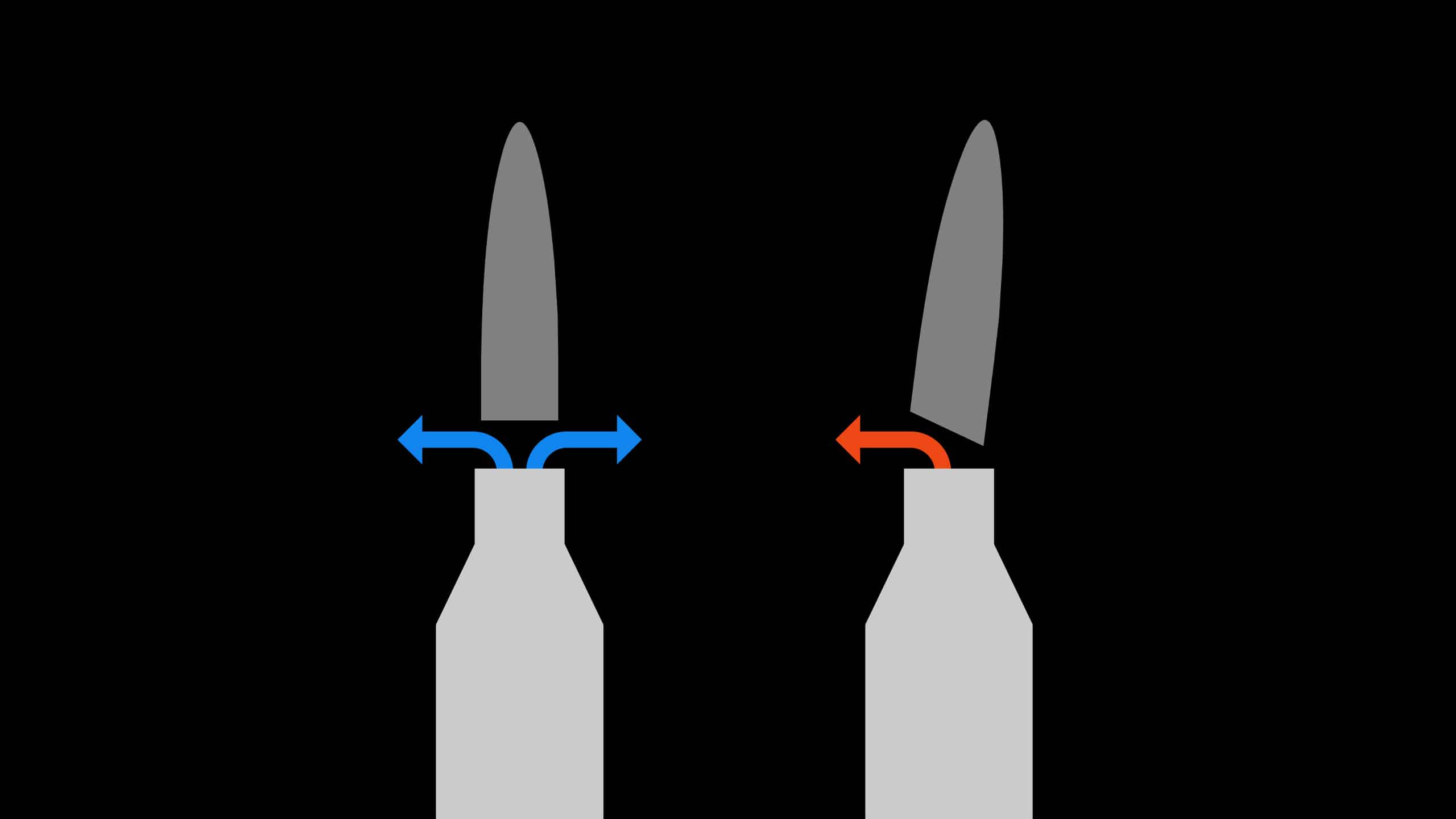
Speaking of uniformity, it’s also highly important to ensure the symmetry of the projectile’s base. Ideally, the expanding gases should push on the bullet evenly and consistently on its way out of the barrel. That’s one reason why shooters are often very concerned with the uniformity of a barrel’s crown. However, if the base of the fired bullet has high or low spots, there’s a risk that gas will begin to prematurely escape from the barrel relative to one side, producing an off-center push just as soon as the projectile exits the muzzle.
Moving Targets
When I was a younger shooter, I figured that trying to predict accuracy at farther distances was a mostly multiplicative affair. For example, a gun that shot 2” at 100 yards could be expected to print a 4” group at 200, and 6” at 300. Right? The theory made mathematical sense, anyway.

Wrong. Seth gave me a great analogy that put this fallacy into perspective. “Imagine you have an imbalanced tire on your car. Initially, the car might seem fine out of the driveway. But, it’s going to behave a lot differently once you’ve been traveling for a few miles on the highway.”
When you’re talking about a projectile launched across a distance of more than a quarter mile, over a few seconds of flight time, and while spinning at more than 200,000 RPM, there’s ample opportunity for things to go differently than expected. Imperfect rounds that cluster well enough at 100 yards could start “keyholing” by 300.
It’s for that reason, Seth said, that Hornady tests its match ammo at 200 yards rather than the more typical 100-yard distance. When the flight time is increased, there’s more ability to expose and address the micro-level imperfections that might critically affect long-range accuracy.
More Devils, More Details
Is there a single “most important thing” to be addressed to ensure an accurate round, or a “most likely” mechanical imperfection that would spoil an otherwise excellent group? Hardly! Producers of high-quality ammunition need to pay careful attention to each of the aforementioned variables. In other words, it’s not just enough to produce perfectly concentric bullets or uniform cartridges with identical bullet seating depths and neck tension — it all needs to be done.

Beyond that, Seth reminded me of one more truth of precision shooting. “Every barrel gets a vote,” he laughed. A perfectly constructed box of rounds faces an uphill battle when it’s shot out of a pitted-out bore, or when a shooter with a serious case of “buck fever” settles behind the trigger.
And if you hold my feet to the fire, I’ll let it spill that not every trigger pull goes the way I want it to. Like any mortal shooter, I’m prone to moments where I know I mashed the trigger, leaned on the rifle or lifted my head in a weird way during ignition. I’m an imperfect guy living in an imperfect world. I consider it pretty amazing that even a dude like me can print an excellent group every once in a while.
That said, I always make a point of buying ammo from manufacturers like Hornady — that is to say, established firms whose expertise has been established over decades. It lets me know that a miss is my fault rather than the result of a weird tolerance stack or otherwise fluky round. From there, I can diagnose and correct what’s amiss with my equipment or inherent to my technique. That reassurance costs a little more, but to me it’s a worthwhile expense.
Naturally, all of the variables we’ve talked about above aren’t meant to be an exhaustive list of all of the things that can make a bullet go where it isn’t supposed to. Suffice it to say that the details matter, and these are some of the finer points I think about decades into my time as a shooter that I never thought to consider before.
Editor’s Note: Be sure to check out The Armory Life Forum, where you can comment about our daily articles, as well as just talk guns and gear. Click the “Go To Forum Thread” link below to jump in!
Join the Discussion
Featured in this article

Read the full article here