






On Wednesday, two classes worth of soldiers will graduate from the Army’s newest Military Occupational Specialties, or MOS, training course at Fort Huachuca, Arizona. A mix of new recruits straight from bootcamp and veteran soldiers retraining will officially become the Army’s new 15X tactical unmanned aircraft system specialists.
So far, the course has graduated more than 250 soldiers in almost a dozen training classes.
“The recruiting folks have been gangbusters on this and sending us people at the rate at which we can receive them,” said Col. Michael Gourgues, commander of the 1st Aviation Brigade, which is in charge of training. “We think by the end of this year, we’re going to have trained 770 new 15Xs.”
Though all new soldiers who join the Army now get basic drone familiarization in basic training, those who join the 15X MOS move on to the 15-week Advanced Individual Training in Arizona, where they learn to assemble, fix, and fly a variety of small, medium, and large drones. They train to fly in contested environments, day and night, out in the woods, in a desert, and against an enemy opposition force.
They also train on many different kinds of drones.
“The Army has not bought a drone that the 15X is responsible for being an expert on. The Army’s bought a bunch of them,” he said. “For the first time ever, it’s not like ‘Hey, here is your rifle.’ It’s like, ‘Hey, I have 30 weapons that I need to make sure that you can shoot.’”
Because drone warfare is changing so rapidly, Gourgues and his instructors are still actively adjusting the course material for every class. The training focus for the new 15X soldiers is large, long-distance drones, but they also taught small systems like tactical FPV drones so they can be attached to infantry units, or even form drone-specific teams that sit behind front lines, akin to artillery soldiers.
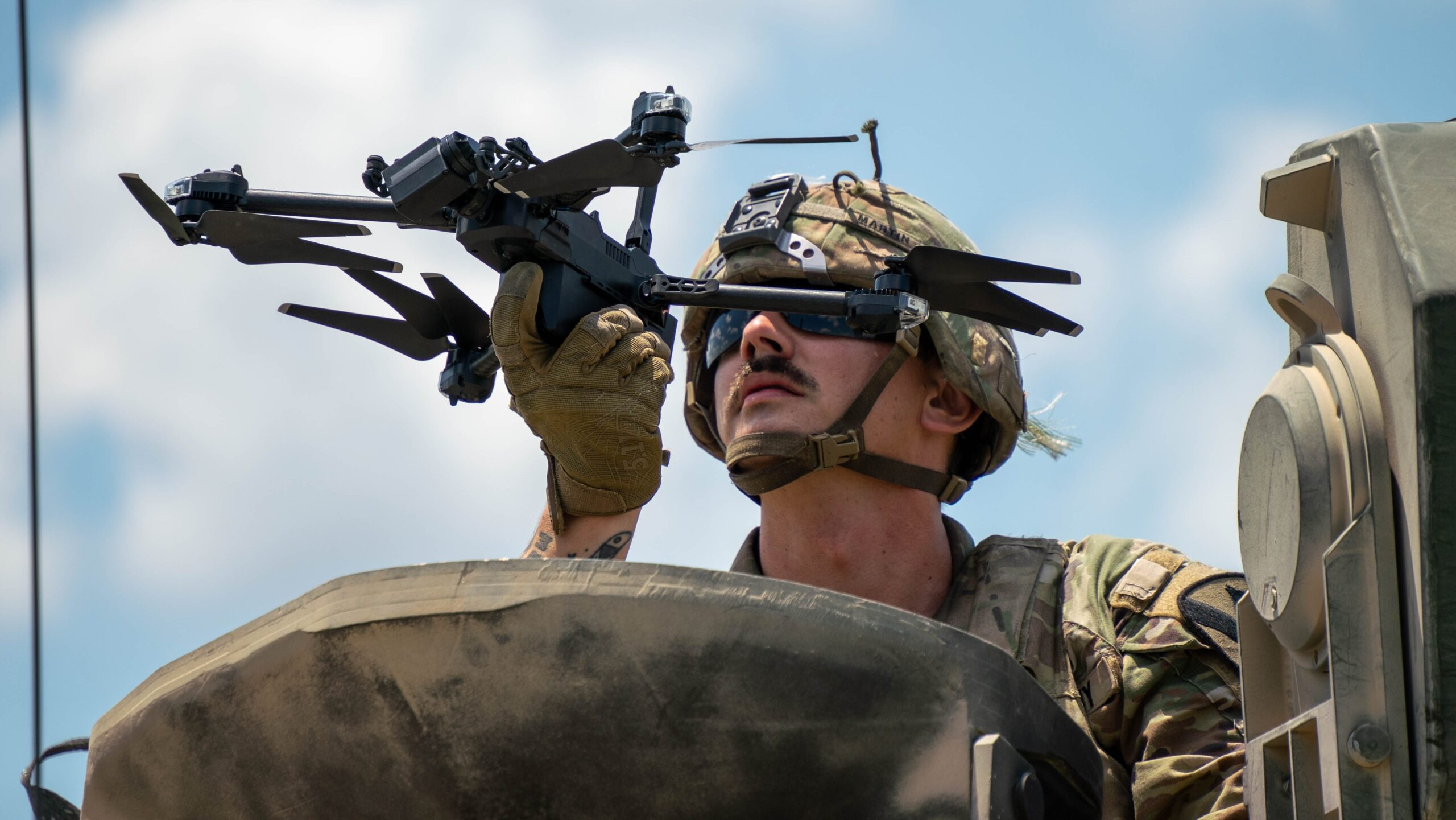
As a result, Gourgues told Task & Purpose, 15X instructors try to train soldiers to be a “jack of all trades” who can pick up a new piece of tech and learn the ins and outs in a matter of hours. He added that the focus of the courses is always a subject of debate among instructors: Should it be more FPV drones and less airspace maneuvers for large drones? Maybe more robotics?
To stay up to date, Gourgues said a “lessons learned manager” monitors open source information and sends observations to the Army’s aviation, maneuver and fire, cyber centers of excellence, which develop doctrine and training for each specialty. Gourgues gave the example of fly-by-wire drones, also called fiber-optic drones, which are controlled by cable instead of wireless radio frequencies to avoid electronic jamming.
“We’re not teaching secret classes. We watch it online,” he said. “I can buy a drone that can fly by wire, and within a week or two my drone instructors have a fly-by-wire drone, and they’re showing the new MOS: ‘Hey, this is how it works, and this is how you might fly it.’ And if we think it’s something that they are going to do, then we put it into the program of instruction on a permanent basis.”
As the Army is still evolving where, how and when it’ll use drones, Gourgues said the new soldiers will go on to join different units — whether it be brigade combat teams, experts attached to a squad, or even advising commanders on how to incorporate drones into the unit’s training or tactics. The soldiers will be part of maneuver operations like infantry and armor units, but also more technical fields like military intelligence and cyber formations. The 15X soldiers have to work with drones of all sizes, which the Department of Defense classifies as groups 1, 2 and 3 unmanned aerial systems, or UASs. But the priority is group 3, the largest-sized drones, he said.
“We are going to make sure that they are experts on utilizations of Group 1 and 2, but that is not limited to 15X,” he said. “You don’t have to be a 15X to fly that, but the differentiator that we see is utilization of it is: how do you inform the commander on the best use of it to achieve the effects that they’re seeking?”
In total, the Army is planning for between 2-to-3,000 15x soldiers who will fly, fix, and deploy all sizes of drones. That number could go up or down in the next year, according to Gourgues.
“We are literally filling all of our barracks beds. My limiting factor right now is infrastructure on how many folks I can train,” he said. “At some point the Army is going to say, ‘Hey, we have enough personnel. We understand how we’re going to fight this and how many folks need to be in there.’ And they’re going to turn the rheostat knob down on me. But this is the first year we’re doing it, and so we’re going 100 miles an hour.
An aviation MOS headed to ground units
About two-thirds of the first wave of 15X soldiers will be made up of new recruits. The rest will be more senior soldiers transferring from other jobs, like current UAS operators (15W) and repairers (15E) who will recertify under the new MOS by October.
Gourgues said the decision to keep drone programs within the Army’s aviation branch comes from the “sheer complexity” of operating the military’s bigger and longer-range UAS platforms like the Shadow and Gray Eagle. Since those larger systems fly in the same airspace as jets and helicopters, drone operators need to have the same expertise in air traffic control, weather, flight regulations, and other air safety measures for complex military operations, he said.
But the 15X soldiers, he said, will have to be physically able to join ground maneuver units and do “all the physical things” that an infantry brigade combat team expects of its soldiers. According to an Army breakdown of the MOS requirements, 15X soldiers need to meet “significant” strength and aerobic fitness scores in exercises like deadlifts, power throws and internal runs, as well as be “fully deployable to all locations and echelons.”
Originally, 15W and 15E soldiers were required to take flight physicals, but with the new MOS, they changed it.
“Now they pass a basic airborne physical,” he said. “Can you duck walk? Can you walk without a limp? Are you able to do the Army physical fitness test? And if you can do those things, then welcome to the MOS.”
Read the full article from the source.