




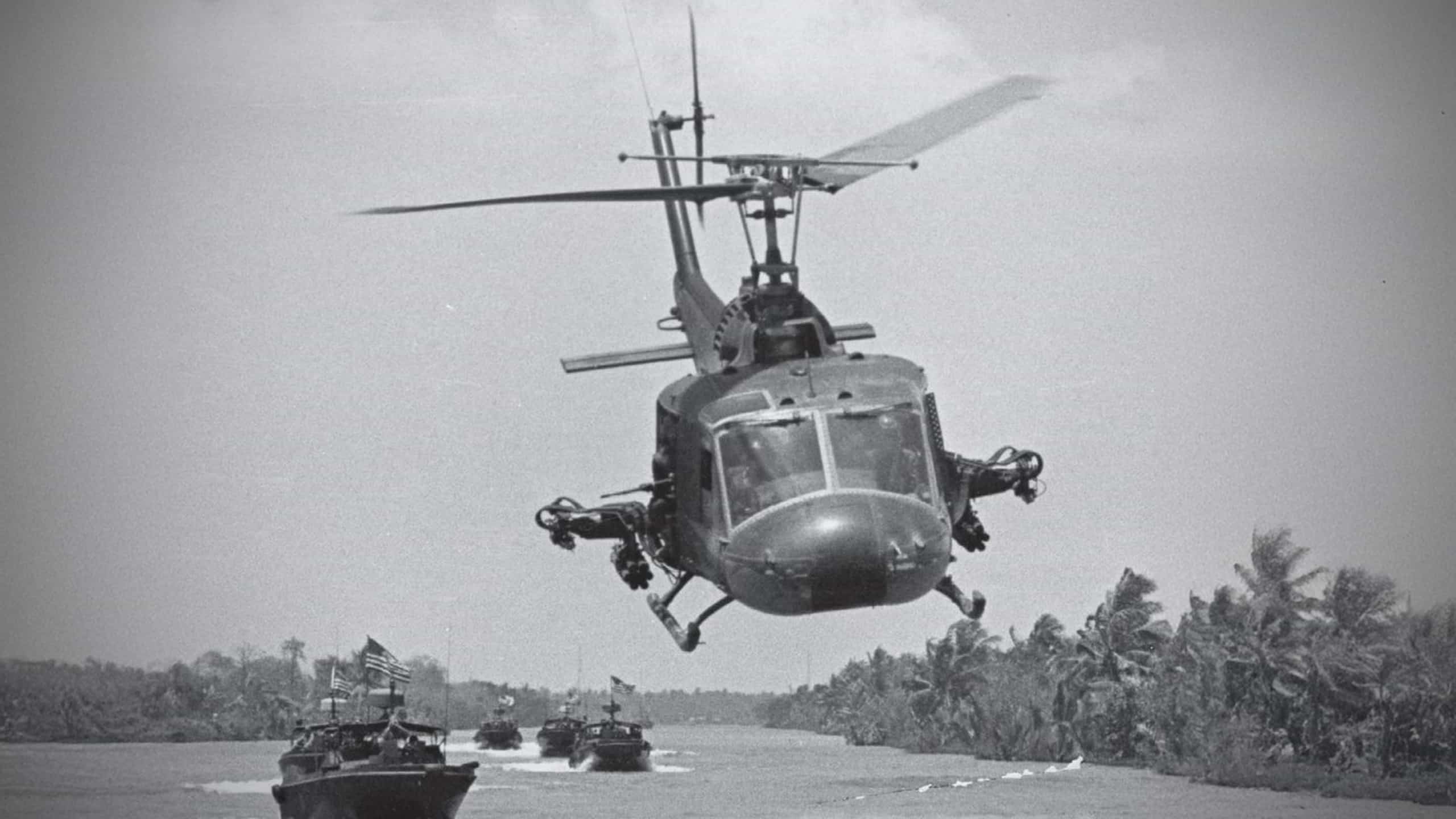

In 1965, as the war in Vietnam continued to escalate, the U.S. Navy began joint operations in the south to stop the flow of supplies and interrupt communications to the Viet Cong via the Mekong Delta.
The U.S. Navy began operating riverine forces throughout the Delta and launched Operation Game Warden in December 1965, establishing Task Force 116. This task force combined U.S. Army helicopter crews for air support of U.S. Navy amphibious vessels and armed river patrol boats (PBRs), collectively known as the “Brown Water Navy.” The task force’s mission was “denying the enemy the use of the major rivers of the Delta and the Rung Sat Special Zone.”

Task Force 116 was assigned 120 PBRs, 20 landing craft, personnel, large, one amphibious transport dock, one LST, and eight UH-1B helicopters. The Army’s 197th Aviation Company provided the Hueys, aircrews, and maintenance support, and the first coordinated PBR-Huey mission was conducted on April 10, 1966.

Due to differences in operating methods and terminology between the two services, the U.S. Navy sought control over air operations in the Delta.
Birth of the Navy Helicopter Gunship
In 1966, Rear Admiral Norvell G. Ward, Commander of Naval Forces Vietnam, presented General William C. Westmoreland, Commander of the U.S. Military Assistance Command Vietnam, with a game-changing proposal: providing air support for his riverine forces.

At the time, Army helicopters had been performing those missions. Still, Admiral Ward proposed providing Navy air crews if the Army provided helicopter gunships, which were not part of the Navy’s aircraft inventory.
Helicopter Combat Support Squadron-1
Beginning in 1966, the Navy began soliciting volunteers to form Helicopter Combat Support Squadron ONE (HC-1), which was subsequently established. Detachments of helicopter gunships were then transferred to the Navy to conduct operations in the Mekong Delta.

HC-1 operated detachments of Army UH-1 gunships providing a quick reaction, close air support (CAS) role for units of PBRs and Swift Boats of the Brown-water Navy. The effectiveness of the helicopter attack squadron was quickly realized.

As the gunship role expanded, the Navy wanted direct control of air operations to support its river patrols. The Army withdrew from the joint operation and transferred eight UH-1B Huey gunships to the Navy in 1966, extending its allocation to 22 by the end of 1967.
Helicopter Attack Squadron (Light) 3
As HC-1 detachments expanded in number, so did the types of missions they undertook, including support of PBRs, landing craft escort, SAR, reconnaissance, SEAL support, and medevac. Following the success of the HC-1 detachments, the Navy established a full squadron on April 1, 1967, at Vũng Tàu, South Vietnam.

HC-1 was divided into four units: Helicopter Sea Combat Squadron 3, Helicopter Combat Support Squadron 5, Helicopter Combat Support Squadron 7 (Search and Rescue), and Helicopter Attack Squadron (Light) 3, named the Seawolves. Their unit insignia was created using the Lowenbrau Lion logo with an added trident and shield.

Follow-on HAL-3 pilots and crews completed training at Fort Benning, Georgia, and Fort Bragg, North Carolina. Initially, the squadron fell under the command of TF 116 and, over time, also began supporting Army-Navy Mobile Riverine Task Force (TF-117).

HA(L)-3 evolved into nine detachments, scattered throughout the Mekong Delta. These were located at five airfields, three LSTs with one extra rotated for maintenance, and a Mobile Advance Tactical Support Base called “Sea Float.”

A typical detachment consisted of two helicopters, a lieutenant commander serving as the officer in command, along with seven additional pilots, eight door gunners, and maintenance personnel.

As a quick reaction force, they manned two-gunship formations operating 24-hour shifts, ready to respond to call-outs within a 50-mile radius regardless of weather conditions. When the alert horn sounded, the command “Scramble the Seawolves” blared from the loudspeaker. The gunships were airborne within three minutes and engaging the enemy within 15.
Live The Armory Life. The latest content straight to your inbox plus an automatic entry to each of our monthly gun giveaways!
The gunships of the Seawolves were the logical solution for the close air support mission (CAS). Fixed-wing aircraft used for CAS were sparse and needed in other areas, and the only runways in the area were located at Vung Tau and Binh Thuy.
Mission Types
The Seawolves performed a variety of missions. This included close air support; tactical reconnaissance; search-and-rescue operations; and the insertion/extraction of SEAL teams from 1968 to 1971, during Operation SEALORD, using eight “Slick” models of UH-1s.
The Bell UH-1 Iroquois
Making its first flight in the late 1950s, the UH-1 Iroquois, also known as the “Huey,” was developed for the U.S. Army as a utility and medical evacuation helicopter, and was the first turbine-powered helicopter to serve in the U.S. Military.

The U.S. Army had been using its Huey gunships quite effectively, and the U.S. Navy needed the identical versions for the Seawolves.

The gunships had pilot-fired weapons, as well as door gunners, and their armament systems varied throughout the mission. The Seawolves gunships were equipped with grenade launchers, both automatic and handheld, M60 machine guns, M2 .50-caliber machine guns, miniguns with an adjustable rate of fire between 2,000 and 4,000 rounds per minute, and rocket pods armed with flechettes or white phosphorus warheads which were used to mark targets, start fires, or inflict mayhem, were fielded, with many of the weapon systems being designed and modified in the field by gunners and crew chiefs for specific missions.
Standing Down
As the war in Vietnam raged on, U.S. strategists were continuously transferring more responsibility to South Vietnamese troops as part of the Vietnamization program. In March 1972, after five years of combat operations, HAL-3 was disestablished at Binh Thuy.
The Legacy
The Seawolves were the only rapid response helicopter squadron ever commissioned in the U.S. Navy, the only squadron to be established and disestablished outside the United States, and the only squadron to never have a base inside the United States.

At the height of the Seawolves’ mission, HA(L)-3 deployed 29 UH-1 Huey gunships, amassing a war record of 78,000 combat missions flown, with a total of 131,000 flight hours, 8,200 enemy killed, 9,500 enemy structures destroyed, and 8,700 enemy vessels destroyed.
Starting with helicopter hand-me-downs, HA(L)-3 went on to become the Navy’s most decorated unit, with 17,339 decorations or medals awarded, with casualties of 44 men killed and over 200 wounded.
Editor’s Note: Please be sure to check out The Armory Life Forum, where you can comment about our daily articles, as well as just talk guns and gear. Click the “Go To Forum Thread” link below to jump in!
Join the Discussion
Read the full article here