



Close Menu
Tactical AmericansTactical Americans
  • Home
  • Guns
  • Knives
  • Gear
  • News
  • Videos
  • Community

Subscribe to Updates

Get the latest tactical, firearms and many more news and updates directly to your inbox.

What's Hot

Woman Discovers Escaped Inmate in Her Car: 'I Saw Something Moving in My Back Seat' By Madison E. Goldberg

Dec 11, 2025 10:09 am

DINOCAM: The Dinosaur-Based Tactical Camouflage Pant Designed by Real Special Operators

Dec 11, 2025 9:22 am

24 Free States Get F Grade

Dec 11, 2025 9:16 am
Facebook X (Twitter) Instagram
Thursday, December 11, 2025 10:10 am EST
Trending
  • Woman Discovers Escaped Inmate in Her Car: 'I Saw Something Moving in My Back Seat' By Madison E. Goldberg
  • DINOCAM: The Dinosaur-Based Tactical Camouflage Pant Designed by Real Special Operators
  • 24 Free States Get F Grade
  • Heirs of 83-year-old mother killed by son are suing OpenAI and Microsoft
  • Venezuela condemns US oil tanker seizure as ‘international piracy’
  • Pediatrician Who Claimed ‘Demonic Entities’ Made Victims Lie About Him Gets 30-Year Sentence for 'Bold and Brazen' Sex Abuse By Christina Coulter and Bethany Brown
  • Straight Talk: Fits and Starts
  • Parent charged with murder in Kentucky State University dorm shooting
  • Privacy
  • Advertise
  • Contact
Facebook X (Twitter) Instagram Pinterest VKontakte
Tactical AmericansTactical Americans
  • Home
  • Guns
  • Knives
  • Gear
  • News
  • Videos
  • Community
Newsletter
Tactical AmericansTactical Americans
Home » Open Bolt vs. Closed Bolt
Guns

Open Bolt vs. Closed Bolt

newsBy newsDec 10, 2025 11:08 am2 ViewsNo Comments
Facebook Twitter Pinterest LinkedIn Tumblr WhatsApp
Open Bolt vs. Closed Bolt
Share
Facebook Twitter LinkedIn Pinterest Email


By Robert A. Sadowski

Posted in
#Guns

While we might hear the terms “machine gun” and “submachine gun” a lot, a more detailed discussion will often touch on the terms “open bolt” and “closed bolt.” But, what do these terms mean?

The Differences Between Open and Closed Bolts

The difference between a firearm with an open-bolt design versus a closed-bolt design is the position of the bolt prior to firing the gun. On an open-bolt gun, the gun is ready to fire when the bolt is locked open and there is no cartridge in the chamber. When the trigger is pulled, the bolt moved forward and strips a round from the magazine. As the bolt closes, the round is fired and the cycle continues until the trigger is no longer depressed or the gun runs empty. In a closed-bolt design, is it the opposite. The bolt is closed and a round is in the chamber prior to firing the gun. Pulling the trigger drops the hammer, the round is fired, the action is cycled, and this continues until the trigger is released or the magazine is empty.

An early production MP-40 submachine gun displayed in profile revealing its stamped metal construction and characteristic open bolt firing mechanism. Open bolt versus closed bolt influenced wartime design. MP-40 employed open bolt technology. Closed bolt guns required more components. German military preferred open bolt SMGs. Open bolt operation simplified production processes. Submachine guns used fewer machined parts. WWII firearms emphasized manufacturing speed. Open bolt mechanisms proved highly reliable.

Examples of a closed-bolt design firearm include the AR-15, the Springfield Armory Hellion, MIA rifles and the Kuna pistol, to name just a few. For examples of open-bolt designs, you really need to look back at submachine guns designed during World War II.

A detailed close-up photograph of a British Sten submachine gun bolt assembly displaying the firing pin integrated into the bolt body and the minimalist open bolt construction. Open bolt firearms use integrated firing pins. Closed bolt guns require separate hammers. Sten SMG exemplified open bolt simplicity. British submachine guns minimized component count. Open bolt designs reduced manufacturing costs. WWII weapons prioritized production efficiency. Submachine gun bolts remained mechanically simple. Open bolt mechanisms eliminated unnecessary parts.

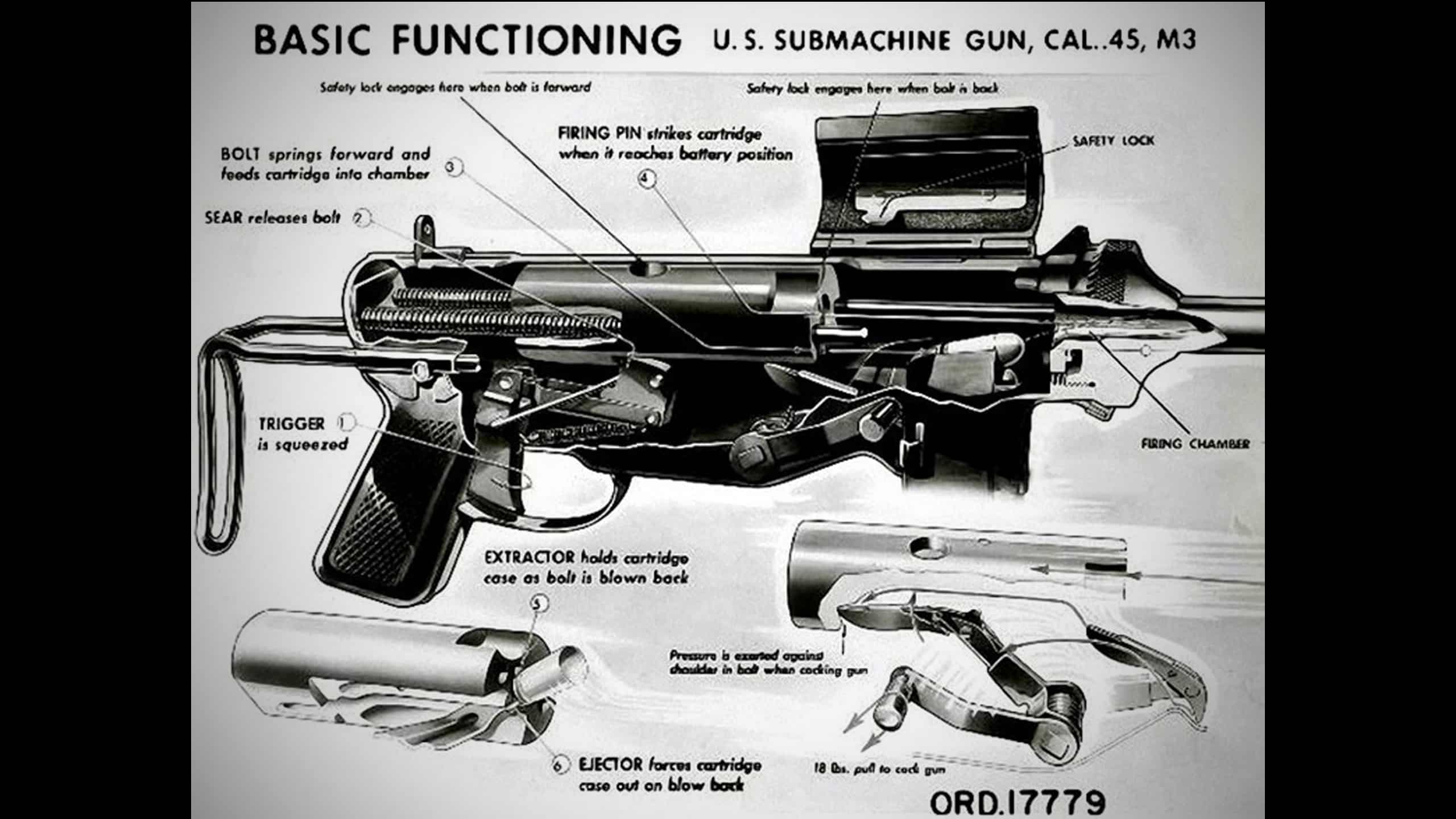
Some of the most common and icon submachine guns during the war were an open-bolt design. The American M3 Grease Gun, British Sten SMG, and the German MP-40 Schmeisser were all open-bolt designs. Also developed during the war was the American M1941 Johnson light machine gun and the German FG 42. These two example are unique because they incorporate an open bolt in full auto and a closed bolt in semi-auto fire.

Open Bolt Design Firing Cycle

Here’s the layman’s explanation of the cycle of operation on an open-bolt design and a closed-bolt design.

An American soldier in combat gear holding an M3A1 Grease Gun submachine gun during REFORGER 85 military exercises in West Germany with other troops visible in the background. Open bolt firearms remained military standard. Closed bolt guns replaced them gradually. M3A1 Grease Gun used open bolt operation. American submachine guns cost little to produce. Open bolt designs enabled mass production. Military weapons prioritized reliability over precision. Submachine gun service lasted decades. Open bolt mechanisms proved extremely durable.

To fire an open bolt design, whether a semi-automatic or a full-auto firearm, the first step is to  insert a magazine and then retract the bolt. In an open-bolt design, the bolt remains rearward. It is literally open and the firearm is ready to fire. Press the trigger and the sear releases the bolt, driving the bolt forward, pushing a cartridge out of the magazine and into the chamber and firing the cartridge in one swift motion. The bolt then cycles back ejecting the spent case and then moves forward to start the process over.

Live The Armory Life. The latest content straight to your inbox plus an automatic entry to each of our monthly gun giveaways!

In a closed-bolt design, the process is different. Insert a loaded magazine and pull back on the charging handle and release it. The bolt flies forward, strips a cartridge from the magazine and runs a cartridge into the chamber. The bolt is literally closed and ready to fire. Press the trigger and either a hammer is tripped or striker released, which fires the cartridge.

Pros and Cons

In an open-bolt system, as the trigger is pressed to fire the gun the weight and mass of the bolt moves forward, jolting the gun as it slams closed. That movement can interfere with the shooter’s aim. In a submachine, that’s not much of an issue. In a closed-bolt design, the bolt is forward and a press of the trigger releases the hammer or striker, so there is no movement in the bolt prior to firing the shot. A closed bolt design is more conducive to better accuracy.

Swedish military personnel conducting an amphibious landing operation while carrying Carl Gustaf m/45 submachine guns with water splashing around them as they move from boats to shore. Open bolt firearms function in wet conditions. Closed bolt guns require careful protection. Carl Gustaf m/45 used open bolt design. Swedish submachine guns emphasized reliability. Open bolt systems resist water damage. Amphibious operations demand robust weapons. Military firearms handle extreme environments. Open bolt mechanisms maintain operational readiness.

The advantage of an open-bolt design is realized in full-auto guns. High rates of fire create extreme heat in the chamber and barrel, which can create a dangerous situation called a “cook off.” This is where a cartridge in a heated chamber fires without the trigger being pulled. In an open-bolt design, since the bolt is open and there is no cartridge in the chamber, air cools the chamber and will prevent the risk of a cook-off.

A World War II British Sten submachine gun displaying its crude stamped metal construction, side-mounted magazine, and bare-bones open bolt firing mechanism against a plain background. Open bolt firearms enabled wartime mass production. Closed bolt guns cost significantly more. Sten SMG exemplified open bolt economy. British submachine guns used minimal materials. Open bolt designs reduced manufacturing expenses. WWII weapons prioritized quantity production. Stamped metal construction lowered costs. Open bolt mechanisms simplified assembly processes.

Another advantage of an open-bolt design is that it generally uses fewer parts than a closed bolt design. In an open-bolt design, the firing pin is generally machined as part of the bolt. Because of the inertia caused by the bolt closing when the trigger is pressed, the fixed firing pin strikes the cartridge primer without the need for a hammer and firing pin.

A Finnish military serviceman engaging enemy forces from a crater position while operating a German MP-40 submachine gun showing the practical combat application of open bolt weapon systems. Open bolt versus closed bolt affects battlefield reliability. MP-40 employed proven open bolt operation. Closed bolt weapons require more protection. Finnish forces trusted open bolt SMGs. Open bolt submachine guns perform under stress. Winter warfare demanded dependable firearms. Combat weapons used simple mechanisms. Open bolt designs ensure operational effectiveness.

Since open-bolt guns are inexpensive to make and use fewer parts, they were mass produced during WWII. The American M3 Grease Gun for example cost about $20 to produced compared to other submachine guns that cost upwards of $70 at the time. The British Sten gun cost only about $10 to make during the war. Both of these open-bolt design weapons were inexpensive and quick to produce.

Sergeant Bruce E. Strickler wading through the Cu De River while carrying an M3A1 Grease Gun submachine gun during a patrol mission into Elephant Valley searching for Viet Cong positions. Open bolt firearms withstood harsh environments. Closed bolt guns required more maintenance. M3A1 Grease Gun featured open bolt reliability. Vietnam War weapons endured extreme humidity. Open bolt designs handled adverse conditions. Jungle combat demanded dependable firearms. Submachine guns served multiple military conflicts. Open bolt mechanisms rarely malfunctioned.

Conversely, closed-bolt designs are more complex and expensive, but can fire more accurate shots and are generally more “refined” designs. Examples of full-auto closed bolt designs would be rifles like the M16 and the M14.

Conclusion

So there you go. If you’re reading up on a machine gun design and they reference “open bolt versus closed bolt,” you’ll now understand what it means. Now that you understand the firing sequence, it’s and an open and closed case from there.

Editor’s Note: Be sure to check out The Armory Life Forum, where you can comment about our daily articles, as well as just talk guns and gear. Click the “Go To Forum Thread” link below to jump in!

Join the Discussion

Go to forum thread

Read the full article here

Share. Facebook Twitter Pinterest LinkedIn Tumblr Email

Related Posts

Straight Talk: Fits and Starts

First Look: Volquartsen Firearms Mini Mamba TF-22

Shotguns: How to Reload

First Look: PSA Olcan Bullpup Jakl Conversion

First Look: TH Holster Fit for Shadow Systems Pistols

Germany’s 8.8cm Raketenwerfer 43 Püppchen

Azimuth Technology Surpasses Major Gun-Parts Manufacturing Milestones

2011 Time: M2XI Bersa’s Journey from Argentine Euroclones to American Iron

Ammo: What is a Lot Number?

Add A Comment
Leave A Reply Cancel Reply

Editors Picks

DINOCAM: The Dinosaur-Based Tactical Camouflage Pant Designed by Real Special Operators

Dec 11, 2025 9:22 am

24 Free States Get F Grade

Dec 11, 2025 9:16 am

Heirs of 83-year-old mother killed by son are suing OpenAI and Microsoft

Dec 11, 2025 9:14 am

Venezuela condemns US oil tanker seizure as ‘international piracy’

Dec 11, 2025 9:10 am

Subscribe to Updates

Get the latest tactical, firearms and many more news and updates directly to your inbox.

Latest News

Pediatrician Who Claimed ‘Demonic Entities’ Made Victims Lie About Him Gets 30-Year Sentence for 'Bold and Brazen' Sex Abuse By Christina Coulter and Bethany Brown

By Jack Bogart

Straight Talk: Fits and Starts

By news

Parent charged with murder in Kentucky State University dorm shooting

By Jack Bogart
Tactical Americans
Facebook X (Twitter) Instagram Pinterest YouTube
  • Privacy Policy
  • Terms of use
  • Press Release
  • Advertise
  • Contact
Copyright © 2025 Tactical Americans. Created by Sawah Solutions.

Type above and press Enter to search. Press Esc to cancel.