




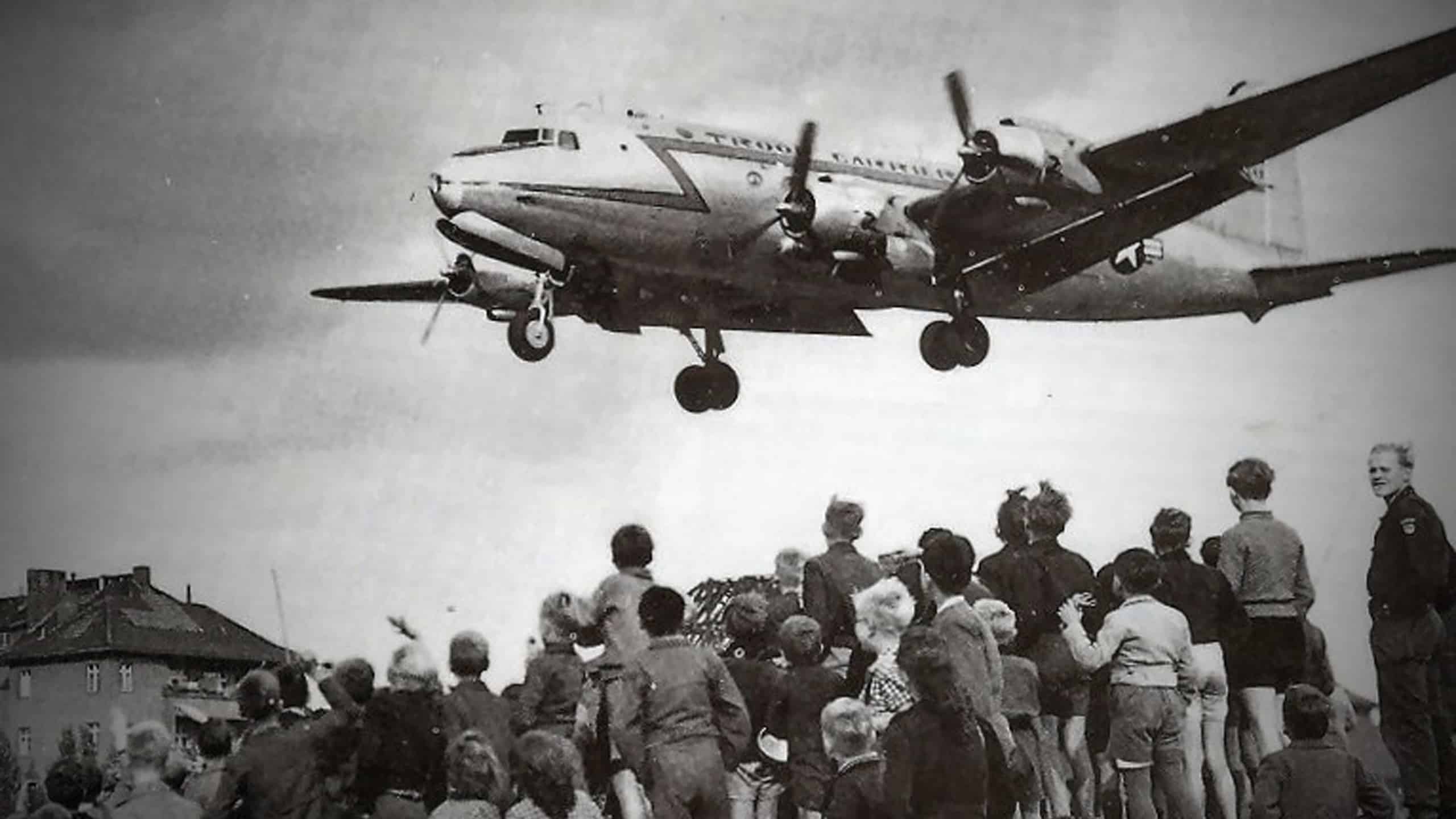
U.S. Air Force Colonel Gail Seymour Halvorsen was a transport pilot best known as the “Candy Bomber” or “Onkel Wiggly Wings,” who became famous for dropping candy to German children in Berlin during the Soviet Blockade of the city.
Following Germany’s defeat in World War II, the victorious powers divided the country into four occupation zones. The United States, Great Britain, France and the Soviet Union each got a piece of the Third Reich. The conditions on the ground were horrible. Commodities were scarce, and Berlin was in ruins. There was no coherent plan on what to do with Germany now that the war was over.
On January 1, 1947, the U.S. and British sectors were unified, and in June, the announcement of the Marshall Plan to rebuild Germany further angered the Soviets. In early 1948, the Allied powers met to draw up a secret plan to form a new German state from the Allied-controlled sectors, and introduce a new Deutsche Mark, designed to take economic control from the Soviets as well as shut down a thriving black market. When the Soviet Union found out, they created the Ostmark. As relations between the countries worsened, something had to give.
Berlin Blockade
On June 24, 1948, the Berlin Blockade began when Soviet forces shut down road, rail and access to water to areas that were Allied-controlled, potentially reigniting World War II.

After the war, the drawdown of Allied forces left them severely outnumbered by the Soviets. The Truman administration decided that the only alternative was to use air assets in an unarmed humanitarian effort to supply the 2.5 million citizens of Berlin.
Operation Vittles
On June 26, 1948, the U.S. launched Operation Vittles, and Great Britain followed two days later. The Soviets offered to stop the blockade in exchange for the removal of the Deutschmark from the West. The Allies refused, and the U.S. stationed B-29 bombers in the United Kingdom.

The Airlift proved successful, and by spring 1949, cargo aircraft were landing every 45 seconds at Tempelhof airport.
Operation Little Vittles
Gail Halvorsen earned his pilot’s license in 1941 by graduating from the civilian Pilot Training Program, and shortly after joined the Civil Air Patrol. In May 1942, he enlisted in the United States Army Air Forces and was stationed in Miami, Oklahoma, for Pilot Training. He spent the war ferrying aircraft to England, Italy and North Africa.

After World War II, he was assigned to Brookley Air Force Base in Mobile, Alabama. On July 10, 1948, Lt. Halverson was ordered to duty in Germany and given one hour to pack up. He was assigned to the 7350th Air Base Group, 17th Military Air Transport Squadron (MATS) at Tempelhof Airport for Berlin Airlift duty. Initially, there were not enough transports, so Halverson flew three C-54 cargo missions daily into Berlin over Soviet controlled areas.
When not flying, Halverson would venture out with his movie camera and film throughout the city. One day, he was filming aircraft operations at Tempelhof and saw a group of children lined up along the fence line. The children thanked him for the supplies the U.S. was bringing in and asked that no matter what, the Americans not abandon the airlift when the weather turned bad. The children told Halvorsen they could go without enough food for a bit, but ‘if we lose our freedom, we may never get it back.”

Live The Armory Life. The latest content straight to your inbox plus an automatic entry to each of our monthly gun giveaways!
Seeing these children with nothing but the clothes on their backs touched him, and he gave them a couple of pieces of chewing gum he had with him. The kids broke up the gum and shared it as best they could. The kinder, without any gum, took to sniffing the wrappers.
After seeing this, Halverson told them he’d be back tomorrow with more candy and would drop it out of his plane! When the kids asked how they would know it was his plane, Halverson told them he would wiggle his wings to let them know it was him.
That evening, Halverson and his co-pilot and flight engineer pooled their candy rations for a drop. The candy was heavy, and he didn’t want anybody getting hurt, so he fashioned three parachutes out of handkerchiefs. During their morning supply run, the crew dropped their candy once a week for three weeks. Halverson noticed the number of children at the fence line increased each week.

When the Tempelhof airlift commander, General William Tunner, learned of their candy drops, he initially reprimanded Halverson. However, as the media got wind of it, he ordered them expanded, and on September 28, 1949, Operation Little Vittles was officially established.
Support grew throughout the squadron, and when the news reached the U.S., candy manufacturers began shipping their products for the operation. More support came from the states as volunteers began sewing and constructing parachutes.
Now, with the help of other pilots, candy drops were occurring every other day, and the children were writing letters and drawing pictures of the candy bombers for the pilots at Tempelhof.
In May 1949, realizing the blockade was hopeless, the Soviets lifted it. A few weeks prior, NATO was formed. A few weeks after the blockade ended, West Germany was established.

With the blockade ended, Halvorsen returned to the United States, married, and raised a family. He considered leaving the Air Force but was offered a permanent commission. Halverson attended the University of Florida, earning both a Bachelor’s and a Master’s degree in Aeronautical Engineering.
He went on to Wright-Patterson AFB as a project engineer for cargo aircraft. Assignments to Air Command and Staff College in Alabama, Air Force Systems Command in Wiesbaden, and in February 1970, he returned to Tempelhof as the commander of the 7350th Air Base Group.
Candy Bomber Legacy
Halverson received accolades for several projects and humanitarian work he was involved with, and the newly designed USAF Halverson Cargo loader was named in his honor.

Of all that he accomplished, his “Little Vittles” had the most impact. It is estimated that the Candy Bombers of Operation Little Vittles dropped over 23 tons of candy using 250,000 parachutes. As one young Berliner told him, “It wasn’t just chocolate; it was hope.”
Halvorsen passed away in 2022 at the age of 101.
Editor’s Note: Be sure to check out The Armory Life Forum, where you can comment about our daily articles, as well as just talk guns and gear. Click the “Go To Forum Thread” link below to jump in!
Join the Discussion
Read the full article here