




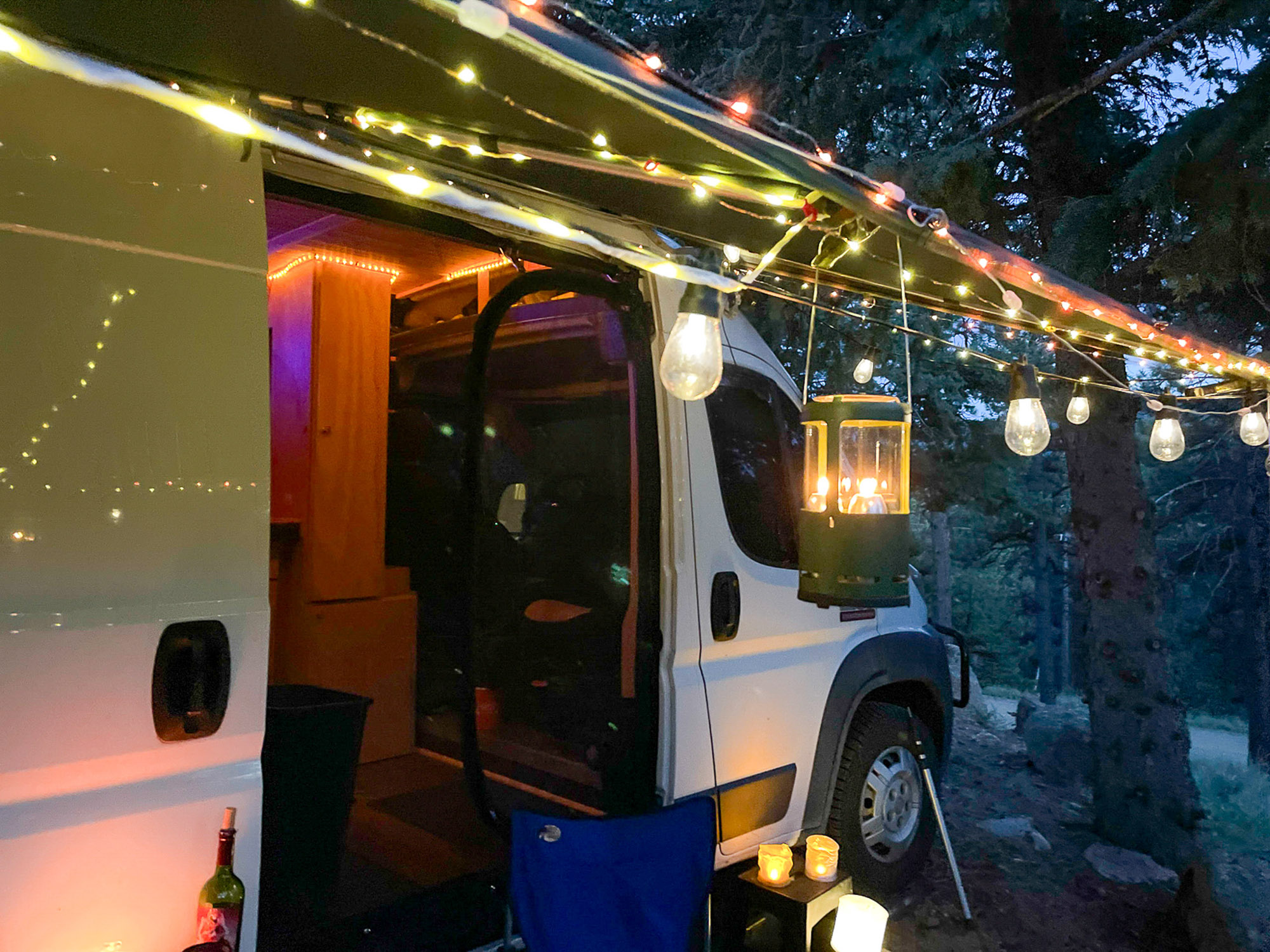
Whether you’re out on a solo car-camping adventure, making fireside meals with friends, or relaxing in your hammock, the best camping string lights make the mood what you want it to be. Our experts have been testing camp lighting for nearly a decade, and we’ve tested just about every option on the market and settled on eight of the best for every occasion.
A long string of twinkle lights like the BioLite Luci 44′ Solar String Lights — our top pick — can really brighten the mood wherever you use them, and even a budget-friendly option like the Revel Gear Trail Hounds can perk up the interior of a tent or car camping situation. More so than camping lanterns or headlamps, string lights are easy to set and forget and can run long into the evening.
Editor’s Note: We updated our Camping String Lights guide on April 2, 2026, to add our new ‘Quick & Dirty’ take on each string light option, as well as extended ratings to better dig into the ‘why’ behind each of our picks.
The Best Camping String Lights of 2026
Lumens
140 lm max; 20 lm low
Power source
4,000 mAh Li-ion rechargeable battery, solar panel
Burn time
40 hrs. on low; 8 hrs. on high
Water resistance
IPX4 water resistant
USB port
USB-C in; USB-C and USB-A out
Pros
- Ability to light up a broad area, focus on specific zones
- String lights store on the lantern, limiting tangles
- Detachable power hub powers your electronics with USB-A and USB-C ports
- Warm light tone is softer on the eyes
Cons
- The solar panel is small, and the charging capacity is limited
- Take care not to snag the lights, as the wiring can break
The Quick & Dirty: An all-in-one camping string light set that combines ambiance, a built-in battery, and a charging function. That solar panel isn’t very big, however, so keep a charging cable handy.
The BioLite Luci 44′ Solar String Lights ($100) are a cool, unique take on a string light, and we think just about the best out there. Their solar-powered battery makes them a great choice for a sunny camping trip. They’re also a great option for a light you don’t want to have to remember to charge.
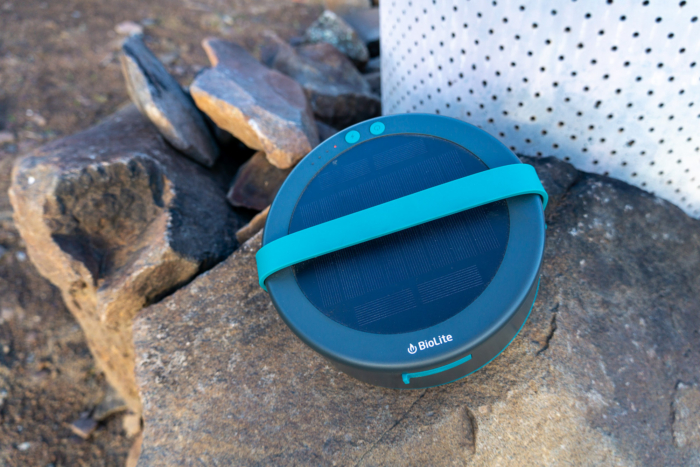
These lights have two battery charging options. The solar panel on the top of the light means you can leave this light out in the sun and forget about it for a while, which we did recently during a camping trip to the deserts of eastern Washington, where the sun is plentiful. On that trip, we were able to keep the lights going for three nights by keeping it topped off during the day. It does take 16 hours for this light to fully charge via solar panel; however, the Luci String Lights also come with a USB charging port.
These lights are best for medium to spread-out spaces. They have 40 light nodes of 140 lumens across 44 feet of cordage, which is considerably longer than other 10-foot string lights. The three brightness settings are easy to click through, though we did wish the internal battery lasted a bit longer, as at full brightness, they only last about 8 hours.
The Luci String Lights can also charge your phone. This is an exciting feature for a string light, but we wouldn’t recommend relying on it, as the battery will only get your phone to about 50% before dying. Still, it’s a good bit more compact than snagging a small solar panel and portable power bank.
We really loved the case for these lights, which was the best of all the lights we tested. You open the body of the lights, wind the string around the center, and twist the top back down to secure the lights inside. It made it nearly impossible to get the lights tangled in transport or unraveling.
Overall, the Luci Solar String Lights are a neat light perfect for camping in sites with plenty of reliable sunny solar power, or on multi-day trips, for those with extra juice to spare from a portable power station or onboard camper battery.
Lumens
350 (across the entire string)
Power Source
USB (5V), optional power pack
Burn Time
Dependent on power source
Water Resistance
Waterproof up to USB connection
Pros
- Warm color
- Dimmable
- Low power draw
- Packable
- Easy to hang
Cons
- Gets tangled easily
- Requires power source
- Damageable
The Quick & Dirty: A budget set of string lights perfect for lighting up the inside of your tent or above a picnic table. They are a little tangle-prone and require a power source to run, however.
The Revel Gear Trail Hound Lights ($25) are a simple, elegant solution to camp lighting and just about the most magical we’ve used. These fairy lights emit a comforting, warm color tone, and are cheap enough that you could get two sets and still spend less than top-dollar string light sets.
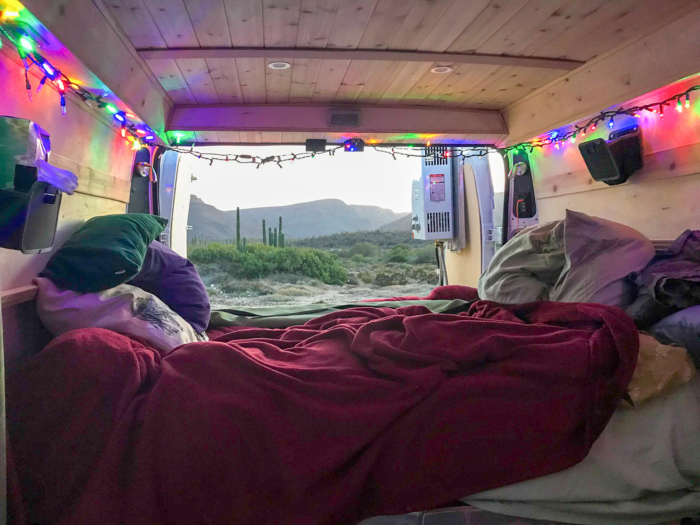
The Trail Hound’s 30 feet of 100 little LED lights are woven into a wire copper strand, which means that they can be wound around tent poles or draped among tree branches. On stormy nights during testing, we used thumb tasks to secure them around the inside of our van to create a cozy, weather-tight nook. In that contained situation, the light they give off is ample to eat by.
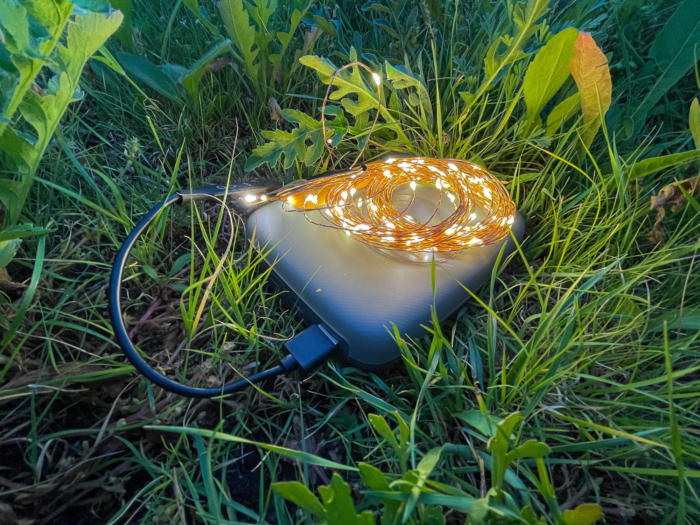
They are also dimmable, which makes them good for nightlight use as well. To power them, you need a USB-A power source. This could be any portable power station or power bank, or a built-in USB in your vehicle.
The only downside to the Trail Hound lights is their lightweight wire matrix, which can get kinked if handled carelessly. It’s not a big deal, as we’ve been using ours for two years now and have somehow managed to keep them going strong. Just be sure to take the time to rewind them neatly, and use the included Velcro wire tie to secure the loops.
Otherwise, the Trail Hounds are an awesome, affordable choice for creating an inviting, warm, cheery camp vibe. They are a perfect addition for any place where you have a USB power source, whether that’s car camping or backpacking. For cooking, you’ll probably want to add more candlepower by pairing them with a lantern or the Brightech Ambiance Pro Solar String Lights. But they can certainly hold their own to gently light up a dark corner of camp or add ambiance.
Power source
Solar or USB
Burn time
20 hrs. on low, 6 hrs. on high
Water resistance
IPX4 (resistant to splashes)
Pros
- Versatile use as string and ground lights
- Solar and USB charging options
- Sturdy, contained case
- Dimmable
Cons
- Expensive
- Cool white light tone
- Heavy
The Quick & Dirty: A unique take on string lights that separates them from the cord, allowing for more lighting options. This does make them a little more fidgety to use, but the tradeoff in versatility is worth it.
The BioLite Luci Site Lights ($100) can rise to the occasion as either overhead solar-powered string lights, portable lanterns, or ground illuminators. This makes them a versatile pick for your car-camping setup. They would also be useful for adding ambiance to a dorm room or illuminating the walkway to the “restroom” during a campfire.
The six lights come in a sturdy plastic box, with a solar panel on the outside that automatically charges the lights stowed away on the inside. Like the brand’s Solar String Lites, they can also be charged via USB-C. Each bulb has a hole for a string to slide through, which means they are modular, and you can space them in any desired configuration. Note: You have to BYO string, but this is a bonus because if the string breaks, it’s an easy fix, and the whole setup isn’t shot.
Also inside the box are six sturdy ABS plastic stakes, which the bulbs affix to when you want to use them for lighting walkways and marking guy lines. The stakes can include a notch to secure guylines, but we’ve found that we still prefer to use our regular tent stakes and just hammer these in next to the ones that might be a tripping hazard.
The lights have a user-friendly on/off swivel, with three brightness settings. There are a few other nice touches, too, including an indicator light for battery level and magnets to hold the lights in place. BioLite claims the setup is shatter- and weatherproof, and in our experience, that has been true. The company also claims they’ll light up 1,000 square feet, which is probably technically true, but with only six lights, we’ve found them to be better suited to smaller areas.
Our biggest gripe about these lights is their cool white color tone, which isn’t great for ambiance, and their plastic feel. The whole setup is also a little bulky and heavy for backpacking, but amply durable for those of us who have a tendency to carelessly toss things in the back of their car with a bunch of heavy gear.
While the Luci Site Lights don’t stay lit for days like the smaller Revel Gear Trail Hounds, the solar case’s built-in 2,600 mAh battery holds enough to fully charge them two times. Still, to keep them running on multi-day trips, you would benefit from a string of sunny days or some sort of portable USB power source.
Power Source
Rechargeable battery, USB charger compatible
Water Resistance
Not rated, but resistant to light rain
Pros
- Versatile corded design
- Rechargeable via Micro-USB
- Easy to hang and store with Nite Ize Gear Ties
- Durable with no cord to kink or break
Cons
- Short battery life
- Not consistently bright, or the brightest overall
The Quick & Dirty: A unique fiber optic design that works best when wrapped around tent poles or tree branches. It isn’t very bright, however, so you may need more of them than other string lights.
Unlike traditional string lights, the Nite Ize Radiant ShineLines ($30) are fiber-optic cord lights, which gives them a unique look. It also makes them super versatile. We hung them between two cars to illuminate a group site, and we used them to outline a tent in a single campsite. However, they really shine when wrapped around another object, like a tent pole, deck railing, or bike frame.
The Radiant ShineLines are also rechargeable, which makes them even easier to bring along. They have a mini USB port, meaning you can plug them into anything with a USB power source. It takes about an hour and a half for these lights to charge completely, and they run for about 6 hours on a full charge. This short battery life means you’ll have to be prepared to charge them on a longer camping trip.
These lights come with four rubber-covered Gear Ties that can be used to hang and store them. We found that the ties made it super easy to attach these lights to tent poles. It also keeps these lights contained in a backpack. After looping the lights up, we wrapped the ties around the loop, which kept them bundled.
Although the fiber optic design is unique, it doesn’t quite live up to the LED standard. These lights aren’t consistently bright the whole way through the cord. They are brightest at either end of the cord, but the middle is dim. However, when wrapped tightly around another object, such as a tent pole, the light is brighter. If you’re looking for something that will offer great reading or cooking light at your campsite, it would be best to stick with an LED light.
The Radiant ShineLines are a cool, versatile addition to your camping set-up, so long as you’re not looking for anything too bright (for a brighter and still versatile option, check out the Revel Gear Trail Hound lights). But get creative with them! They’re not a light you have to leave at camp when you go play.
Power Source
USB power source
Burn Time
Dependent on battery source
Water Resistance
Water-repellant LED case with waterproof connectors
Pros
- Impressively bright lighting
- Sized perfectly to fit beneath an awning or inside a rooftop tent
- Durable LED casing and waterproof cord connectors
- Powered from more universal USB, instead of cigarette port
- Dimmer switch
Cons
- Pricey for the length
- Cannot change the light temperature
The Quick & Dirty: The string light choice for lighting up overlanding or car camping trips. You’ll need your own power source, but the trade-off in durability makes these a great choice for the long haul.
Calling the Front Runner LED Light Strip ($60) a string light is a bit of a stretch, but it functions similarly. It’s really more like a flexible light bar, more applicable for the overlander than the camper. We previously awarded the Lightforce Flexible LED Strip Light as being the best for truck camping, but found these lights to be the very same construction, cheaper, and run off a more universal USB vs. a cigarette plug.
If you have the equipment, this lighting system is an impressive option. The strip is not long — about four feet of lighting with an additional 16 feet of power cable — but it puts out an impressive amount of glowing light. And 72 LEDs create 1,600 lumens of light, which was enough to light up our entire campsite this spring while overland camping in the John Day National Monument in Oregon.
The strip is also easy to deploy, thanks to a clip on either end of the light strip and Velcro straps throughout. You can wrap it around something, hang it from a tree, or strap it to a pole. It’s like one of those light bars you might see on the roof of a truck but with the flexibility you need for camping. In practice, we found the length perfect for stringing across the struts of an off-road awning or inside of a rooftop tent.
However, the ~4-foot length isn’t great for especially spread-out campsites or large rigs like RVs or campers. For that, we recommend grabbing a full-length option like the Brightech Ambiance Pro Solar String Lights. The trade-off, of course, is in ease of set-up and use (the Brightech lights can be a bit of a bear to set up), so there’s good reason to keep your camping quarters tight and go with the Front Runner option.
The LED Strip Light is easy to use, easy to attach to things, and incredibly bright. It is an easy choice for an overlanding campsite; you just need to make sure you have a power supply for it. We often bring along a dedicated portable power station when we’re off-grid in our vans, but a small power brick will work equally as well (your run-time will just be lesser).
Water Resistance
Water resistant
Pros
- Ample light for cooking
- Fun, retro look
- Exceptionally warm light temperature
- Solar charging
- Long lasting
Cons
- Bulky
- Cable is messy to store
- Easy to neglect on/off switch
The Quick & Dirty: A solid string of cafe lights for more-permanent camp setups off the grid. The bulk means they won’t ever go backpacking, but the durability and vibe they provide rank them high.
The Brightech Ambiance Pro Solar String Lights ($45) are the ultimate ambiance creators for boondocking and glamping. They are actually marketed as home lights for pergolas and gazebos, but they’ve been a trusted part of our van-camping lighting ensemble for four years.
First of all, they’re just fun-looking, reminiscent of some stone-cobbled European cafe. Plus, the 2,700K light tone is particularly warm for LED lights. They nicely light up the cooking area and beyond without being overpowering. In fact, we liked these so much that we eventually installed two sets on my mom’s deck. We’ve found the best way to hang them is off of awnings, car racks, or tree branches using zip ties or wire ties.
The lights, which are 27 feet long with 12 bulbs, run off a small solar panel (which is a bit bigger than the BioLite Luci Solar String Lights). Though the company claims five to six hours of runtime, we’ve found that they actually run more like 10 to 12. We never leave them on all night while camping, but at Mom’s house, they almost always stay on until the sun comes up, which gives her an added sense of security.
As for durability, they’ve held up for two years and counting on the deck through rain, snow, ice, wind, and squirrels. Just recently, we did end up replacing our first camping set, but only because we slammed the wire in the van door while camping in Colorado. The wire is very sturdy; we just did a particularly fine job of destroying it. The bulbs are also shatterproof.
The Solar String Lights also have a nice feature: an on/off switch behind the solar panel. However, this is also a pitfall as they don’t charge when the switch is in the off position. There have been several mornings when we forgot to flip the switch back on and thought they were charging when they were not — a glum realization once evening rolled around.
The other downside is that these lights are bulky and heavy, certainly not okay for backpacking but fine for a car setup. And we have yet to demonstrate enough patience to wind up the cord in any sort of organized pattern. But if you have the space and a tiny bit of patience, they’re unmatched for both function and ambiance.
Other String Lights We Recommend
The string lights we’ve chosen above are the options we lean on the most for our campsite illumination needs, but they aren’t the only strings out there. Check out our backbench of solid options that might be right for your camp.
Power Source
Three AAA batteries or USB
Water Resistance
Not rated, but resistant to light rain
Pros
- Diffusing carry bag creates a simple lantern
- Multiple power options with USB port
- Ripstop fabric string cover protects delicate wiring
- Integrates with certain Big Agnes tents
Cons
- Hanging clips don’t like to stay where they’re put
- Bit short for some campsite needs
- Included AAA battery case is liable to break
The Quick & Dirty: Another option for lighting up inside your tent, but not the best we’ve tested so far. The integration with certain Big Agnes tents is novel, but the hanging system isn’t perfect.
Originally designed as an add-on for the brand’s popular backpacking tents, the Big Agnes mtnGLO Camp Lights ($55) work just as well on their own, and can be strung up pretty much anywhere around camp for a bit of added ambiance. Our favorite feature, however, has to be the added translucent stuff sack, which when illuminated from within, doubles as a camp lantern.
Powered by either 3 AAA batteries or a USB power source (we love options), it’s pretty simple to pivot mid-camping trip if your batteries decide to take the dive. Unfortunately, we did find that the included battery case for AAAs is pretty easy to break, with the door on our unit now no longer closing. Either way, these little LEDs sip juice and can be left on all night if you so choose — we’ve definitely fallen asleep more than once with them twinkling overhead.
The ripstop fabric cover surrounding the strand is a nice touch, and makes the string lights feel a good bit more durable than having the wire exposed like on some lights. Whether or not this plays out long-term is left to be seen, but we’re putting the miles in and will update our review with our findings. The plastic hanging clips used to attach these lights, however, aren’t our favorite, and tend to slip around and don’t hold the strand very securely.
Perfect for finishing that last chapter in your tent, the mtnGLO Camp Lights add a soft glow to the inside of your shelter that’s sure to brighten up any camping trip. They aren’t our first choice (scope the Revel Gear Trail Hounds for that), but if you’re already in a Big Agnes tent, they can make a lot of sense.
Lumens
110 lms (high), 30 lms (low)
Burn Time
Dependent on battery source
Water Resistance
Not rated
Pros
- USB power greatly extends run time
- Ability to add more lights
- Adjustable brightness and shades
- Color light options
Cons
- Brightness not adjustable as a group
- Expensive
- Cluttered set-up
The Quick & Dirty: A bit pricey for what they are, and best used with a portable power station, but the chainable aspect is helpful for adding more light.
If you’re looking for versatility and the ability to light up one campsite or a few separate tents, the Goal Zero Light-A-Life Mini ($80) is a great fit. This is really more like a set of four chainable lights rather than a single string. That means it has the same amount of lights as the BioLite Site String Light, but covers almost twice the distance across the cord.
Each light has about four feet of cord with a USB on each end to chain them together. The segments each have their own switches with a brightness function: a 110-lumen function, and a 30-lumen “low” function. This is both handy and annoying. While it gives you greater versatility to adjust the lights when they are separated, it means you have to turn on or adjust each light one by one when they’re strung together.
For lights that don’t come with a battery, the Light-A-Life Minis are fairly expensive. But they do come with a number of features we really enjoyed.
The modular setup means you can easily split the lights to send two lights into two separate tents with battery packs. The lights are decently warm in tone, though we’d still like to see them go a nudge toward the warmer side. They also have shades you can adjust to give direct light or provide a more diffuse, lantern-like effect. Colored shades also give you the ability to set your desired mood.
As a string, though, we found the lights could be rather busy. There are a lot of cords, plugs, plastic, and switches, but if you’re after pure versatility, that’s the price of admission. Goal Zero says you can only chain four lights together, but that didn’t stop us from plugging our BioLite SiteLights into the fourth Goal Zero Mini for even more light. Just don’t tell anyone.
Camping String Lights Comparison Chart
| Camping String Lights | Price | Lumens | Burn Time | Water Resistance | Best For |
|---|---|---|---|---|---|
| BioLite Luci 44′ Solar | $100 | 140 lm max; 20 lm low | 40 hrs. on low; 8 hrs. on high | IPX4 | Most camping where you need plenty of light, and maybe to top off your phone |
| Revel Gear Trail Hound 30 Ft. | $25 | 350 (across the entire string) | Dependent on battery source | Not rated, but resistant to light rain | Lighting up the interior of your tent, or buying a few sets |
| BioLite Luci Site Lights | $100 | Not provided | 20 hours on low; 6 hours on high | IPX4 | Dual-use while camping or backpacking, and lighting up the path to your tent |
| Nite Ize Radiant ShineLine | $30 | Not provided | 6 hrs | Not rated, but resistant to light rain | Fun additional lighting to add ambiance, not coverage |
| Front Runner LED Light Strip | $60 | 1,600 lms | Dependent on battery source | Water resistant | Overlanding or RV camping where high light output is needed |
| Brightech Ambiance Pro Solar | $45 | Not provided | 6+ hours | Not rated, but resistant to light rain | Glamping setups that are off-the-grid |
| Big Agnes mtnGLO | $55 | Not provided | Dependent on battery source | Not rated, but resistant to light rain | Inside-tent use and backpacking |
|
GoalZero Light-A-Life Mini |
$80 | 110 lms (high), 30 lms (low) | Dependent on battery source | Not rated | Using with a portable power station |
How We Tested the Best Camping String Lights
Camping string lights are pretty simple, but that didn’t stop us from diving in and trying to separate the excellent from the just alright. Our selection process begins by word of mouth or through deep research to key in on a slate of worthy testers. From there, it’s into the hills.
Our Testing Process and Testing Grounds
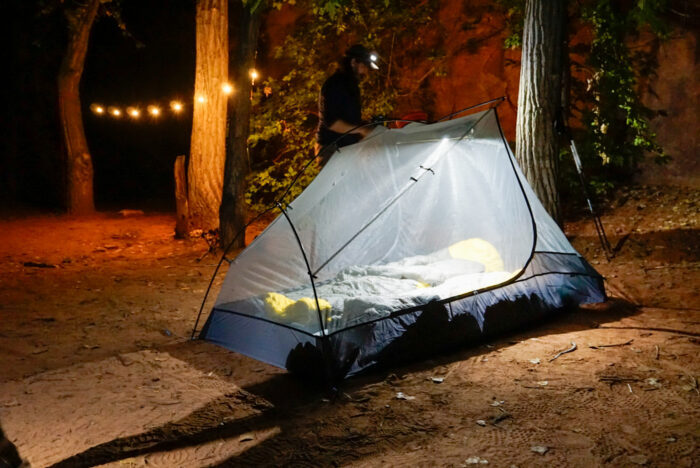
- Field testing: Our camp testing of these string lights has taken us far and wide, and they’ve lit the way to front country campsites across the West — from dim ocean-side camps in the Hoh Rain Forest to alpine lakes in the Colorado high country. Our experts cover the spread from mobile-working van lifers to itinerant dirtbags, and each has strung up a light or three to see what they’ve got to offer.
- Overnight rain resistance challenge: The weather isn’t always going to cooperate for your weekend shindigs, and our rain test occurs during real, day-long Pacific Northwest rainstorms. After spending the night in the rain, each light is turned on and inspected for any damage.
- Run-time and lighting coverage measurement: The battery test seeks to challenge these string lights with real-life usage, and includes charging rechargeable lights fully, setting up battery-powered lights with brand new batteries, and hooking up plug-in lights with portable batteries, then running each light until it dies. The big campsite test assessed each light’s ability to light up a large campsite on its own. The lights that weren’t suited for whole campsites were set up in tents, the backs of cars, and over hammocks to see if they worked better for a single camper.
- Durability and packability bench tests: The first challenges string light’s particular capacity for turning into tangled spaghetti when absent-mindedly packed away, and during our so-called stuff test, we packed away each of these lights both loosely and in any included storage bag. This test aims to determine how easy these lights were to pack and unpack, as well as how likely they were to tangle or break inside a pack. In addition, the durability test involved some good old-fashioned muscle power, and saw our testers pulling, stretching, and yanking on these lights to see if they would break under abuse.
- Our string light rating system:
- Brightness: 30% weighted. The amount of light provided is the most important aspect we weigh when rating these string lights, and we measure that both by individual bulb and the spread of illumination these options provide across an entire camp or tent.
- Battery Life: 30% weighted. Lights with integrated battery packs are judged on their overall longevity, while strings that need to be plugged into a separate battery source typically receive a zero in this metric, as they require an added piece kit to function. We look for a solid run time of at least a full evening on the high setting to rank highly here — typically 6 hours or more.
- Features: 20% weighted. Features such as dimmability, color adjustment, and novel attachment ability all rank a string light high in this section of our ranking.
- Durability: 20% weighted. Finally, we assess overall durability and rank it based on any damage we observed during our testing time, as well as any potential weak points that might develop later on.
Our Expert Testers
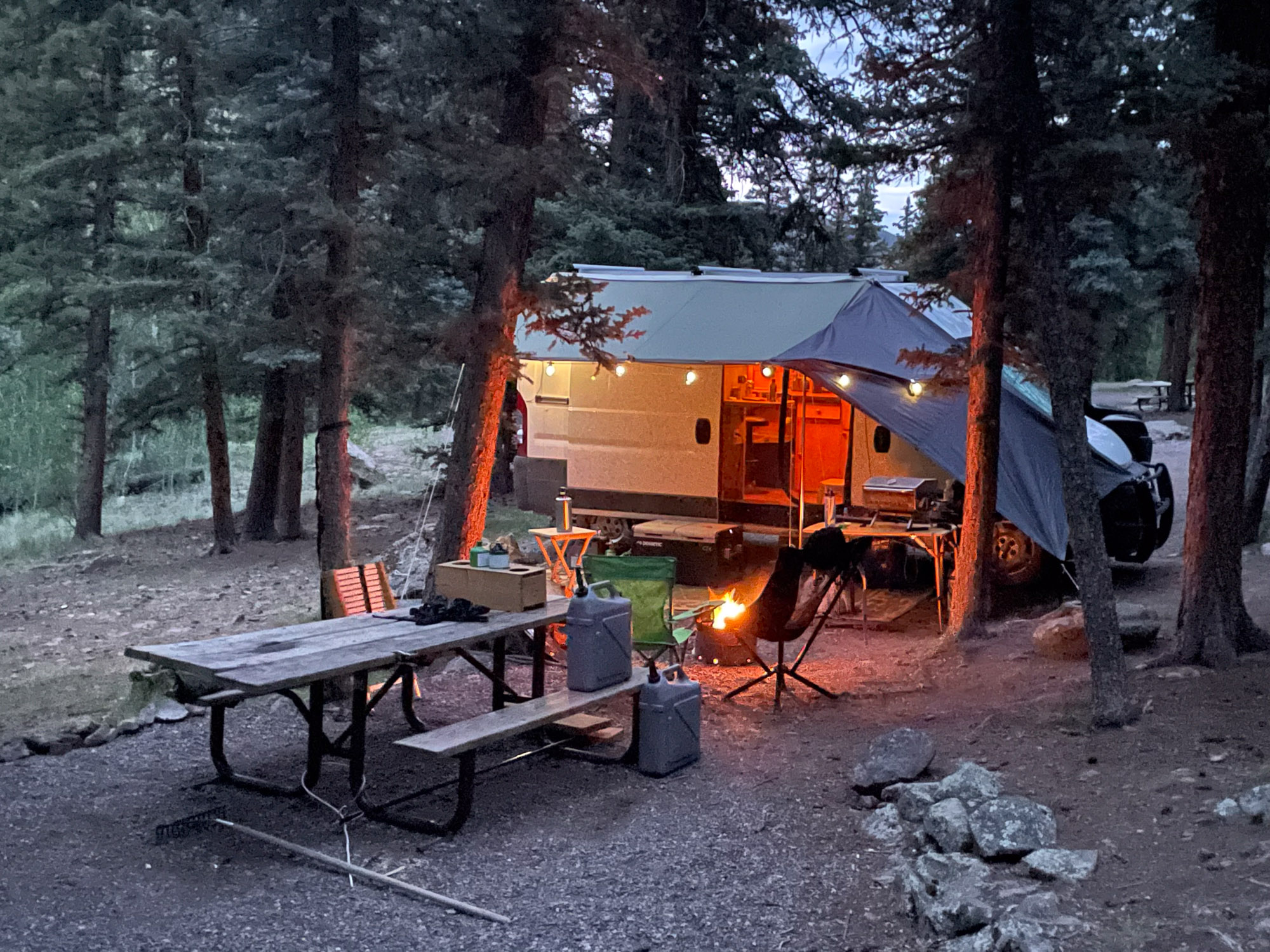
Our lead tester Maddie Downie is an experienced camper, hiker, hammocker, and fireside hang-outer based in Washington State. She grew up camping with her family in the Colorado backwoods, and now spends almost every weekend night out of the summer sleeping outdoors.
Maddie understands the difference between setting up a camp for an early start the next day and putting together a campsite for friends to gather for drinks, and tested each light with this context in mind, developing a few specific tests to put these lights through: a stuff test, rain test, battery test, “big campsite” test, and durability test.
One of our other main testers, Karuna Eberl has spent decades backpacking, tent camping, and van-life-ing around the West and Baja, down to the Florida Keys, and around Europe. She also has a background in filmmaking, which adds to her persnicketiness about using lighting to create a feel-good mood.
Buyer’s Guide: How to Buy Camping String Lights
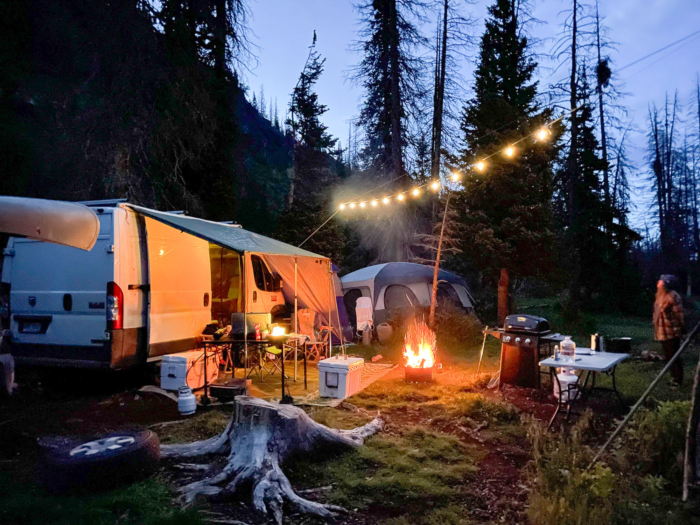
We set out to find the best camping string lights on the market to give you the best recommendations for your adventures. It’s important to note, also, that string lights oftentimes will be accessories to other camp lighting solutions, such as Camping Lanterns or a good Headlamp.
Consider all of these to form a system that covers your campsite with light: headlamps for detail work like chopping veggies or zipping up a tent, lanterns for gathering around and telling stories, and string lights to guide your way around the party. Here’s what we’ve found to be the most important considerations when purchasing camping string lights:
Power Source
Before you can have light, you need power. String lights have a few different means of power, and what will work best for you depends on how you plan to use your lights.
Built-in Battery
For optimal portability, having a set of string lights with a built-in battery will allow you to bring light anywhere without further complications. These lights have the benefit of not needing anything else to work, but that means they’re another thing you’ll have to remember to charge before heading out for the weekend.
If you have the space, you can pack a portable battery as well. While these lights are easy to bring along, they typically don’t have long battery life, lasting for an average of less than 10 hours. For instance, the Nite Ize Radiant ShineLines take about an hour and a half to charge completely for a 6-hour battery life.
Replaceable Battery
Battery-powered lights are also portable, but keep in mind that these batteries can weigh down your pack. It also means you have to remember to put in fresh ones before heading out or running the risk of running out of power. Having rechargeable batteries for these lights will save you money!
These lights will generally last longer than the built-in battery lights, anywhere from three days to a few weeks, depending on how much you’re using them. It’s most likely a string light with a replaceable battery will take AA or AAA batteries.
Plug-In
Lights that require a plug-in to work may be better suited for car camping, boondocking, or lighting up an outdoor space at your home. Plug-in lights can come in a variety of types, such as USB or outlet plug-ins.
Keep in mind that not all USB cords are the same; lights may come in USB-C, USB-A, or Micro-USB. USB plug-ins are the most portable as long as you don’t mind packing a battery bank. And some USB plug-in lights are compatible with lanterns, such as the Revel Gear Trail Hounds.
However, lights that require being plugged into a wall outlet are better suited for RV camping or lighting up your back porch. These lights are a great choice for car camping in cars that have USB or house-plug converters, or when you’re bringing along a portable power station. Plug-in lights also mean you can run these lights longer. House plug-in lights last as long as you want and USBs last as long as your battery bank can.

String Light Size
Some string lights are for small areas, like the back of a pickup truck, while others will light up your whole campsite. String lights that emphasize portability are generally better for smaller campsites as they are dimmer and smaller. These lights range anywhere from one foot to 10 feet in length. Shorter ones are better for lighting up the inside of your car or tent, or illuminating your hammock.
Lights that require being plugged in are better suited for large areas as they are generally larger and brighter. These lights can range from a few feet to several yards, and can stay brighter for longer. But we didn’t include any in this guide, since there are also lights suited for larger areas that don’t require an outlet, like the Brightech Ambiance Pro Solar String Lights, which are 27 feet long with 12 LED bulbs. We use these with our van camping setup, plus have installed them over our back deck, even though there are outlets available.
Brightness
The brightness of a light is also dependent on its power source, as well as the type of light. LEDs are the most common because they work really well and are power efficient. LED lights that run off a rechargeable or battery-powered source (including solar) are often not as large or bright as plug-in lights. This makes them better suited for lighting up small spaces such as a car or tent. Some, like the Revel Gear Trail Hounds, are particularly suited for backpacking, being very lightweight and compact. However, these types of lights may also dim as the battery dies.
Plug-in lights are brighter from 100 lumens (lms) to 1,000 lms. The Front Runner LED Light Strip comes in at 1,600 lms! Plug-in lights also stay brighter for longer and are less likely to dim as you use them.
Some camping lights use alternative light sources, such as the fiber optic lights in the Nite Ize Radiant ShineLines. These lights are generally not as consistently bright as LED lights, and offer more of a glow than a shine. The fiber optic design means that the light isn’t consistently bright through the cord, but is brighter the more it is bent.
Light Spectrum and Color
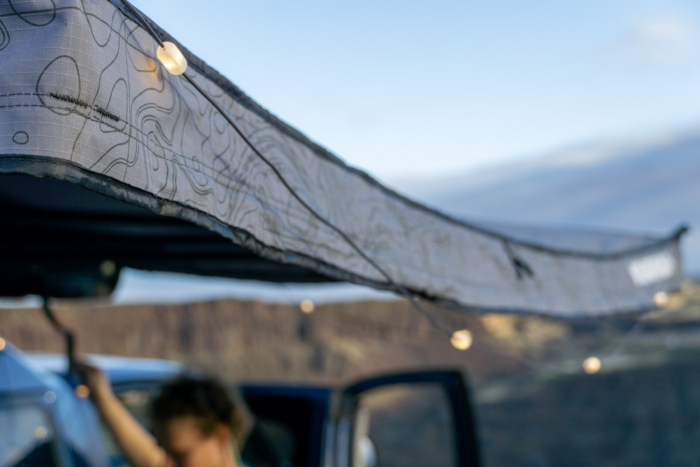
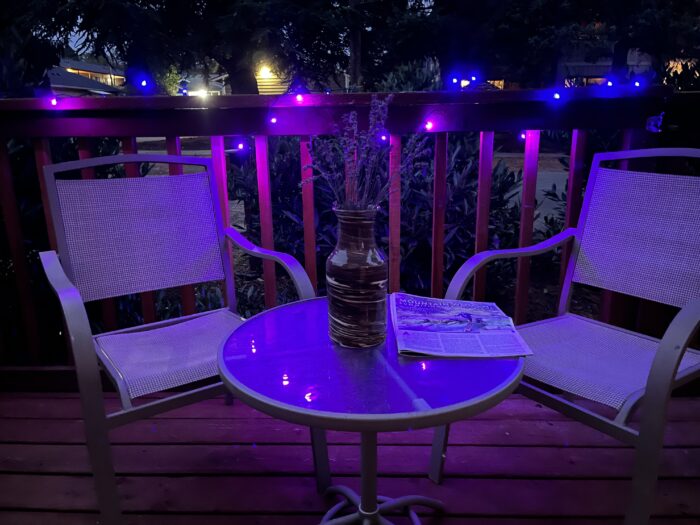
Some lights give off a warm glow, like a campfire, while others are starkly white or even borderline bluish, like the moon. This is called color temperature, and it is measured in degrees of Kelvin. Camping and household lights commonly range from 2,000 to 6,000 degrees. The lower the number, the warmer the tone.
Choosing a color temperature is a matter of personal preference. Generally speaking, warmer tones create happier, more welcoming vibes, whereas cooler temperatures tend to feel utilitarian, even irritating. Cooler tones travel farther, so they’re better for flashlights. Otherwise, warmer tones are still capable of illuminating a cooking area, plus allow your eyes to more quickly readjust to the darkness beyond and are less obnoxious for all of the wild creatures you’re sharing space with (same idea as using a red reading lamp vs. a white one).
If you’re not used to looking at color temperature, you might not even notice it. Many people don’t until it’s brought to their attention. For me, it’s the most important factor when buying a light. There’s a reason movies use lighting to manipulate the mood. It’s the difference in scene between a rom-com, with a cozy cuddle on a beach, and a horror flick, with a lurker creeping up on the camp.
Light Adjustment
Many camping string lights come with light adjustment options which can be helpful in setting a desired mood. Many come with a simple high brightness and low brightness, such as the GoalZero Light-A-Life lights that have a 110-lumen high setting and 30-lumen low setting. This setting is great for transitioning into a sleepier mood.
Other lights have blinking and color-changing effects, which keep the mood more energized. However, a few lights require that you cycle through these different settings to turn the light off, which can definitely be an annoyance around bedtime. No one likes a strobing light right as they’re about to fall asleep.
Storage
There are a few factors to consider when thinking about storage of your camping string lights, which can be dependent on the type of camping you want to do. For backpacking or camping where a portable light is necessary, having a specific storage container is nice.
Several battery-powered or rechargeable lights come with a soft storage bag that fits nicely inside a pack. Some lights, such as the Nite Ize Radiant ShineLines come with gear ties that make it easy to loop these lights up and tie all ends together. Lights without a specific storage method require a little creativity to store and run the risk of getting tangled or damaged.
Even if a light comes with a specific storage container, the ease of setting them up and putting them away is a consideration. Soft storage bags are generally easy to stuff lights into, and ties take a bit longer to put away. The BioLite Luci Site Lights may win the award for easiest to store as the lights are stored in a magnetized case.
Despite how easy each light is to store, there is always the risk of lights getting tangled in storage. We found that string lights that can be stored in a soft bag are easy to get tangled, which adds more time to setting up your campsite. Lights that are stored with ties are less likely to get tangled. Spending the time to fold or wrap your lights carefully will prevent tangling and make your future self a happier camper.
Proper storage can also prevent wear and tear. Lights with rubber or plastic wire coverings have a higher chance of tearing, stretching, or breaking, so it’s especially important to store these lights with care. We found that lights that are shoved into bags or that are just tossed loosely into packs are more likely to experience this kind of wear. Even if a light doesn’t come with a specific storage container, creating one out of a plastic bag or with wire ties could save you from having to replace them right away.
Hanging Functionality
The types of hanging features on a string light can determine how easy they are to set up at a campsite. Many string lights come with hooks that can be used to clip the lights to tent poles, hammocks, or the inside of your car. The BioLite SiteLights come with small hooks on either end that make it easy to attach these lights to different parts of a campsite.
The Nite Ize ShineLines might take the cake for hanging features. Not only are these lights easy to wrap around objects, but they come with four rubber-covered hanging wires that can be used to attach these lights to almost anything. The attachments are super malleable and can be moved anywhere on the light where they are best fit. They also make it easy to store these lights as you can tie off the lights when they are bundled.
Durability and Water Resistance
When choosing between camping lights, the durability of those lights should be a consideration. As a whole, companies designing outdoor lights have put effort into making them durable, such as concealing the lights and wires themselves in some protective material.
Plug-in lights that come with exposed components should be handled and stored with extra care. For instance, the Revel Gear Trail Hounds come with a USB dongle that could be damaged if left in the dirt and rain. The Nite Ize ShineLines have a plastic cover that should be used to keep dirt out of the charging port on the end of the light.
Many of these outdoor string lights are water-resistant and IP-rated. The IP scale refers to how water-resistant something is, and the definitions of each rating are easy to look up online. In general, most string lights seem to be resistant to splashes, but aren’t likely to make it if dunked in water. The Front Runner LED Light Strip is IP65 rated, meaning it’s resistant against “jets” of water. Still, it’s best to assume that no string light is waterproof and try to keep your lights out of the rain as much as possible.
Price & Value
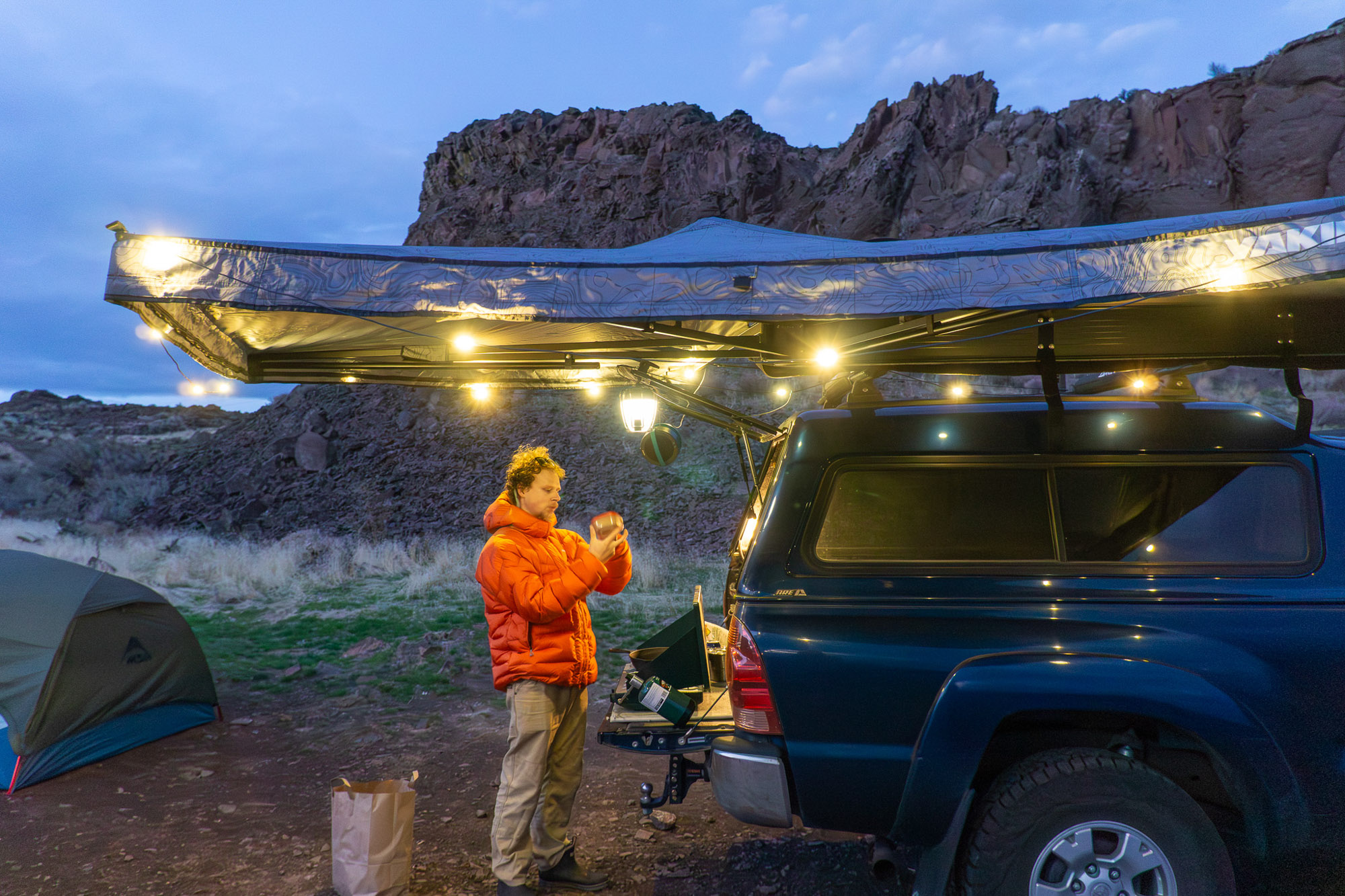
Camping string lights aren’t typically the priciest thing you’ll splurge on for your camping kit, but as consumer electronics, there is a pretty wide spread in terms of price and in turn quality. Cheap string lights tend to burn out prematurely, so it’s good to invest in something that is going to last, and provide the ambiance you’re going for.
Budget
Even budget string lights can be excellent (or pick, the Revel Gear Trail Hounds, are only $25), but there are a few things you’ll likely leave on the table for spending bottom dollar. For one, budget options tend to be powered by traditional AA or AAA cells. This isn’t a hard and fast rule, but you’ll be hard-pressed to find integrated batteries in a cheaper set. Overall brightness might also be a little less, and make these lights better suited for use inside of tents compared to across entire campsites.
Mid-Tier
Spending $40-60 for a set of string lights means they’ll almost always be brighter, longer, and potentially adjustable. This can come in the form of dimmability or the addition of different light modes, such as a twinkle or pulse effect. Increased durability will also come with the increase in price, with better water resistant ratings, as well as more protected cords that might be covered in rubber or textile sleeves.
The Brightech Ambiance Pro Solar String Lights ($45) get you a lot for the money, and while they’re better suited for RV boondockers, you do get a built-in solar panel to power the lights, meaning you’ve got true off-grid ability. The Front Runner LED Light Strip ($60) is similarly suited for vanlifers but is a bit more functionally rich with a dimmable switch as well as a robust sleeve for the LED strip and multiple mounting options.
Premium
Premium string lights are going to offer up even more versaility, and the BioLite Luci 44′ Solar String Lights ($100) integrates a built-in solar panel, as well as an on-board battery bank that can even charge your phone. The extended length is also typical of the price range, and a full 44 feet can illuminate even the biggest campsites.
Frequently Asked Questions
The most convenient light will depend on what you need to do with your light. Are you walking and exploring in the dark? Then you’ll want something like a headlamp or flashlight you can use to direct a beam of light ahead of you and down the trail.
Do you have a central area like a table or tent you need to light? Then the expansive glow of a lantern might be what you’re looking for. If you’re trying to light up a large, spread-out area, string lights are likely your best bet as they can extend over a large area. And if you want brighter light, you can simply wrap them, or even pile them, in a more central location.
The length of time your lights can stay on will depend on how bright you have them set and how powerful the battery is. Sometimes the power source is built into the lights, but others can be plugged into an external power bank. The bigger the bank, the longer the lights will last.
Still, with most high-efficiency LED lights used in these products, you can expect your lights to last for at least several hours. If you use a lower-power setting, some string lights can even last for days at a time, and features like built-in solar panels on the BioLite Luci Solar String Lights will only extend this time.
The number of lights you need is entirely dependent on how big your campsite is and how bright you want it to be. For brightness, consider whether you want a single string light that crosses a campsite for some added ambiance, or if you want to crisscross string lights across your campsite to provide illumination.
Some brands offer long strings with dozens of lights (like the Brightech Ambiance Pro Solar String Lights). However, you may actually be better off opting for smaller sections of lights you can string together. Just remember, the more you string together, the faster the battery drains.
Don’t be afraid to get creative and experiment to find the lighting you prefer.
Read the full article here