




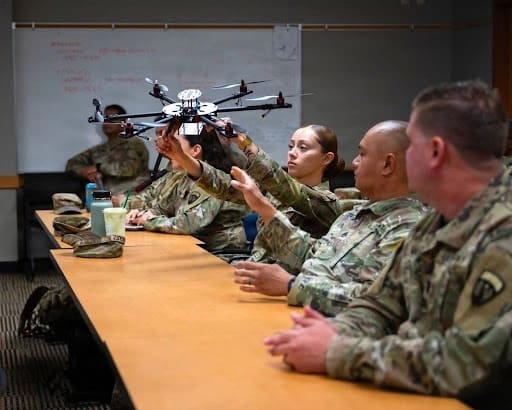
MARCH AIR RESERVE BASE, Calif. – In a classroom here, Soldiers learned that on today’s battlefield, even a small drone can present a serious threat. Through small unmanned aircraft systems training, they sharpened the skills needed to identify, report, and respond to emerging aerial dangers.
To increase readiness on an evolving battlefield, Mel Pilapil, an instructor with the U.S. Army Reserve Command Readiness Support Development Team, conducted several blocks of instruction on identifying and countering sUAS. Dozens of Soldiers assigned to the 302nd Mobile Public Affairs Detachment and the 371st Combat Sustainment Support Battalion attended the training to improve their ability to identify and respond to sUAS on a modern battlefield.
As sUAS technology continues to evolve and spread rapidly, Soldiers must be prepared not only to use these systems, but to defend against them. Training focused on recognizing, mitigating, and responding to enemy drones is now essential to maintaining battlefield awareness, protecting personnel, and ensuring mission success. During the training, Soldiers were introduced to the various ways enemy forces can employ sUAS, including intelligence, surveillance, and reconnaissance (ISR), direct and indirect attacks, swarm tactics, and electromagnetic warfare. Understanding these capabilities allows Soldiers to anticipate threats before they become immediate dangers.
Instruction also emphasized recognizing Low, Slow, Small (LSS) drone systems, including Group 1, 2, and 3 classifications. Soldiers learned to identify visual indicators such as rotor configuration, lighting, and potential payloads—critical details that improve reporting accuracy and response time.
Beyond identification, the training focused heavily on passive air defense techniques, teaching Soldiers how to reduce their visibility and vulnerability. Camouflage, dispersion, emission control, and avoiding predictable patterns were reinforced as key survival tactics in an environment where drones can quickly detect movement.
In one training scenario, Soldiers identified a simulated enemy drone entering the area of operations. Using the SALUTE reporting format, they communicated the size, activity, location, and characteristics of the threat, demonstrating how structured reporting supports faster decision-making and coordinated responses.
“This training is critical in today’s operational environment,” said instructor Mel Pilapil. “As we know currently, there are drones and drone attacks everywhere. The only way we can protect ourselves and others is by being aware of how to recognize, report, and react to these kinds of threats.”
For Soldiers preparing for future missions, the training reinforced how these skills directly impact survivability. “I think it’s important because it increases troop survivability in the battlefield and gives you insight on how to deal with drones and emerging situations,” said Pfc. Adam Li, a Soldier assigned to the 371st Combat Sustainment Support Battalion, whose unit is scheduled to deploy in the future.
For many Soldiers, the training highlighted how quickly warfare is changing. Unlike traditional threats, sUAS systems are accessible, adaptable, and increasingly used by adversaries at all levels. What once required large-scale air support can now be achieved with a small, inexpensive drone, making awareness and preparation more important than ever.
As demonstrated during the training, sUAS can serve as both a powerful force multiplier and a significant threat on the battlefield. Their rapid advancement and widespread use over the past decade have transformed the way military operations are conducted.
There is no single solution to countering this threat. Instead, Soldiers must continuously train, adapt, and employ a combination of counter-sUAS tactics, techniques, and procedures. By doing so, they remain prepared to meet the challenges of modern warfare and maintain the advantage in an increasingly complex operational environment.
Story by SPC Nathan Starr
302nd Mobile Public Affairs Detachment
You can skip to the end and leave a response. Pinging is currently not allowed.
Read the full article here