




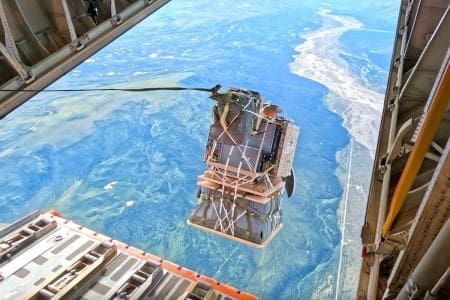
The nature of warfare is in constant flux, and with it, the demands on military logistics. As the U.S. Army shifts its focus toward Large-Scale Combat Operations (LSCO) and confronts the challenges of Anti-Access/Aerial Denial (A2/AD) environments, the ability to sustain dispersed forces becomes a principal concern. The Joint Precision Airdrop System (JPADS) has emerged as a critical enabler for this new era, evolving from a simple accuracy-improver to a key component of the Army’s strategy for contested logistics and strategic mobility. This system, and its future iterations, will be instrumental as the Army continues its transformation, adapting its formations and capabilities to meet the demands of the modern battlefield.
FROM BALLISTIC TO PRECISE: A BRIEF HISTORY
The concept of airdropping supplies is nearly as old as military aviation itself, but for decades, it was a notoriously inexact science. Traditional ballistic parachutes were at the mercy of the winds, often scattering loads far from their intended drop zones. As a result, critical supplies were frequently lost or damaged. This exposed ground troops to greater risk as they attempted to retrieve scattered cargo and forced delivery aircraft to fly slow low altitude passes making them more vulnerable to enemy fire.
Recognizing these shortfalls, the U.S. Army and Air Force began joint development of a solution in 1993.
This effort culminated in the JPADS. The initial version, JPADS Version 1 (V1), was fielded in 2009, followed by JPADS V2, which began fielding in 2015 and was fully deployed by 2020. These early systems represented a significant leap forward. Utilizing the Global Positioning System (GPS), an onboard computer, and steerable parachutes, JPADS could guide payloads of up to 10,000 pounds to within 100 meters of a designated target.
This accuracy allowed for drops from higher, safer altitudes, up to 24,500 feet Mean Sea Level and from a standoff distance of up to 15 nautical miles, significantly enhancing aircraft survivability.
ADAPTING FOR CONTESTING ENVIRONMENTS: THE NEXT GENERATION
The contemporary operating environment, however, presents new and complex challenges. Potential adversaries possess sophisticated A2/AD capabilities, including the ability to deny or degrade GPS signals. This critical capability gap rendered early versions of JPADS, which were solely reliant on GPS, ineffective.
The Army is actively addressing this vulnerability with the latest iterations of the system. JPADS V3, which began fielding in 2026, introduced a daytime vision navigation capability. This allows the system to operate in GPS-denied environments during the day by using visual landmarks for guidance.
The forthcoming JPADS V4, currently in development and slated to begin fielding in 2028, will represent another significant advancement. It will incorporate a suite of advanced proprietary sensors, including infrared cameras, coupled with anti-jamming technology. This will give JPADS V4 the unprecedented ability to navigate with precision in GPS-denied environments at night, in inclement weather and even over open water. Recent tests of this technology have proven successful, including a demonstration in a GPS-denied environment at White Sands Missile Range during the All-Domain Persistent Experiment.
EXTENDING THE REACH: THE FUTURE OF DISTRIBUTED LOGISTICS
The evolution of JPADS is not stopping with enhanced navigation. To truly enable distributed operations and contested logistics in a LSCO scenario, the Army needs to project sustainment over vast distances, far beyond the current 15-nautical mile offset. This is where the Long-Range JPADS (LR-JPADS) comes into play.
Beginning development in 2026 under Product Manager Force Sustainment Systems, LR-JPADS will add a propulsion kit to the standard system, extending its range to potentially hundreds of nautical miles. This will allow resupply aircraft to remain well outside the reach of most enemy A2/AD systems while still delivering critical supplies to forward-deployed units. LR-JPADS will be available in the same 2,000-pound and 10,000-pound gross payload variants, ensuring a wide range of supplies can be delivered across the operational theatre.
The Army is even looking beyond LR-JPADS to a potential Extended Long-Range JPADS, referred to as ELR-JPADS, with a conceptual range of 1,000 nautical miles. This ambitious goal would leverage ongoing science and technology efforts from the U.S. Army Combat Capabilities Development Command Soldier Center to create a truly strategic logistics asset.
These future capabilities were recently put to the test at Fort Greely, Alaska, during the Arctic Edge test event, where JPADS V3, V4 and an LR-JPADS candidate system were evaluated in the harsh arctic environment. Further operational testing is anticipated, with potential participation in major exercises like African Lion and Talisman Sabre.
CONCLUSION
As the U.S. Army continues to transform and adapt for the complexities of future warfare, the ability to sustain the force in contested environments is a non-negotiable requirement. The JPADS, through its continuous evolution and planned future enhancements, is poised to be a cornerstone of this capability. From its origins to improve airdrop accuracy, JPADS is becoming a vital tool for strategic mobility, enabling distributed operations and ensuring that the American Soldier remains the best-supplied and most lethal force on the battlefield. By extending our logistical reach while reducing risk to our personnel and aircraft, systems like JPADS ensure the Army can fight and win, anytime and anywhere.
For more information, go to www.peocscss.army.mil.
By MAJ Jonathan Perry for Behind the Frontlines
MAJ. JONATHAN PERRY is an Army Acquisition Corps officer and assistant product manager for the Cargo Aerial Delivery product office, CPE Combat Sustainment. He holds an M.A. in management with a concentration in global business from the University of Alabama and a B.S. in business management from Athens State University. He is a graduate of the Logistics Basic Officer Leadership Course, the Combined Logistics Captains Career Course and the Army Acquisition Transition Course.
You can skip to the end and leave a response. Pinging is currently not allowed.
Read the full article here