





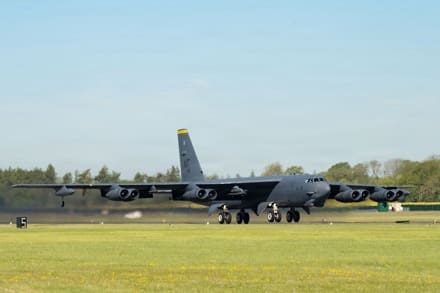
ARLINGTON, Va. (AFNS) —
The U.S. Air Force marked major progress in the long-term modernization of the B-52 strategic bomber fleet in 2026 with two critical acquisition decisions: Milestone B approval on June 1 for the B-52J Commercial Engine Replacement Program, allowing the engine upgrade to move into development, and Milestone C approval on Aug. 21 for the B-52 Radar Modernization Program, authorizing radar upgrades to begin production.
Together, these milestones advance upgrades that will keep the aircraft operationally relevant through 2050 and beyond as a cornerstone of the Nuclear Triad and the nation’s long-range strike capability.
“These back-to-back milestones reflect the maturity of both programs and the strong partnership between the B-52 Program Office, Boeing, Rolls-Royce and Raytheon,” said Brig. Gen. Timothy Spaulding, portfolio acquisition executive for Bombers and Director of the Air Force Life Cycle Management Center’s Bombers Directorate. “These programs are delivering the propulsion reliability, sensor capability and electrical power needed to keep this legendary bomber viable, lethal, and supportable well into the future.”
Program Office leaders describe B-52 modernization as essential to the future capability of the Air Force. The effort is organized around four functions: aviate, navigate, communicate and eliminate.
Aviate: new propulsion and subsystems
CERP replaces the B-52’s original TF33 engines with commercial-derivative Rolls-Royce F130 engines and modernizes critical supporting subsystems, including hydraulic pumps, cockpit displays, flight systems and generators that increase electrical power capacity.
The June 1 Milestone B decision established the program’s first official Acquisition Program Baseline and authorized entry into the Engineering and Manufacturing Development phase. Total acquisition cost was established at $20.2 billion, which includes funding for research, development, test and evaluation, procurement, and military construction. Of the $20.2 billion, $2.6 billion has been spent since 2018.
The baseline reflects a realistic, data-driven service cost position that accounts for the complexity of integrating new systems onto a 70-year-old airframe.
The program has made significant progress retiring technical risk. Early wind-tunnel testing identified inlet airflow distortion; engineers redesigned the nacelle and inlet, validated the solution through extensive testing, and completed the critical design review with Boeing and Rolls-Royce in May 2026. Ongoing engine testing continues.
“CERP is a critical investment in the enduring credibility and capability of the B-52 force,” said William Bailey, performing the duties of the assistant secretary of the Air Force for Acquisition, Technology and Logistics. “By establishing a stable cost and schedule foundation, we are positioning the B-52 to provide reliable, long-range strike and deterrence capacity for decades to come.”
Two dedicated test aircraft, currently flying operational missions after recent depot maintenance, are scheduled to enter modification at Boeing’s San Antonio facility — in the coming months. These jets will receive both CERP and RMP modifications concurrently.
Navigate: modern AESA radar
RMP replaces the 1980s-era APQ-166 analog radar with the APQ-188, a military-off-the-shelf Active Electronically Scanned Array Radar that is a cousin of the F-15 and F/A-18 radars.
The Aug. 21 Milestone C decision authorized Low-Rate Initial Production. The same day, the program awarded LRIP contracts to Raytheon Technologies for the radars and to Boeing for aircraft integration kits – beginning with Lot 1 of four kits. The five-lot production plan will deliver a total of 74 kits while maintaining production stability and affordability.
The program retired integration risks and proved hardware maturity through ground testing of its initial software build. A comprehensive Production Readiness Review completed in June 2026 assessed the system could be built reliably and was ready for initial production.
Communicate and eliminate
Beyond propulsion and radar, the B-52 enterprise continues work on survivable nuclear command-and-control communications, including Extremely High Frequency terminals, and conventional beyond-line-of-sight capabilities such as Hybrid SATCOM. Weapons integration efforts include the latest variants of the Long-Range Anti-Ship Missile and Joint Air-to-Surface Standoff Missile, while the B-52 continues to serve as a test platform for hypersonic weapons.
Strong bones
The structural integrity of the B-52 remains one of the aircraft’s greatest strengths. As part of the Milestone B activities for the CERP, the program office conducted detailed structural assessments across the fleet to ensure the airframe could safely support new engines, increased electrical power generation and decades of continued operations.
These assessments confirmed that the B-52’s airframe – originally designed in the late 1940s and built into the early 1960s – retains substantial structural life. Analyses project the airframes will have sufficient fatigue life to support operations well into the 2050s and beyond.
Via Secretary of the Air Force Public Affairs
Both comments and pings are currently closed.
Read the full article here