




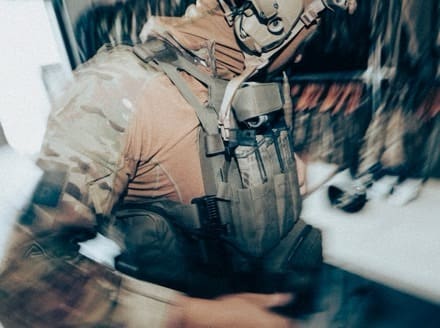
Explore six Direct Action® configurations and remember: gear should enhance the operator’s capabilities, not limit them.
There is no single plate carrier for every task. Choosing a plate carrier doesn’t start with the product. It starts with the mission. A dynamic CQB environment places different demands on an operator than those faced by a team medic or JTAC, while covert operations come with an entirely different set of requirements.
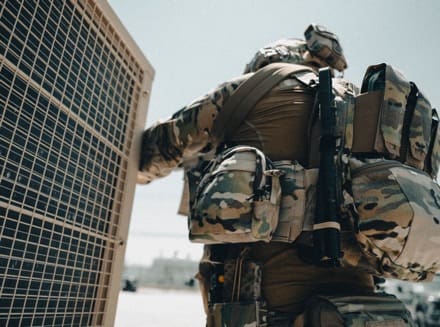
That is why choosing a plate carrier and the rest of the loadout should start with the requirements of a specific mission, not with the product itself. Mission duration, threat level, access to support, load carried, operational environment, and the need to maintain high mobility – each of these factors influences the final setup.
Direct Action® treats the plate carrier as the foundation of a scalable system. Combined with cummerbunds, front flaps, back panels, pouches, and magazine pouches, it allows operators to build a configuration around the requirements of a specific task. Each component of the system is designed to enhance the operator’s capabilities rather than restrict mobility or access to mission-essential equipment.
This approach is part of the Individual-as-a-System® concept developed by Direct Action®, where equipment is treated as an integrated system tailored to the individual operator, their role, and the mission at hand.
ASSAULTER – MAXIMUM MOBILITY. MINIMUM UNNECESSARY GEAR.
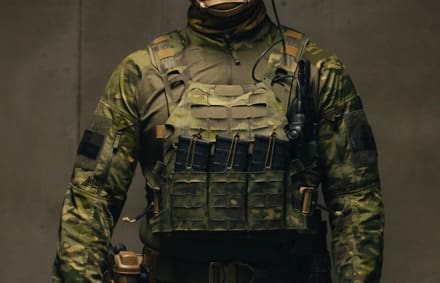
An assaulter operates fast, dynamically, and aggressively. Especially in CQB, seconds can determine the outcome. Ergonomics, unrestricted movement, and immediate access to weapons, magazines, and essential equipment are therefore critical.
This setup is designed primarily for missions where speed and mobility take priority over the ability to carry large amounts of additional equipment.
HEAVY ASSAULTER – GREATER PROTECTION FOR GREATER THREATS.
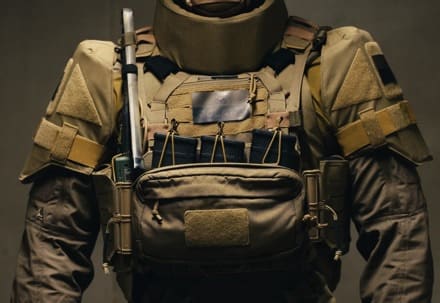
Not every operation allows for a minimalist approach. In high-threat environments, increased operator protection and the ability to carry more ammunition and equipment become priorities.
In the Heavy Assaulter configuration, some mobility is deliberately traded for a higher level of protection. The setup can be expanded with additional protective components, including soft armor, while its configuration provides greater load-carrying capacity.
ASSAULTER QR – RAPID RELEASE WHEN IT MATTERS.
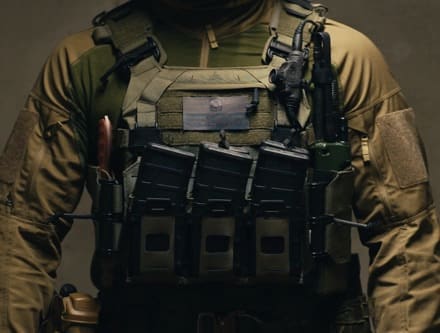
Operations conducted on or around water place additional demands on equipment. In an emergency, the ability to rapidly ditch the plate carrier together with the complete loadout can have a direct impact on operator safety.
The Assaulter QR configuration is built around the Spitfire QR Plate Carrier, equipped with Duraflex® QRS quick-release buckles on the shoulders and cummerbund. The system allows the carrier to be rapidly removed and then put back on while retaining full functionality – for example, after providing medical assistance.
MEDIC – SAVING LIVES WITHOUT SACRIFICING COMBAT CAPABILITY.
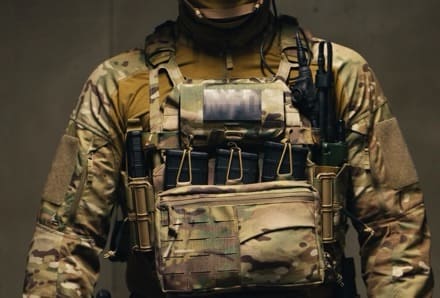
A team medic remains a full-fledged member of the assault team. They must be prepared both to fight and to provide immediate care to a casualty. The setup must provide rapid access to medical equipment without restricting access to weapons and essential gear.
JTAC – COMMUNICATION AND COORDINATION AS PRIORITIES.
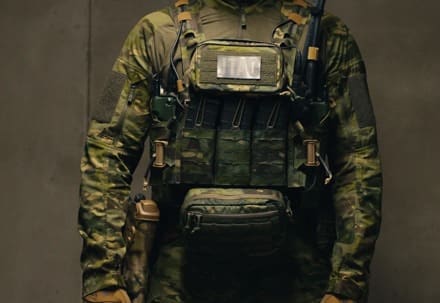
A JTAC’s role requires an entirely different approach to equipment configuration. Coordinating air support and managing communications means carrying multiple radios, PTTs, navigation devices, phones, map pouches, and additional equipment.
The JTAC configuration is built around organizing this equipment, providing easy access to communications, and enabling the operator to work effectively over extended periods.
In this role, the plate carrier becomes more than a protective and load-bearing platform. It serves as the foundation of a system that allows the operator to manage multiple means of communication while maintaining access to the rest of their equipment.
LOW PROFILE – WHEN DISCRETION AND SURPRISE ARE KEY.
In some operations, discretion and surprise provide a critical advantage.
The choice between the Hellcat Low Vis Plate Carrier and the Corsair Low Profile Plate Carrier depends on the amount of equipment carried and the nature of the mission. Both were designed to provide protection while minimizing their impact on freedom of movement and the operator’s visual signature, but each addresses a slightly different set of requirements.
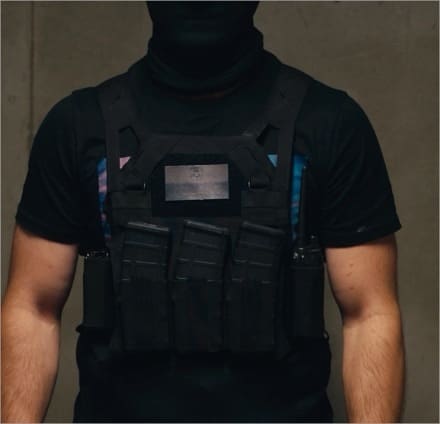
The Hellcat Low Vis Plate Carrier can be worn discreetly under a jacket or sweatshirt, but it can also serve as an outer plate carrier. It is an ideal solution when you need to keep a low profile while maintaining greater firepower. The individual pockets in the front flap and cummerbund can accommodate rifle, pistol, or SMG magazines, allowing the setup to be adapted to the weapon system without any modifications. The carrier is also compatible with selected components from the Spitfire system, while the buckles on the front panel make it compatible with most Direct Action® chest rigs.
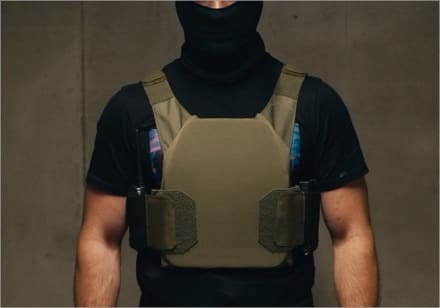
The Corsair Low Profile Plate Carrier takes minimalism a step further. It was designed primarily for covert wear under clothing – even beneath a lightweight shirt. Components that would add bulk or increase the carrier’s visual signature, such as additional Velcro panels, flaps, or extensive external modularity, have been eliminated. Its elastic cummerbund features internal pockets for magazines and a compact radio.
THE MISSION DEFINES THE SETUP.
Assaulter, Heavy Assaulter, Assaulter QR, Medic, JTAC, and Low Profile represent six different approaches to equipment configuration. These are example setups that can be modified according to individual needs, preferences, and mission requirements.
Together, they demonstrate the fundamental principle behind the Direct Action® system: define the mission requirements first. Configure the gear second.
The gear should follow the mission – not the other way around.
directactiongear.com/en/plate-carriers/mission-setup-execution
Useful links:
youtu.be/gtzMQF6doA0
youtu.be/AWJ66GIjyLU
youtu.be/AL0Fn0v8vxo
youtu.be/Unu1Jtg4AiY
Both comments and pings are currently closed.
Read the full article here