




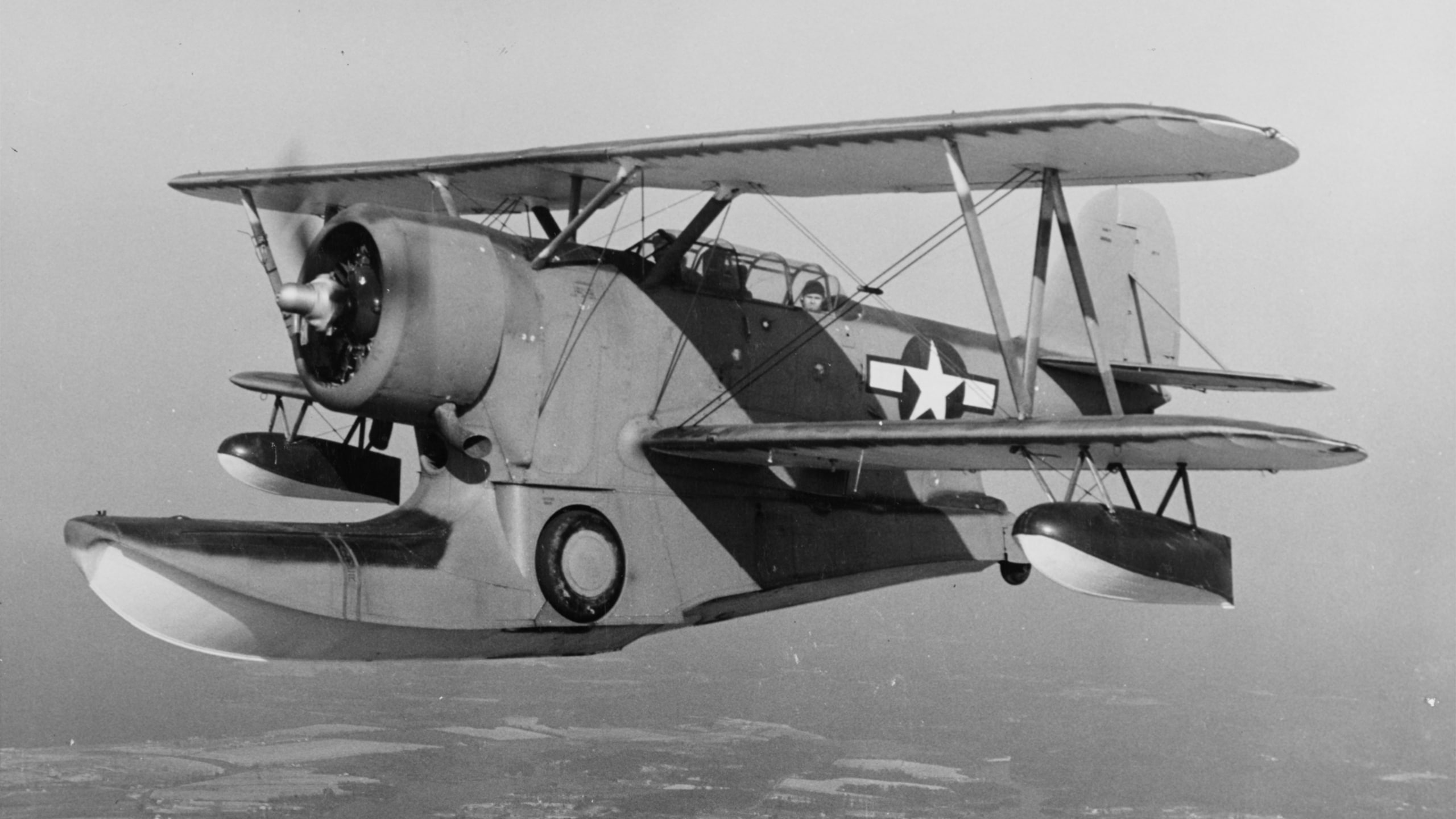
On April 24, 1933, a legend was born when Grumman test pilot Paul Hovgard flew the prototype Grumman J2F “Duck,” designated XJF-1, on its first flight, taking off from the factory’s grass strip at Farmingdale, New York. The flight marked the debut of one of the most versatile amphibious aircraft ever created.
Originally designed as a utility aircraft, the Duck has the distinction of being the U.S. Navy’s first amphibious aircraft to outfit its initial utility squadrons and to serve in various roles throughout World War II.
Grumman’s New Design
In 1931, a streamlined amphibious float, designed by Grumman designer Charles Tilgner, became the basis for a new aircraft to replace the older Loening amphibious plane flown by the U.S. Navy.
The Loening OL was first flown in 1923. It was an amphibious biplane, powered by a 400-horsepower Liberty L-12 engine, with a large single hull and stabilizing floats fitted underneath each lower wing. The hull was built of Duralumin on a wooden frame, with five watertight compartments, and the fuselage was constructed on top of the hull.

Tilgner’s design had the amphibious float as an integral part of the fuselage. The 700-horsepower Pratt & Whitney R-1830 Twin Wasp radial engine powered it. The new design was designated the XJF-1, intended for utility duties.
With its retractable landing gear and tail hook, the Duck was able to operate from aboard ships and land bases, even though the landing gear had a narrow track and was operated by a hand crank.
The crew consisted of two to three personnel seated in tandem cockpits. The aircraft pilot flies from the front cockpit, while an observer sits in the rear with room for a radio operator if needed. There is a cabin downstairs for two additional passengers or downed pilots, and a hatch in the bottom of the hull used for taking aerial pictures.

The Duck was initially designed as an unarmed utility aircraft, as the large centerline float prevented the mounting of weapons. Later Ducks were fitted with a .30-caliber machine gun and ordnance racks capable of carrying two 100-pound general-purpose bombs, with a few modified to carry two 325-pound depth charges. It had a top speed of 185 mph with a cruising speed of 155 mph.
An order was placed for 27 JF-1s immediately after trials, with deliveries commencing in late 1934. By 1936, JF-1s had replaced the older Loenings. That same year, the Coast Guard ordered 15 JF-1s, but wanted them equipped with the new 750-horsepower Wright R-1820-102 Cyclone engine, which redesignated the aircraft JF-2s.

In 1939, nine J2F-2As were modified with machine guns and bomb racks for use by the U.S. Marine Corps. By 1940, the threat of war brought an order for 144 J2F-5 variants, equipped with a new 1,050-horsepower R-1820-54 engine. It was the last model built by Grumman.
After Pearl Harbor, the U.S. Navy ordered 330 more Ducks. Still, Grumman assigned the contract to Columbia Aircraft Corporation of Long Island, New York, so they could concentrate on building the F4F Wildcat.
World War II and the Grumman J2F Duck
The Duck was assigned to both carriers and land bases and used as a jack-of-all-trades aircraft. It performed several search and rescue missions, particularly in the Guadalcanal area. With its bomb racks installed, the Ducks were fitted with depth charges and assigned to anti-submarine warfare duties.

In the Philippines, four Ducks with the U.S. Patrol Wing 10 operating from the carrier USS Langley (CV-1) were destroyed along with several PBY Catalinas.
The Candy Clipper
One special Duck made it into the history books: the “Candy Clipper”. In early 1942, airmen with the 20th Pursuit Squadron, a local P-40 Warhawk unit in the Philippines, refloated a Navy J2F that had been abandoned. USAAF pilots flew this Duck across enemy lines four times to transport badly needed medical supplies for the defenders of Bataan and Corregidor. The pilots also brought candy for the nurses, which earned the aircraft the nickname “The Candy Clipper.” It was the last aircraft to leave Bataan during the siege of the island in 1942.

As the war was winding down, the Navy decided to switch over to the monoplane Vought OS2U Kingfisher. The Kingfisher was initially designed for observation and scouting during naval battles, but was used more for scouting for bombardment.
Post War
In 1946, J2Fs were assigned to Task Force 68. They participated in Operation Highjump, the exploration of the Antarctic led by Rear Admiral Richard Byrd. The mission was to set up the Antarctic research base Little America. The mission objective was the training of personnel and equipment in frigid conditions, the development of air bases on ice, and, although it was denied, establishing U.S. sovereignty over the largest portion of Antarctica possible.

Operation Highjump also fueled numerous unfounded conspiracy theories that the United States was searching Antarctica for a secret Nazi base that survived World War II. Some of the more fervent of these theories believed this base potentially hid things such as advanced technology like flying saucers and even a still-living Adolph Hitler, with the United States on a search and destroy mission looking for it. I can’t help but wonder how the Duck would fare in a dogfight against Nazi flying saucers!

Live The Armory Life. The latest content straight to your inbox plus an automatic entry to each of our monthly gun giveaways!
Back here in the real world, though, in 1948, the U.S. Air Force acquired eight surplus Navy Ducks for air-sea rescue missions. They redesignated the aircraft as OA-12s, with five aircraft assigned to the 10th Air Rescue Squadron in Alaska, and the other three shipped to the Colombian Navy under a mutual aid agreement.
Grumman Duck in Popular Culture
Several Ducks have been used in movies and on television. The Duck was seen rescuing downed pilots in several episodes of the television series Baa Baa Black Sheep, which chronicled the history of U.S.M.C. Major Pappy Boyington and his Black Sheep Squadron.

The 1971 film “Murphy’s War,” starring Peter O’Toole, has several minutes of Duck flying footage, and this very same aircraft now sits in pristine restored condition, painted to represent one of the rescue OA-12s the USAF acquired in 1948, at the National Museum of the U.S. Air Force.
The Legacy
The Duck served the country well with an essential role in military aviation with all the military branches during World War II. It could perform a wide range of roles, including medical transport, observation, patrol, anti-submarine warfare, aerial photography, target towing, VIP transport, and search-and-rescue missions.

After the war, the Duck served several foreign countries, was used as a water bomber, and as a taxi, transporting businessmen between Long Island and Manhattan. A total of 632 Ducks were produced, with a few survivors to be found in museums on static display, and even fewer in flyable condition. A rare bird with a quite remarkable history, whether or not it actually hunted down Hitler in Antarctica!
Editor’s Note: Please be sure to check out The Armory Life Forum, where you can comment about our daily articles, as well as just talk guns and gear. Click the “Go To Forum Thread” link below to jump in and discuss this article and much more!
Join the Discussion
Read the full article here