




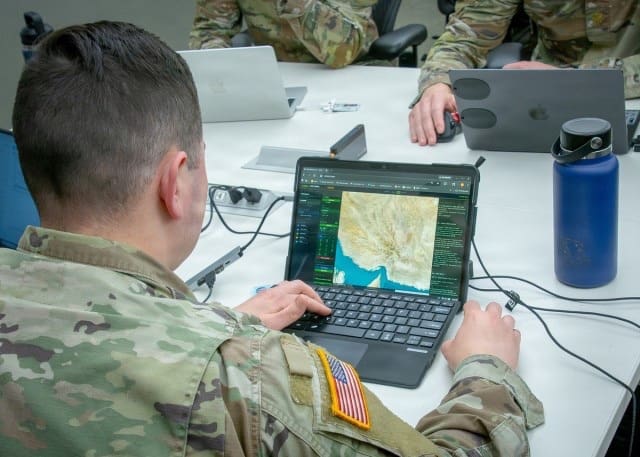
FORT LEAVENWORTH, Kan. — Before any Soldier steps up to a sniper hide or takes a precision shot, they must first know their weapon inside and out.
From day one of basic training, Soldiers are taught to field-strip their rifles, understand the mechanics of the bolt carrier group, and know exactly what to do when the weapon malfunctions.
It isn’t magic; it is simply a tool of the trade.
The U.S. Army Command and General Staff College’s newest AI Basics elective course is applying that same philosophy to Artificial Intelligence.
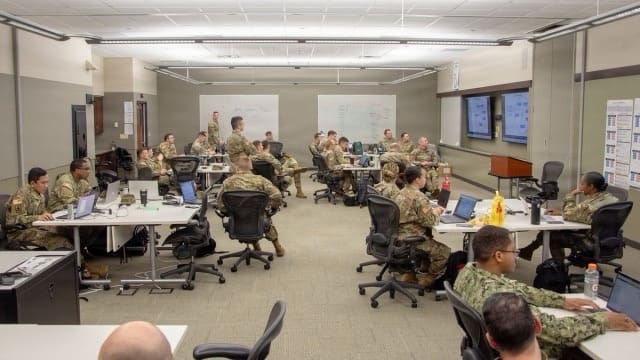
Day one of the new course started with a question: How many people know how their rifle works?
“AI is just another weapon system,” Instructor and Curriculum Developer Lt. Col. Timothy Williams said. “This class is going to teach you how AI works to that level – how it is built, how it is trained, what it is you’re actually interacting with when you interact with these platforms. We’re going to teach you how to use AI not just as a rifleman, but a sharpshooter.”
Early in the Command and General Staff School’s 2026 Command and General Staff Officer Course academic year, fellow AI elective Instructor and Curriculum Developer Lt. Col. Anthony Joyce and Williams observed students using AI in varying levels of expertise.
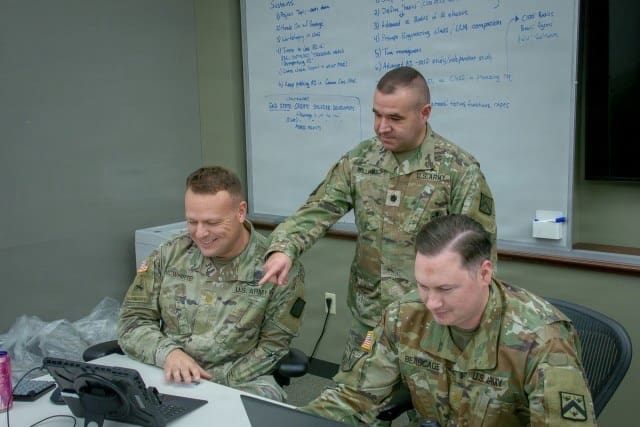
The 48-hour elective was created to provide structure and a kind of basic training for AI mechanics of Large Language Models, what tokens are, and how data is ingested, similar to understanding how gas operates the bolt in an M4.
The elective is a two-pillar design focusing on foundational understanding of AI and how to use the technology effectively and then using that knowledge to create agents to solve real-world Army problems.
“We teach any AI user level how to leverage AI to make tools rapidly for warfighting organizations. Service men and women know what their tools need to do, now they can make them themselves,” Joyce said.
A foundational understanding of how AI works is critical to enabling the officers to go beyond using technology to solve basic staff work problems, similar to basic training, Joyce said.
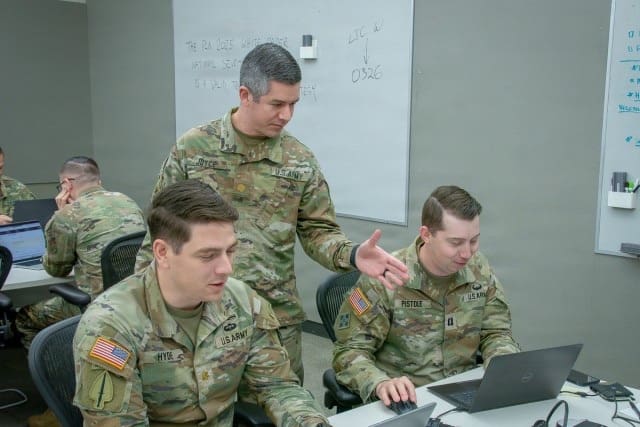
By demystifying the technology, the CGSC elective is transforming staff officers from basic users firing generic prompts downrange into digital marksmen capable of surgical, data-driven precision, he explained.
“If you know how to make slides, you know how to do so with any tool. The same is what we’re teaching here in this class,” he said. “If you can build agents leaving this class you will be able to build agents across all the joint force platforms and softwares.”
A total of 130 students took the new elective. Nearly two thirds of them had little to no experience using AI in an operational environment.
According to both Williams and Joyce, that is 130 Soldier developers who, at their next units, will be AI agent ambassadors, effectively dispersing the no-cost software creation skill across the force.
The population that took the first AI elective represented not only U.S Army students, but joint service members and international students from allied partner nations.
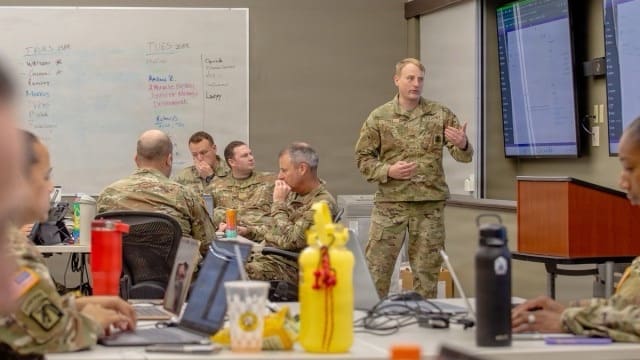
The large variety of knowledge bases, services and nations challenged Joyce and Williams to create a curriculum that was deliberate in its delivery.
“One of the most surprising things to me about this elective course was the diversity of military occupational specialties [signing up to take it]. Everything from chaplains, Medical Corps, MPs, to the more obvious MI and Signal,” he said. “However, no matter their starting point, they all achieved the overall learning objectives that will enable the entire Army, joint force, and partner forces: they all became Soldier Developers.”
For Zambia Army student, Lt. Col. Victor Simukonda, the AI elective course was another means of building interoperability. He noted AI is something militaries across the globe are learning and this course demonstrated a U.S. Army capability that could be transferred.
“It gives us [international students] a better view, and understanding of the differences in capabilities. But this also is an opportunity to bridge that gap,” Simukonda said. “It helps us all start thinking of applying this in a similar manner that can help us achieve better interoperability and be able to work as allies and partners.”
At the end of the course, Simukonda created Vanguard, a modular command intelligence system, intended to assist soldiers in understanding doctrine and military information.
In building the agent, Simukonda learned more than just how AI works, but its intended application, problem solving.
“My biggest takeaway was to stop looking at artificial intelligence as merely tools that we create, but [stet] look at them as in things that help us solve problems,” he said. “It’s changing the mindset from a tools sort of mindset to a problem mindset. Sort of asking ‘what kind of an AI am I creating?’. We were encouraged to think of what are the problems that we’re trying to solve, and that ties into the human aspect of this system, or these systems that we’re creating are meant to help solve human problems.”
Similarly, Maj. Andrew Fletcher, a civil affairs officer, came into the elective course with very little experience with AI, but the staff and faculty encouraged him to take advantage of the professional military education environment that allows for space for experimentation.
The course did more than teach foundational understanding of what AI is, Fletcher explained, it changed how he thought.
“Once you understand how AI thinks and how it makes use of information in order to get you the answers that you’re asking for, it completely changes your mental framework for how you view information,” he said. “Now when you receive data, instead of viewing it and categorizing it how you used to, you start to view it in a way that can be made use of by AI. And I think that mental shift was key.”
After graduation, Fletcher transitioned to the 96th Civil Affairs Battalion under the Special Forces Group, taking with him his AI agent that assists in a secondary effect of the Civil Affairs force modernization efforts.
Smaller, more mobile detachments are capturing critical data points at an increased rate, he explained, generating a need for the ability to analyze and share outcomes.
AI was the perfect, low-cost solution, that goes beyond civil affairs, Fletcher said.
“With some really basic instruction and just ‘how to’ on how to use some of the tools, I think Soldiers everywhere throughout the Army would be really surprised by how powerful their knowledge of their job, paired with very little technical expertise and what it’s able to produce, and the power and impact that they’re able to have on the force,” he said.
For Joyce and Williams that impact is the introduction of no-cost software solutions being created by the Soldiers who can easily identify the problems the solutions can solve.
“Innovation at the speed of war is what is going to win battles in the future and war in the future. And traditionally in the military, we had to rely on our defense industrial base, which are great partners to have, but we relied on them for absolutely everything software related at scale. We now necessarily don’t have to rely on them to solve small problems, and we could allocate our budget, time and effort to more complicated problems that they’re suited to solve,” Joyce explained.
AI is the future of warfare, according to Williams, making CGSC the ideal place for electives like this one to emerge, reform, and eventually be pushed across the force.
CGSC is a generating force, Joyce explained, educating the largest population of the Army’s field-grade officers.
“If we can train the field-grade officer to be a Soldier developer, we are the generating force for the Army of that capability, which goes out to the operational force, implements it, trains their subordinates and then creates the flywheel,” he said. “It’s reciprocal because now these captains that come here to CGSOC, they are further along in the pipeline of using AI technology than the existing cohorts are.”
The prediction of each future academic year’s students having more AI-related knowledge and skills has already encouraged curriculum adaptations.
Williams explained some of the initial lessons of the AI Basics Course will be integrated into the first Common Core lessons of the academic year, exposing students to AI even sooner in PME than before.
In addition, the future of the AI elective will expand to the students’ needs, he said, with the potential of evolving into a more advanced elective.
The number of CGSOC students leaving with AI proficiency and potentially agents to solve some of the Army’s most persistent problems will nearly triple next year, Joyce explained.
Students and instructors described their excitement to watch the lessons learned and agents applied at divisions and corps across the force.
“There’s this idea that the Army has over a million people in it, and if we put this capability in the hands of a million Soldiers, the Army can become the world’s largest software developer overnight. And that’s powerful to think about. The Army didn’t start with that role, but we have that capability now to generate that,” Joyce said.”
By Sarah Hauck, U.S. Army Command and General Staff College Public Affairs Office
You can skip to the end and leave a response. Pinging is currently not allowed.
Read the full article here