




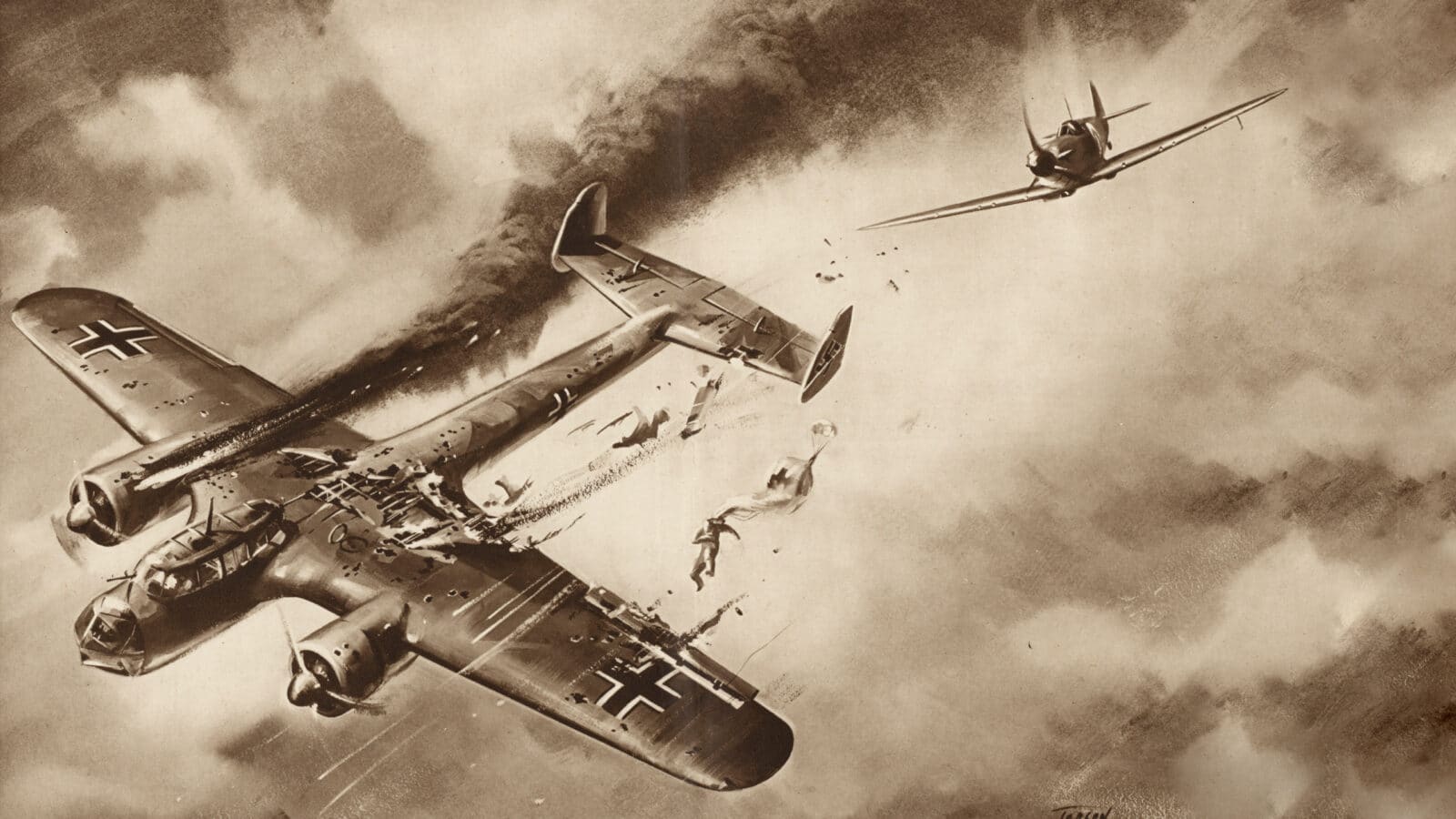
The idealized concept immediately took root and blossomed: the Royal Air Force saved Britain from invasion in 1940. The conventional wisdom holds that Prime Minister Winston Churchill’s legendary “few” handed Nazi Germany its first defeat in World War II and paved the road to eventual victory.
But was it true?
After eight decades, it’s time for some objectivity about this admittedly heroic stand.
When Germany invaded Poland in September 1939, the Western allies joined in a belated effort to counter Adolf Hitler’s avarice. The months-long “phony war” turned chillingly real in May 1940 when the Wehrmacht unleashed the Blitzkrieg that swallowed Western Europe, leaving Britain to face the all-conquering Third Reich alone. After a short interval in which Hitler expected London to accede to his demands, the Battle of Britain began with persistent Luftwaffe attacks from July onward.
Before the Battle
Britain had fought an aerial battle in home skies during World War I, soundly defeating Germany’s Zeppelins and heavy bombers. Then the years preceding World War II stirred a mixture of techniques and technologies that proved crucial in 1940. They included obvious factors such as aircraft and radar — vitally linked by voice radio — and high-octane fuel. Organizational innovation also factored.

Fortunately for Britain, Air Marshal Hugh Dowding took over Fighter Command in 1936, affording the RAF the priceless advantage of four years to prepare.
Radar — a new, still evolving technology — emerged a major player on the global stage. “RAdio Detection And Ranging” permanently changed the way air operations were conducted, spreading its electronic ripples throughout the world’s air forces, navies, and armies.

Early tests showed exceptional promise. An RAF committee consulted Robert Watson-Watt, a noted electronics authority descended from the inventor of the steam engine. Working with a handful of colleagues, in 1935 he demonstrated that “aeroplanes” passing through a radio beam interrupted the signal strength, suggesting that early radar could identify aircraft from a considerable distance, increasing to 60 miles.
Knowing that the Luftwaffe would come at night, the RAF pushed hard to deploy an all-weather early warning capability. The first three stations were operational in 1937, beginning the “Chain Home” (CH) network that by September 1939 grew to 21 stations on England’s southeast coasts. The CH network was expanded throughout the war, covering most of the island’s eastern and southern approaches.

Radar became essential for effective air defense in the fourth decade of the 20th century. Whereas Gotha bombers had cruised English skies making 78 mph in 1918, 22 years later Heinkels, Dorniers, and Junkers bore down on Kentish targets two or three times faster. Moreover, the 1940 bombers flew from some of the same bases as the big biplanes had — as little as 100 miles from the center of London — vastly reducing the defenders’ response time.
However, CH radar only provided reasonably accurate range and bearing. Altitude was far less reliable, with errors of thousands of feet. Radar “fade charts” were only approximately accurate but gave controllers a starting point.

Despite Chain Home’s success, the network necessarily looked seaward. Once German aircraft passed the coast, the British were electronically blind over most areas, relying upon visual reports from outposts manned by Observer Corps civilians.
The Numbers
At the beginning of the Battle in July 1940 Fighter Command counted 55 squadrons in Britain after attrition over France. About 80 percent of Dowding’s strength was contained in 27 Hawker Hurricane and 18 Supermarine Spitfire squadrons plus eight Bristol Blenheim fighter units and two Bolton-Paul Defiant outfits. The latter ten squadrons were only marginally useful in daylight.
The vital area was No. 11 Group under Air Vice Marshal Keith Park, a World War I ace commanding 27 squadrons on nine bases in southeastern England.

To the west was No. 10 Group with 17 squadrons on six fields, commanded by Air Vice Marshal Quintin Brand, a South African who had downed a Gotha in 1918.
Immediately north of Park was No. 12 Group under Air Vice Marshal Trafford Leigh-Mallory, an accomplished service politician. Throughout the battle he consistently refused Park’s requests for immediate reinforcement, preferring to organize some of his 11 squadrons into “big wings” in accordance with the military concept of Mass. But assembling the wings took time that Park did not have, and No. 11’s fields often took a pasting. Conversely, Dowding and Park could rely upon Brand.
Across the Channel lay two Luftwaffe air fleets: Luftflotte Two under Field Marshal Albert Kesseling in Belgium, and Field Marshal Hugo Sperrle’s Luftflotte Three in France. Between them they counted 34 Gruppen (mostly with three squadrons) of Heinkel 111s, Dornier 17s and Junkers 88 bombers plus nine Ju 87 dive-bomber Gruppen. Fighters were 25 Gruppen of Messerschmitt Bf.109s and eight with twin-engine 110s.

Live The Armory Life. The latest content straight to your inbox plus an automatic entry to each of our monthly gun giveaways!
Long-range missions were flown by Luftflotte Five from Norway with four bomber Gruppen and one each Bf. 109 and 110 units, the former useless across the North Sea. In all, Reichmarshal Hermann Goring’s three fleets totaled nearly 1,500 twin-engine bombers; 330 Stuka dive bombers; 1,200 fighters; and some 280 miscellaneous types.
Thus, typical figures show the three engaged RAF groups with 900 fighters versus more than 3,000 German aircraft plus a small Italian contingent from late October. In both the RAF and Luftwaffe operational rates hovered around 70 percent availability.
British histories declare the Battle ended on October 31, with combat every one of the preceding 92 days. Since then, historians have argued over “the score.” A typical figure is 1,800 to 1,900 German planes written off from all causes with about 2,600 Fliegern killed and 900 captured.

RAF casualties seem more definite: usually 1,100 fighters (plus some bombers and miscellaneous types) and 520 Fighter Command pilots and aircrew. The RAF over-claimed by almost 50 percent; the Luftwaffe by more than three times as much with some 3,050 credited victories. The eight Bf.109 wings claimed over 1,700.
With a strategic vision well above his level, then-Major Adolf Galland commanding a Gruppe of Bf. 109s realized, “In spite of the heavy losses we were inflicting on the enemy fighters, no decisive decrease in their number or in their fighting efficiency was noticeable. Even if the German figures of enemy aircraft destroyed were over-estimated, the fact that their strength did not diminish could only be accounted for this way: England, by a great concentration of energy, was making up her losses in the peaceful nine-tenths of her territory.”

Stymied in the daylight air battle, in late October the Luftwaffe switched to night bombing, beginning “the blitz” that lasted into the spring. As Galland summarized, “Without fanfare or fuss, the Battle of Britain came to an end.”
D-Day in Reverse?
In the summer of 1940 Britain faced an appalling military situation. After the June debacle in France, evacuating via Dunkirk, the British Expeditionary Force abandoned enormous amounts of vehicles, artillery and supplies.

Yet however grim the situation appeared, it’s doubtful that the Battle saved Britain from invasion, for two reasons. First, although Hitler’s generals drafted Operation Sealion, his willingness to commit to the world’s largest amphibious operation is dubious. The Fuhrer believed in a bond among Anglo-Saxons, and his geo-strategic goal was the destruction of the Soviet Union. It seems more likely that Hitler hoped the threat of invasion would compel a cease-fire with Britain, freeing him to concentrate eastward.
Second, even granting the will, the Wehrmacht lacked the ability to conduct “Overlord in reverse.” That was extremely unlikely, even assuming that Germany achieved both air and naval superiority.
The Wehrmacht was impoverished for an amphibious capability. Germany possessed almost no dedicated landing craft, and in fact, bow-ramp vessels were still testing that summer. Even the U.S. Navy was still grappling with designing amphibious vessels such as the Landing Craft Mechanized (LCM) and the far more capable Landing Ship Tank (LST).

Thus, German planners needed means of offloading tanks, vehicles and artillery on a hostile shore. Presumably that meant dedicated auxiliary craft to hoist equipment from their transports onto the beach.
Ultimately, Sealion postulated 28 divisions in three waves. To deliver them the Germans accumulated some 2,400 barges from across Europe, only about one-third self-propelled, and few of those capable of battling the Channel. Therefore, hundreds of tugs were needed to tow the barges to England and return them to France for the next echelon. In most cases, troops would remain aboard the barges until the tide receded, leaving them vulnerable to attack.
The German Navy had taken serious losses supporting the Norwegian campaign that spring, leaving its surface forces badly depleted. According to one order of battle, in September 1940 the Kriegsmarine could muster only three cruisers and four destroyers to escort a cross-channel operation. The few heavy ships were delegated to diversionary operations unlikely to encounter much resistance. Lesser combatants included torpedo boats and U-boats, which could be effective, but probably could not offset the immense power of the British Home Fleet.

That June the Royal Navy owned about seven battleships or battle cruisers plus some nineteen cruisers and nearly forty destroyers in British waters, plus two aircraft carriers. Most were based far beyond Luftwaffe bombing range but could respond to an invasion if required. And given the composition of Sealion’s escort forces, the Royal Navy’s abundance of frigates and sloops, with some larger combatants, probably could have derailed the endeavor.
Often lost in discussions of Operation Sealion is the mine war. Both navies devoted serious efforts to offensive and defensive mining, and the small vessels that deployed and swept mines were essential components of British and German planning.
Granting the huge assumption that the Germans could reach English beaches, then what?
While light-weight Panzer Mk IIs were modified to swim ashore, even assuming they survived, they were nowhere near the door-kickers required for a combined-arms assault.

Thus, Germany needed to seize some channel ports intact, and the British simply would not allow that to happen, especially at major cities like Portsmouth or Dover. If Luftwaffe airborne forces secured the inland approaches, the defenders would destroy any port facilities.
However, there were numerous smaller coastal cities with adequate facilities for delivering vehicles and equipment. Achieving local air and ground superiority might have been feasible for the attackers, but even then, serious problems remained. Reinforcement and adequate supply were essential — and uncertain especially given the Channel’s uncertain weather.
After the war General Gunther Blumentritt re-examined Sealion and concluded, “Even had we succeeded in landing on the English south coast, the future would still be grim…the terrain was suitable for defense and guerrilla warfare. Above all, however, even had we landed successfully, the great difficulty of supplying our troops would still have to be overcome. The English fleet and air force would certainly not have looked on idly!”

Additionally, an extensive 1974 wargame at Royal Military Academy Sandhurst concluded that German troops could get ashore but were unsustainable, especially given the barges’ extreme vulnerability. Likely Wehrmacht casualties were assessed at 80 percent.
Conclusion
To summarize: even if the Royal Navy expended most of its strength repelling Sealion — probably unnecessary — it was acceptable to London. Playing a zero-sum game, the admiralty would find Britain still intact with Germany’s minimal amphibious capability in ruins.
All honor, then, to the Royal Air Force, which fought the all-conquering Luftwaffe to a standstill in Kentish skies. But in the cold light of the 21st century, Shakespeare’s scepter’d isle was not in serious danger of conquest in the summer and fall of 1940.
Editor’s Note: Be sure to check out The Armory Life Forum, where you can comment about our daily articles, as well as just talk guns and gear. Click the “Go To Forum Thread” link below to jump in!
Join the Discussion
Read the full article here