




It was nearly 20 years ago when I slapped skins on my dad’s old 210cm telemark skis for the first time. Those first few tele turns made that much more unnatural by the headlamp-lit darkness and the icy bite of the evening wind. It didn’t help that his old Garmonts were at least three mondo sizes too big for my teenage feet. I was absolutely swimming.
Yet somehow it clicked. Dropping a knee weirdly made sense, even if my feet were a wobbly, sloppy mess and the telemark equipment of the day was a sketchily contrived deathtrap.
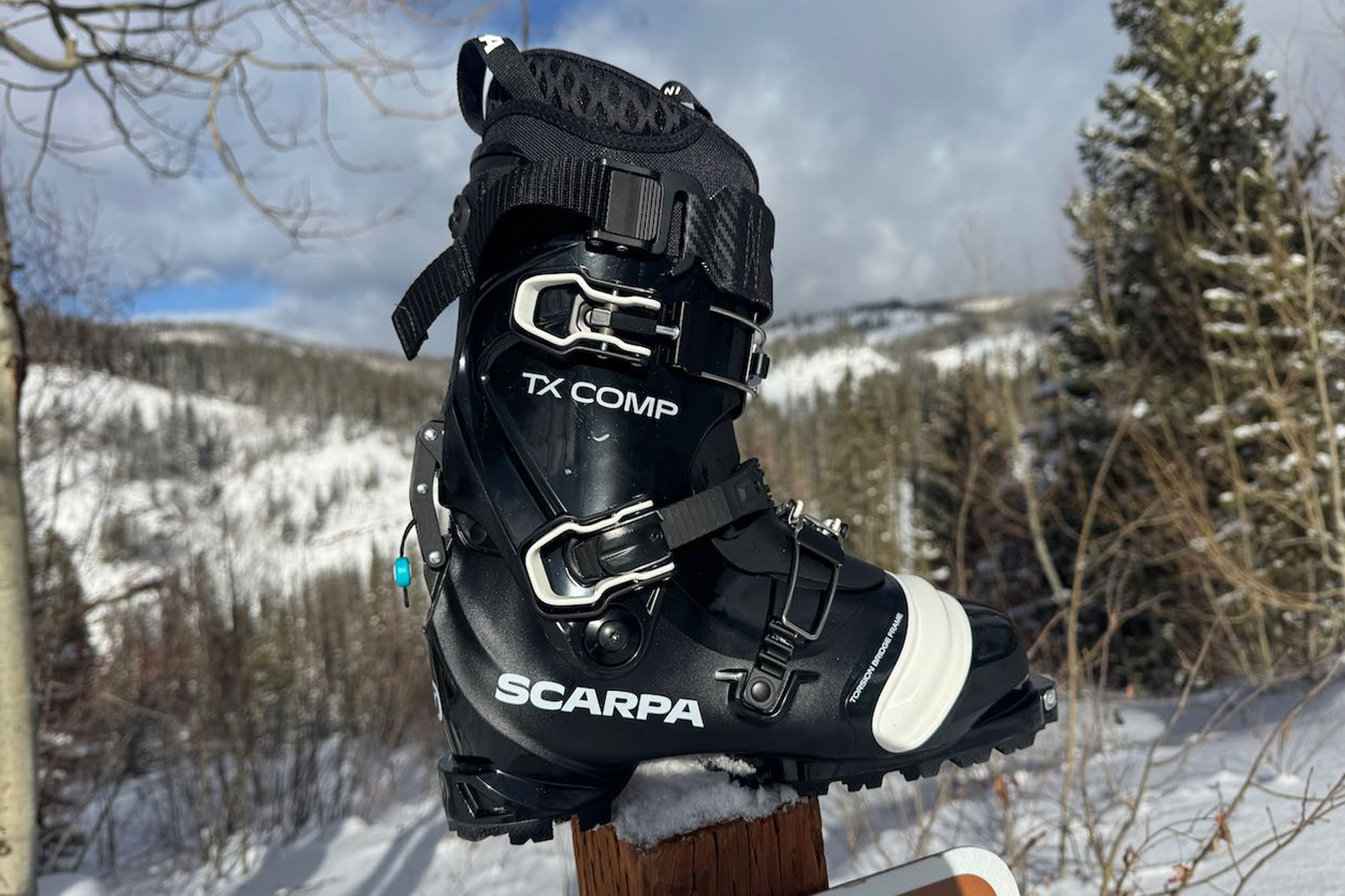
Fast forward 2 decades. Scarpa just released the next generation of Telemark boots, the TX Comp, after a decade-long dry spell. The TX Comp is easily the most advanced telemark boot ever created, which is an admittedly low bar. But if Scarpa’s bet pays off, these new boots could be the spark to reignite the delightfully weird skiing counterculture that offers a version of skiing closer to its roots than the modern-day downhill setup.
But here’s the thing: They have to fit well, ski great, withstand a decade of use, and work flawlessly with all the new telemark binding standards. I slipped my feet in and set off into the mountains to test them for myself.
Just when I thought telemark skiing might be fading into mythology, Scarpa may have pulled it back with this boot.
In short: The new TX Comp telemark boot follows Scarpa’s softer TX Pros from last year. The NTN and Tele-Tech compatible TX Comps utilize stiff triple-injected Pebax Rnew and a three-piece cabrio design for a smooth, stable flex. On the snow, the fit and tightening felt low-profile and comfortable, with minimal slop for precise turns. Most importantly, Scarpa integrated a refined walk mechanism for long days on the skin track. They’re a meticulously designed pair of boots designed for strong skiers on either side of the resort boundary.
Check out GearJunkie’s guide to the Best Ski Boots and the Best Backcountry Boots.
-
Versatile for resort or backcountry -
Excellent walk mode -
Consistently stiff cuff to toe -
Comfortable high end liner
-
Distinctly long break-in period -
Roomy for narrow feet
Scarpa TX Pro Telemark Boot Review
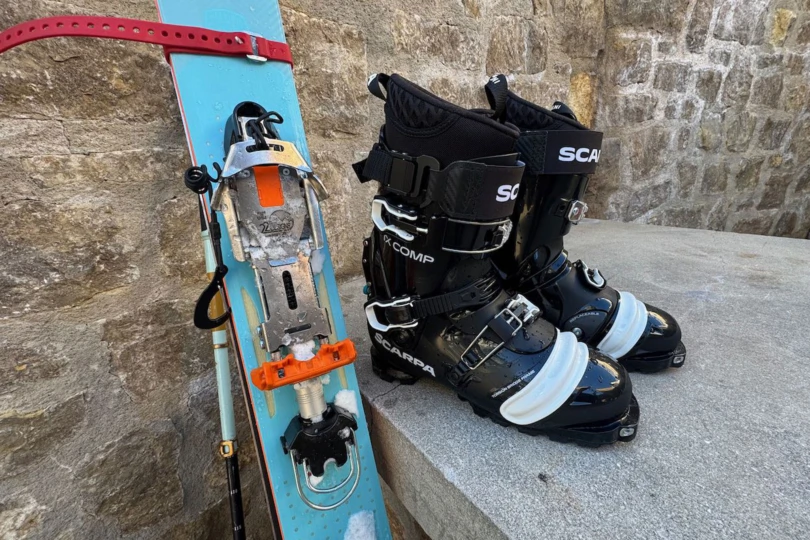
Most people know Scarpa from the ski touring world. Its Maestrale boot is one of the bestselling alpine touring boots of all time. But before the Maestrale, there was telemark. The brand launched the world’s first plastic telemark boot — the Terminator — in 1992, followed by the T2 in 1994 (A refreshed version of the T2 remains in Scarpa’s lineup).
Scarpa’s new TX Comp is actually the second Telemark boot the brand has released in the modern era — its revolutionary updated TX Pro relaunched last season after its original 2008 debut. The new TX Comp shares the same mold as the TX Pro. However, it’s decidedly stiffer in the cuff and bellows. It’s a harder-charging, resort-oriented option for larger skiers who like big, fast turns.
Fit
There’s a contingent of telemark skiers who are — and I’m serious here — only in it for the boots. Back in the day, it made sense. Tele boots have traditionally been pretty roomy and soft compared to alpine ski boots. With so few telemark boots on the market these days, Scarpa had a duty to uphold. An uncomfortable or poorly fitting boot could kill the sport altogether.
They didn’t squander the opportunity. Slipping into the TX Comps was blissful. The three-piece cabrio layout lends itself to a big, wide opening and minimal jerking. But like with the new Maestrales, Scarpa molded a heel pocket like they mean it. It took a stomp to force my heel in until they broke in fully.
Scarpa is one of the oddballs when it comes to Mondo sizing, and it’s worth noting. The brand’s shells break on the full size. So a 26.5 and a 27 are in the same shell. The 27s fit dang near perfectly for my 10/10.5 U.S. Men’s hooves.
I didn’t die immediately with my feet inside, which isn’t always the case. The heel pocket is the first thing you notice. It’s distinctly cup-shaped with a medium volume. But the rest of the shell was accommodating without being sloppy for my average-width feet. Its 102mm last has a solid all-rounder fit that should work for most crunchy tele skier feet, though they might feel roomy for narrow-footed skiers.
I quickly ditched the factory insoles and swapped in a Remind Remedy Impact 5.5MM Custom Arch Heat Moldable footbed. It made for a much more agreeable fit.
Build
Scarpamade the new TX Comp boots from the ground up with Pebax Rnew. It’s a castor-bean oil thermoplastic that the brand regularly uses in boots.
Tele skiing is all about smooth style. So Scarpa naturally went with a three-piece cabrio design that oozes smoothness like butter. They doubled down with triple injection molding, which allowed designers to more carefully control the boots’ flex pattern. Thicker areas are stiffer, while thinner zones are softer.
Buckles
Unlike a true fourth buckle like the original, the new TX Comps utilize three buckles and a camming power strap that essentially functions as a fourth buckle. The cuff and shell buckles are powerful yet lightweight and boast plenty of throw. I had no problem squeezing the life out of my feet with a couple of extra notches of tension.
The instep ratchet strap/buckle makes a real difference for performance. It pulls tension in just the right place to pull the heel and ankle into the heel pocket by pressing the tongue down. It’s a critical feature given the nature of tele turns. And I was psyched to see that it’s easily replaceable thanks to serviceable hardware.
Soles & Liners
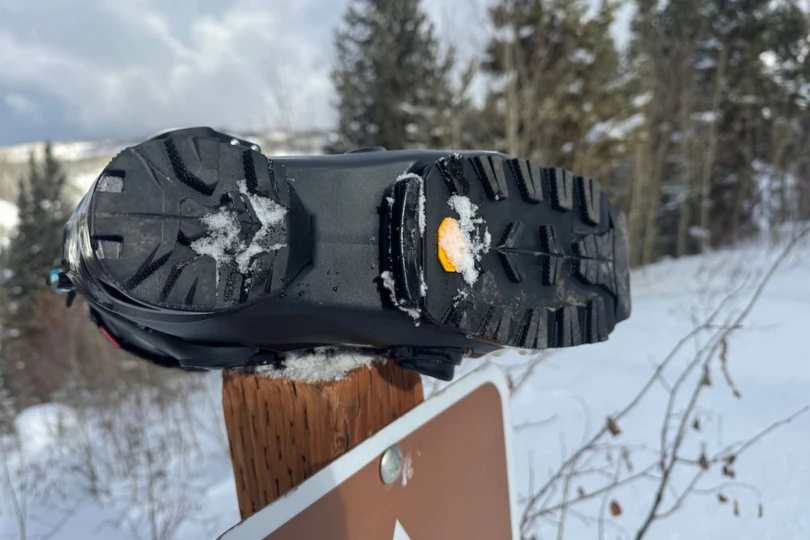
Migrating downward, the sole is distinctly burly. A Vibram EVO LT lugged sole delivered steadfast traction on snow, ice, and rock that backcountry skiers will most appreciate. It’s the icing on a versatile sole shape designed for modern tele bindings — more on that later, too.
Scarpa doesn’t skimp on liners. Each of its boots, including the TX Comps, comes stock with Intuition Pro Flex TK Comp heat-moldable liners. They’re some of the best in the game. They’re fully heat-moldable, though I usually forgo heat-molding unless I have a serious fit issue. Since the boots fit naturally, other than being satisfyingly tight, I broke them in the old-fashioned way, like the tele skiers of yore.
Walk Mode & Forward Lean
Scarpa’s best-in-class walk mode trickled into the TX Comp’s design. The cuff releases from the shell with the flip of a beefy lever at the back of the boot. When it’s open (after the liners are broken in), the articulation is massive and low friction. I can confirm that the full 62 degrees is available both forward and backward.
Integrated into the ski walk mechanism is a forward lean adjustment mechanism that gives skiers three options: 12 degrees, 14 degrees, and 16 degrees. I left it in the factory setting and called it good.
Binding Compatibility
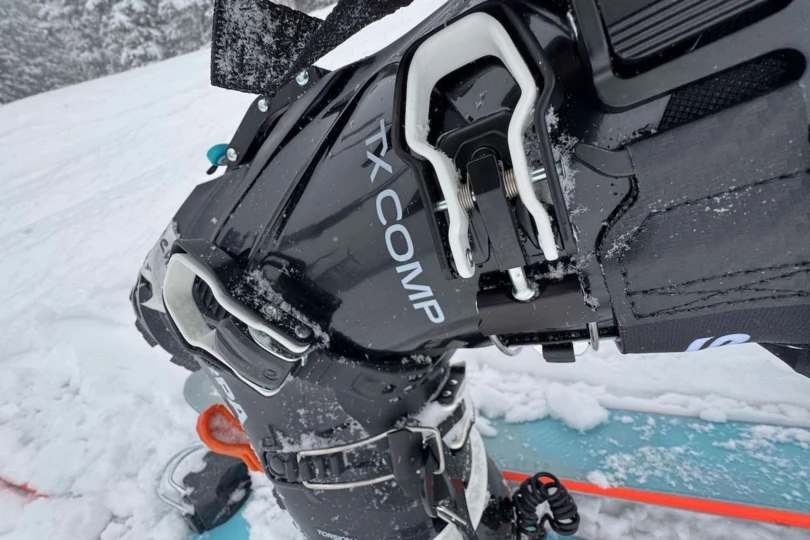
What was true a decade ago when I worked in a telemark and backcountry-focused ski shop remains true today: many newcomers to the sport assume that telemark boots are capable of alpine touring by default, given the flexing toe and the heel-releasing telemark turn. The new Scarpa TX Comp will further confuse those folks with the tech toes.
So, it’s worth diving into a few notes about modern tele bindings before we move on.
Binding Compatibility
Be assured, there is no overlap between this new boot and an alpine touring “tech” binding. For one, they don’t have heel slots to accept pins. And don’t try to cheat with a hybrid like the Marker Duke or Kingpin (your ACLs will never forgive you). Instead, the Scarpa TX comp is compatible solely with NTN (New Telemark Norm) or TTS (Tele-Tech) bindings.
No, they won’t work in your dad’s mousetrap bindings from the early ‘90s. And 75mm (aka duck bill) bindings are out of the picture, too.
NTN Bindings
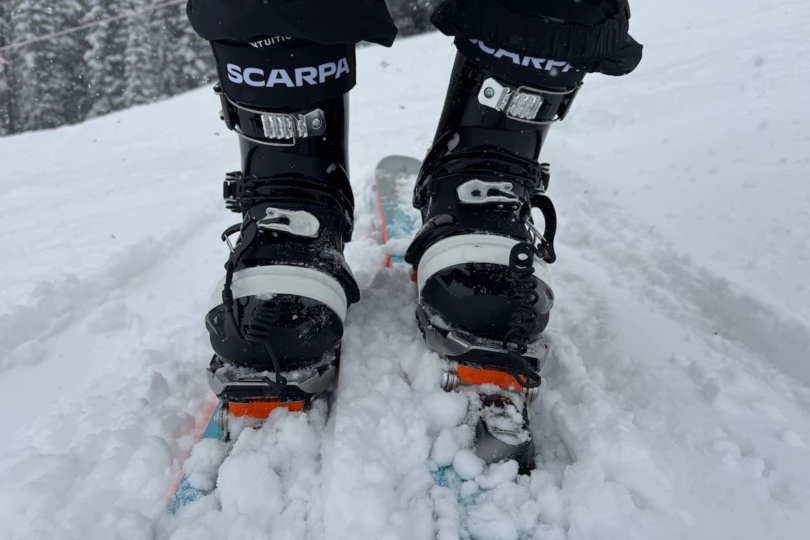
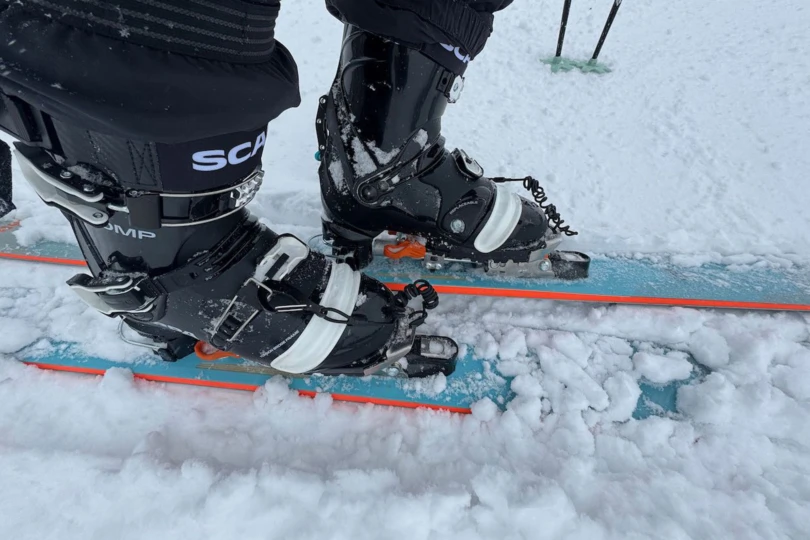
I paired the TX Comps with one of the best all-around bindings in the game, the 22 Designs Outlaw X. It’s a sturdy NTN binding designed for both resort and backcountry that perfectly complements the TX Comp’s intentions.
And that brings me to the next telemark paradox. Despite the free heel, not all telemark (even NTN) bindings are touring capable. 22 Designs’ Bandit, for example, is an NTN binding designed solely for lift-serviced skiing.
NTN Bindings like the Outlaw X offer a nice balance between flex for the turn and a full touring mode where the spring releases to accommodate friction-free touring strides. It’s a hybrid-style binding.
Tele-Tech Bindings
Tele-Tech bindings like 22 Designs’ Lynx fall more on the backcountry side of the spectrum. They connect via the TX Comp’s tech toe and offer an even better — and much lighter by 300 g per binding — touring experience.
Skiing the TX Comp
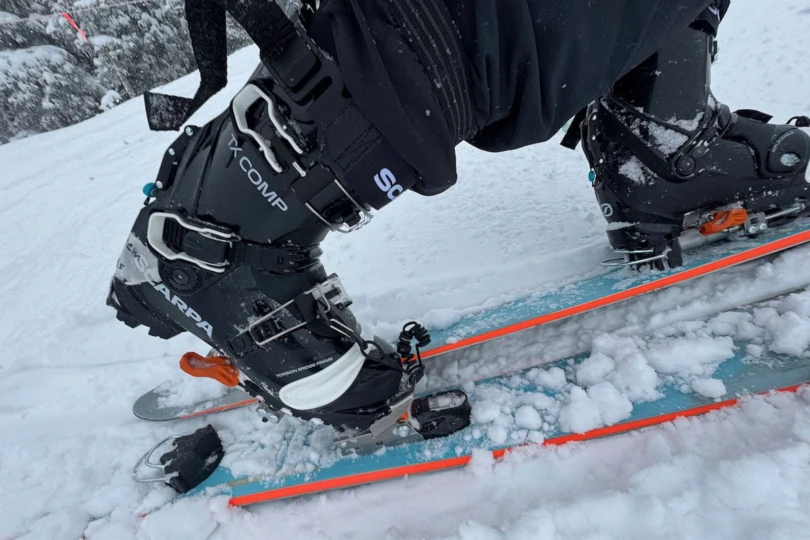
It took forever for the TX Comps to break in compared to most ski boots. I might as well have been in alpine boots on day one. Easily three or four days of skiing for them to feel like I was getting anywhere.
After six or seven, maybe they were genuinely broken in. But once the bellows continued to soften and the liners broke in naturally, it was game on. And yeah, you got me, the right boot broke in faster than the left boot because my early-season technique is garbage.
Smooth, Damp, and Stiff
The TX Comps are undeniably stiff boots, even for my 195-pound fast-skiing self. But they’re stiff in all the right ways that will satisfy the hard-charging skiers needing all the support they can get. And they manage to be stiff enough without losing their smooth flexing character.
But most importantly, they were consistently stiff throughout the boot. The bellows, cuff, and shell’s stiff, and simultaneously lively, flex patterns were well matched with each other. They just felt intuitive and consistent in each turn. The pressure on the back ski felt supported and natural. And there was a sturdy, damp cuff to drive pressure into when the bellows were fully compressed.
The boots’ torsional stiffness is what really impressed me. The boot endures an enormous amount of stress in each turn because so much leverage is applied to the front half of the boot. Lesser boots can hemorrhage energy. The boot’s stout lateral build, combined with a close fit, provided a more precise and consistent feel than the previous generation of tele boots.
The Outlaw X binding was, of course, a big part of that equation, too. It’s a stout, strong binding that matches or even exceeds the boot’s lateral stability.
Too Stiff?
Tele turns are a spectrum. The true knee-to-ski telemarkers could easily find that the TX Comps are too stiff for deep drops.
I find myself somewhere in the middle — cranking a few deep turns on open piste, but primarily skiing in a moderately stacked upright stance. For that purpose, the TX Comps worked naturally. I had to apply pressure to give the TX Comps the force they demanded to engage, but it wasn’t difficult to get there.
The beefy Intuition liner and cabrio flex profile made them easy to engage off the top, which subsequently helped leverage the cuffs into their deeper flex. My back foot felt stable and supported as it applied pressure to the outside edge. It provided a smooth, predictable, albeit very stiff, progression into that sweet, sweet tele turn.
But more importantly, at no point did I feel like the TX Comps were too soft for my tastes in the resort. I was able to push them to my limit in terms of power, which I’ll admit was a significantly lower threshold than the boots could match. Tele rippers who charge more than I do will be pleased with the TX Comps’ stout character.
On the flip side, the TX Comps would be challenging at first for a tele greenhorn. They require speed and committed pressure to engage them fully. They’d feel frustratingly upright for folks trying to wrap their heads and legs around the tele turn. That said, they provide plenty of muscle to “grow into” for alpine converts if they’re willing to muddle through a stiff introduction.
Scarpa TX Pro Telemark Boot: Conclusion
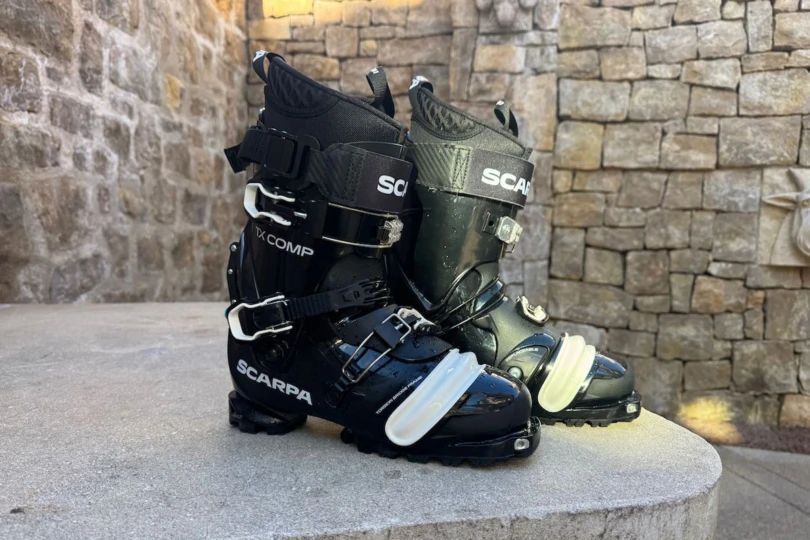
Right when the naysayers were content with a dying sport on the brink of extinction, kept alive solely by the faithful oddballs, dead set on the gloriously inefficient tele turn, a spark of innovation lit a fire. The new TX Comps are a major addition to the dwindling telemark boot options and a complementary brethren to the previously released TX Pro. The duo will undoubtedly dominate the tele boot market for years.
The TX Comp is a stiff tele boot designed for heavy resort use and the skin track alike. It manages to pack in heaps of muscle (aka Pebax Rnew) that give them a consistently stiff and stout flex. Its torsional support matches that of modern NTN bindings, such as the 22 Designs Outlaw X. Unlike its predecessors, it achieves an outstanding walk mode, comparable to modern AT boots, and boasts a relatively svelte 1,545g weight.
The TX Comps are the new standard for stiff, aggressive telemark boots. Did I mention that they’re stiff? That makes them a stellar companion for strong tele skiers who like to push their gear to the limit. They’re also a great option for tele skiers who primarily arc turns at the resort, even though they have no issues pulling double duty in the backcountry.
With the introduction of the TX Comp, the reverse becomes true for the TX Pros — a slightly softer backcountry-forward boot that can naturally pivot to the resort. And for the classic old-school diehard knee-to-ski tele skiers out there, the 75mm-compatible T2 ECO is running strong because duckbills are forever.
Love it or hate it, the TX Comp proves telemark isn’t done evolving, and this ski form is here to stay. If that’s enough to tempt you back or to finally try the tele turn for yourself, well, drop a knee and let it rip.
Read the full article here