



Close Menu
Tactical AmericansTactical Americans
  • Home
  • Guns
  • Knives
  • Gear
  • News
  • Videos
  • Community

Subscribe to Updates

Get the latest tactical, firearms and many more news and updates directly to your inbox.

What's Hot

Active shooter reported at Brown University

Dec 13, 2025 5:15 pm

What Did Sherrone Moore Allegedly Do? Everything We Know About the Ex Michigan Football Head Coach's Arrest By Jordana Comiter 12

Dec 13, 2025 5:09 pm

Israel kills senior Hamas official Ra’ad Sa’ad, Oct. 7 architect in Gaza

Dec 13, 2025 4:11 pm
Facebook X (Twitter) Instagram
Saturday, December 13, 2025 5:36 pm EST
Trending
  • Active shooter reported at Brown University
  • What Did Sherrone Moore Allegedly Do? Everything We Know About the Ex Michigan Football Head Coach's Arrest By Jordana Comiter 12
  • Israel kills senior Hamas official Ra’ad Sa’ad, Oct. 7 architect in Gaza
  • Trump vows ‘very serious retaliation’ after ISIS kills US soldiers in Syria
  • 2 Women and a Service Dog Killed in Penn. Machete Attack: 'Callers Reported Screams, Visible Blood,' Police Say By Escher Walcott
  • ZeroTech Vengeance 6–24×50 Riflescope Gets R3 Reticle Options
  • Family finds grandfather’s remains in basement decades after he vanished
  • Trio Wore Masks and Face Paint — Then Opened Fire in Grocery Stores, Killing 28 People, Including Children By Christina Coulter
  • Privacy
  • Advertise
  • Contact
Facebook X (Twitter) Instagram Pinterest VKontakte
Tactical AmericansTactical Americans
  • Home
  • Guns
  • Knives
  • Gear
  • News
  • Videos
  • Community
Newsletter
Tactical AmericansTactical Americans
Home » Vought OS2U Kingfisher: Ugly, Slow and Indispensable
Guns

Vought OS2U Kingfisher: Ugly, Slow and Indispensable

newsBy newsDec 13, 2025 11:24 am1 ViewsNo Comments
Facebook Twitter Pinterest LinkedIn Tumblr WhatsApp
Vought OS2U Kingfisher: Ugly, Slow and Indispensable
Share
Facebook Twitter LinkedIn Pinterest Email


By Will Dabbs, MD

Posted in
#History

What was the most important American warplane used in the Pacific Theater during World War II? The P40 Warhawk equipped the American Volunteer Group — the vaunted Flying Tigers — to stand against the Japanese when no one else could. The SBD Dauntless turned the tide at Midway. The F4F Wildcat held the line at Guadalcanal. Navy aviators in Hellcats slaughtered Japanese pilots by the thousands, while the B-29 Superfortress finally delivered the coup de gras.

All of those combat aircraft played a major role in our ultimate victory over the Japanese. However, one of the most important planes of the war sported a 450-horsepower engine and a cruise speed of 152 mph. The Vought OS2U-3 Kingfisher floatplane carried a pilot and a single gunner/radio operator. It was armed with but two M1919 Browning .30-caliber machineguns. It was old, slow, and ugly at the outset of the war.

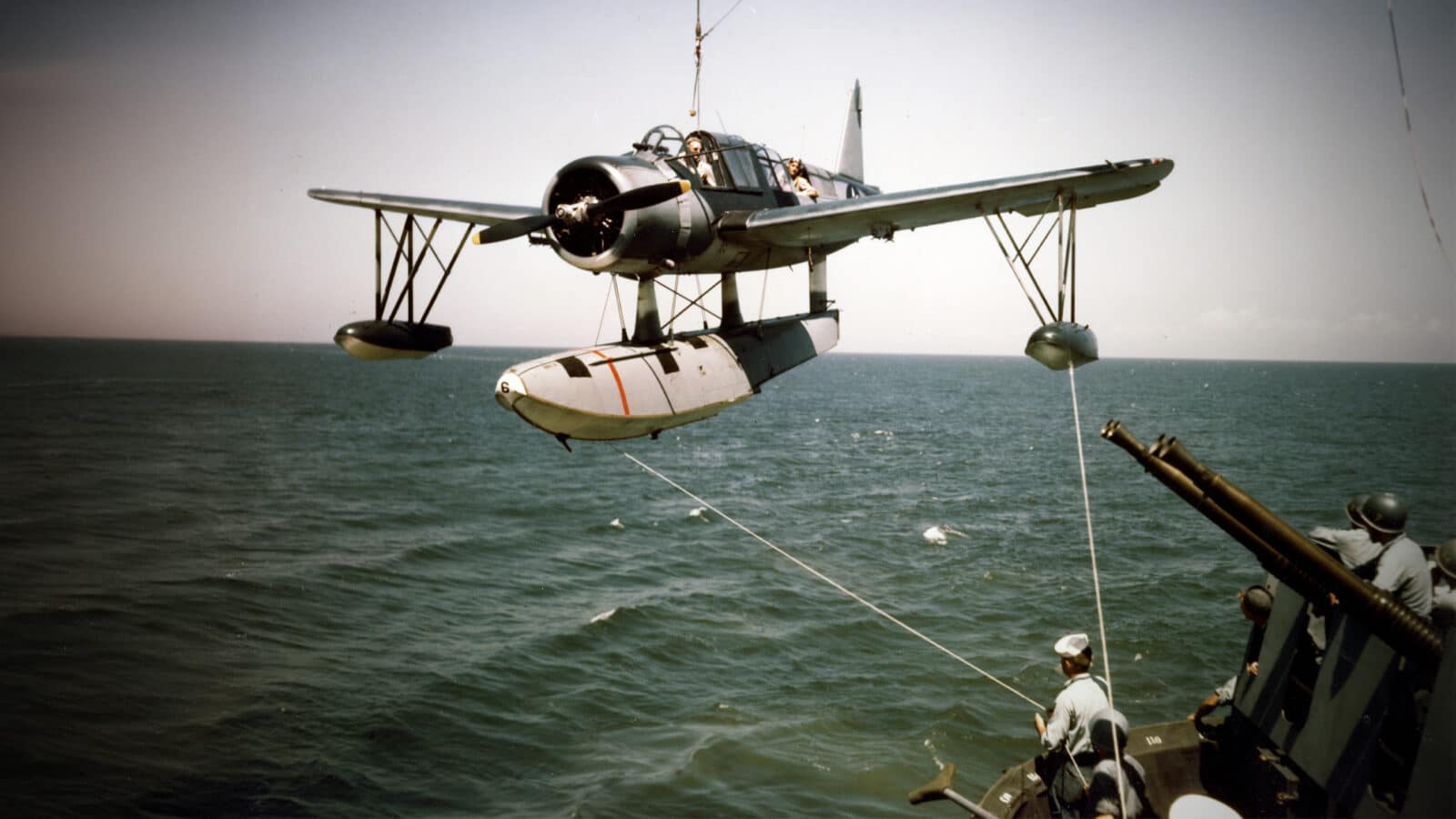
A Vought OS2U Kingfisher floatplane from squadron VSU-2 flies low over ocean waters with its large central float and wing-mounted stabilizing floats clearly visible beneath the aircraft, showing the distinctive radial engine cowling and enclosed tandem cockpit configuration typical of wartime naval observation aircraft. The Vought OS2U Kingfisher performed reconnaissance missions. Kingfisher floatplanes operated at low altitudes. Naval observation squadrons flew patrol sorties. OS2U aircraft featured Pratt Whitney radial engines. Kingfisher floatplane crews conducted search operations. Floatplane designs enabled water landings. Vought OS2U Kingfishers served multiple nations. Shipboard spotter planes patrolled coastal areas.

However, the Kingfisher served as the eyes for American battleships while also rendering vital service in the search and rescue role. Kingfisher crews spotted the fall of heavy shot and rescued stranded Americans. The OS2U was one of the most pivotal planes of the war.

Radial-Powered Angel

Eddie Rickenbacker was the most successful American fighter ace of World War I. He shot down 26 enemy aircraft while flying French-built Nieuport and Spad fighters. Rickenbacker returned home after the war a hero and was later awarded the Medal of Honor.

Maintenance personnel work on a Vought OS2U Kingfisher floatplane at a Brazilian naval air base with mechanics attending to the exposed Pratt & Whitney radial engine and inspecting the landing gear assemblies, showing the aircraft supported on maintenance stands with engine cowling removed and tools scattered around the work area during routine service operations in 1945. The Vought OS2U Kingfisher required regular maintenance intervals. Kingfisher floatplanes operated from shore bases. Naval mechanics serviced observation aircraft. OS2U engines needed careful attention. Kingfisher floatplane maintenance supported mission readiness. Ground crews worked in austere conditions. Vought OS2U Kingfishers deployed to Allied nations. Radial engines demanded skilled technicians.

Eddie Rickenbacker was too old to fight in World War II. However, he nonetheless used his celebrity status to support the war effort. Though originally an isolationist, when it became obvious that the Axis was never going to stop, he went all-in for Great Britain.

The Vought OS2U Kingfisher observation floatplane wallows in Truk lagoon waters with its fuselage and floats nearly submerged under the weight of nine rescued airmen, the aircraft unable to achieve takeoff due to excessive load after successfully recovering carrier pilots shot down during the Allied assault, now taxiing toward the waiting USS Tang submarine for final rescue transfer. Kingfisher floatplanes exceeded normal capacity. The Vought OS2U Kingfisher enabled risky rescues. Observation aircraft operated near enemy positions. OS2U structural strength proved remarkable. Kingfisher floatplane missions saved countless aviators. Naval aviation prioritized aircrew recovery. Vought-built planes demonstrated versatility. Lifeguard submarines coordinated with floatplanes.

In 1942, US Secretary of War Henry L. Stimson gifted Rickenbacker the use of a B-17D Flying Fortress and asked him to tour air bases in the Pacific Theater. His mission was to asses conditions, offer support, and deliver a secret message to General Douglas MacArthur.

A U.S. Navy crewman stands in the rear cockpit of a Vought OS2U-3 Kingfisher floatplane demonstrating the flexible-mounted .30-caliber Browning machine gun on its Scarff ring mount, with the gunner positioned behind the pilot's compartment showing how the defensive weapon could traverse to cover various angles during patrol and observation missions in 1941. The Vought OS2U Kingfisher carried two crew members. Kingfisher floatplanes featured defensive armament. Naval observation aircraft employed radio operators. OS2U gunners managed multiple responsibilities. Kingfisher floatplane crews conducted dangerous missions. Rear cockpit positions offered limited protection. Vought OS2U Kingfishers emphasized reconnaissance over combat. Browning machineguns provided defensive capability.

Unbeknownst to the crew, however, the bubble octant used for navigation onboard the plane had been damaged onboard a different plane in a hard landing. This defective device was then installed on Rickenbacker’s Fortress prior to a leg destined for Canton Island. The broken octant introduced a systematic bias to all of the navigator’s readings. The big plane subsequently wandered badly off course and ran out of fuel over open ocean.

The Vought OS2U-3 Kingfisher observation floatplane sits in the water near USS Baltimore's stern with radioman Hickman visible on the aircraft's wing working to secure the hoisting attachment points while the cruiser prepares to lift the plane and its crew aboard following their successful combat rescue of a carrier pilot shot down during the major Allied assault on the heavily fortified Japanese base at Truk in February 1944. Kingfisher floatplanes performed documented rescues. The Vought OS2U Kingfisher enabled crew recovery. Observation aircraft operated under fire. OS2U radiomen handled recovery procedures. Kingfisher floatplane missions saved experienced pilots. Naval cruisers supported aviation operations. Vought-built planes conducted combat SAR. Recovery operations required skilled crewmen.

Rickenbacker and seven Army crewmen survived the ditching and subsequently drifted thousands of miles in tiny life rafts. Everyone but Rickenbacker had been injured to one degree or another in the crash. They ran out of food after three days.

A Vought OS2U-3 Kingfisher floatplane flies patrol above a merchant convoy formation in the Atlantic Ocean with multiple cargo vessels visible below on the water surface, the observation aircraft conducting anti-submarine surveillance operations with its distinctive central float and radial engine clearly visible as it maintains watch over the vulnerable supply ships during World War II. The Vought OS2U Kingfisher conducted anti-submarine patrols. Kingfisher floatplanes protected merchant convoys. Naval observation aircraft hunted U-boats. OS2U crews carried aerially-delivered depth charges. Kingfisher floatplane missions included convoy escort. Atlantic Theater operations utilized spotter planes. Vought OS2U Kingfishers served in multiple theaters. Maritime patrol aircraft defended shipping lanes.

On day eight, a tern landed on Rickenbacker’s head. The WWI ace grabbed the bird, and the starving men ate it raw. They used whatever they couldn’t eat as bait to catch small fish.

One man died of exposure, and the survivors split up. However, on day 24, Rickenbacker and his fellow survivors heard the characteristic drone of a radial airplane engine approaching in the distance. The crew of a Vought OS2U-3 Kingfisher patrol plane had spotted them adrift at sea and landed.

Live The Armory Life. The latest content straight to your inbox plus an automatic entry to each of our monthly gun giveaways!

Rickenbacker lost 40 lbs. during the ordeal. However, following a few days’ rest, he resumed his journey and delivered his message to MacArthur. He was also personally responsible for the inclusion of basic fishing tackle with American aviators’ survival gear, something that continues to this very day. The ugly, slow airplane that effected his rescue was an unsung hero of the Second World War.

Origin Story

Developed by Vought engineer Rex Bessel in the 1930s the OS2U Kingfisher was an all-metal monoplane that could be configured for either land or sea operations. Bessel was later chief engineer for the F4U Corsair, the first fighter aircraft capable of sustaining 400 mph in level flight while fully loaded. The Kingfisher was to be a versatile utility plane capable of operation in some of the world’s most unforgiving environments.

A Vought OS2U Kingfisher floatplane sits on a concrete seaplane ramp at the Nukualofa base in Tongatabu with palm trees and tropical vegetation visible in the background, showing the aircraft positioned between water operations and shore facilities at this South Pacific island outpost during the critical early months of the Pacific War in June 1942. The Vought OS2U Kingfisher operated from island bases. Kingfisher floatplanes used seaplane ramps. Naval observation aircraft deployed to remote locations. OS2U operations required minimal infrastructure. Kingfisher floatplane bases supported reconnaissance missions. Pacific Theater facilities hosted spotter planes. Vought OS2U Kingfishers patrolled vast ocean areas. Shore-based floatplanes extended operational reach.

The Kingfisher incorporated a variety of advanced concepts in its design. It was the first production aircraft to be constructed via spot welding, a process that created a smooth surface to minimize drag and resist mechanical deformation. Deflector plate flaps and drooping ailerons along with carefully designed spoilers increased lift and improved low-speed handling, critical features for the sorts of missions the Kingfisher was expected to perform. The plane was powered by a Pratt & Whitney R-985-4 Wasp Junior radial engine. A larger version of this same powerplant drove such planes as the T6 Texan.

Student naval aviators observe and practice with the rear-mounted .30-caliber machine gun aboard a Vought OS2U Kingfisher observation floatplane during flight training, with cadets learning how to operate the Scarff ring mount that allowed 360-degree traverse while also understanding the dual responsibilities of gunnery and radio communication that rear seat crewmen would handle during actual operations. Kingfisher floatplanes demanded comprehensive training. The Vought OS2U Kingfisher equipped training squadrons. Observation aircraft required specialized crew skills. OS2U gunners trained extensively. Kingfisher floatplane instruction covered multiple disciplines. Naval flight schools emphasized readiness. Vought-built trainers prepared combat crews. Defensive armament required proficiency.

The pilot was afforded a single .30-caliber Browning machinegun mounted low on the right side of the cockpit and synchronized to fire through the propellor arc. The pilot’s weapon was situated between the cylinder heads on the engine and carried 500 rounds. The rear gunner had another .30-caliber machinegun with 600 rounds on a Scarff ring mount. The Kingfisher could also carry a pair of small 100-lb. general purpose bombs or two 325-lb. aerially delivered depth charges. 1,519 airframes saw service.

Applications

The Kingfisher was well-established in US naval service by the onset of war. While the plane was used in a variety of roles, its most effective was as a shipboard spotter plane aboard American battleships and both light and heavy cruisers. What made the Kingfisher so effective was its means of launch and recovery.

Multiple Vought OS2U Kingfisher floatplanes fly in tight V-formation against a cloudy sky with their distinctive central floats and radial engines clearly visible, demonstrating the coordinated flight training conducted by U.S. Navy observation squadrons during the pre-war period around 1940 when these aircraft were being integrated into fleet operations before America's entry into World War II. The Vought OS2U Kingfisher trained in peacetime. Kingfisher floatplanes flew formation exercises. Naval observation squadrons practiced coordination. OS2U units prepared for war. Kingfisher floatplane pilots developed proficiency. Pre-war aviation emphasized readiness. Vought OS2U Kingfishers entered service early. Formation flying required skilled aviators.

These heavy battlewagons were equipped with a pair of steam catapults on their sterns, each of which could manage a single Kingfisher. These catapults launched the ungainly planes over a very short distance. Once the mission was complete, the warship would make a long, slow turn to create a flat space in its wake. The Kingfisher pilot would then land his plane in the relatively still water and taxi up to the stern of the ship. The vessel towed something called a sea sled that rode just below the water’s surface. Once secured atop the sled, a hoist on the deck lifted the plane and crew back up into position. This allowed the battleship commander access to a bird’s-eye view of the tactical situation.

Ground crew members work to secure yellow-painted practice bombs beneath the wings of a Vought OS2U Kingfisher observation floatplane with the distinctive training ordnance clearly visible against the aircraft's darker fuselage, demonstrating the weapons training conducted at naval air stations where pilots practiced attack runs before transitioning to live 100-pound general purpose bombs or 325-pound depth charges for actual missions. Kingfisher floatplanes conducted bombing exercises. The Vought OS2U Kingfisher accommodated external stores. Observation aircraft trained for offensive missions. OS2U hardpoints carried various munitions. Kingfisher floatplane versatility included light attack. Naval aviation emphasized combat readiness. Vought-designed planes featured weapons capability. Practice ordnance enabled skill development.

The kingfisher was a fair-weather machine. Rough seas made recovery difficult. However, the vantage afforded by the Kingfisher crews linked to the ship via radio allowed accurate gunnery against both ship and shore targets. Particularly when combined with radar, the Kingfisher maximized the effectiveness of American battlewagons. The 16-inch rifles mounted on these massive ships accurately fired shells that weighed more than a VW Beetle out to 24 miles when properly spotted.

Denouement

The Kingfisher was used by the militaries of 10 different nations. Only eight examples survive today, none of which are flyable. The Steven F. Udvar-Hazy Center of the National Air and Space Museum at Dulles International in Washington DC has one. The Naval Aviation Museum in Pensacola sports another.

Navy personnel manually push and guide a Vought OS2U Kingfisher floatplane out of its protective hangar at a naval air station with multiple sailors positioned around the aircraft's wings and fuselage to carefully maneuver the observation plane on its wheeled dolly, showing the labor-intensive ground handling operations required to move these floatplanes during the early months of American involvement in World War II between January and May 1942. The Vought OS2U Kingfisher required ground support crews. Kingfisher floatplanes needed careful handling. Naval air stations maintained observation aircraft. OS2U operations involved extensive preparation. Kingfisher floatplane hangars protected aircraft. Ground crews enabled flight operations. Vought OS2U Kingfishers operated from shore bases. Manual aircraft movement was standard procedure.

There is a Kingfisher on display with the USS North Carolina museum ship in Wilmington, NC. This example was recovered in 1963 from a crash site in Calvert Island, British Columbia. Volunteers at Vought restored the plane before gifting it to the battleship museum in 1971. There is also a restored Kingfisher originally sourced from Mexico included in the extensive aircraft collection on display at the battleship Alabama memorial in Mobile. I recall being impressed with this machine when I saw it perched on the stern of the big battleship as a kid. It is housed indoors today.

A fully restored Vought OS2U Kingfisher sits on display stands in pristine condition with its bright yellow-orange paint scheme, large central float, and polished metal surfaces gleaming before installation aboard the USS North Carolina battleship museum, showing the complete aircraft with propeller, cockpit canopy, and tail assembly after volunteer restoration work completed in 1971. The Vought OS2U Kingfisher served ten different nations. Kingfisher floatplanes required extensive restoration efforts. Naval observation aircraft faced postwar neglect. OS2U examples became rare museum pieces. Kingfisher floatplane survivors number only eight. Battleship museums preserve naval aviation history. Vought OS2U Kingfishers demonstrate wartime innovation. Restored floatplanes educate modern visitors.

Fighters and bombers get all the press, because they are fast, powerful and sexy. However, sometimes the most important military machines are also the most humble. Nothing really works if you can’t keep the grunts fed, the weapons supplied, and everything pointed in the proper direction.

The Vought OS2U Kingfisher provided a vital service during World War II, something that could not have been done by any other machine. In so doing, the ungainly plane helped win the war for the Allies.

Editor’s Note: Please be sure to check out The Armory Life Forum, where you can comment about our daily articles, as well as just talk guns and gear. Click the “Go To Forum Thread” link below to jump in and discuss this article and much more!

Join the Discussion

Go to forum thread

Read the full article here

Share. Facebook Twitter Pinterest LinkedIn Tumblr Email

Related Posts

First Look: XS Sights for Diamondback SDR and Walther PDP

First Look: Taurus Raging Hunter In .350 Legend

Shinenyx G1A Review: Merging Thermal and NV

First Look: Sons of Liberty Gun Works Special USMC-Finish Rifles

I Carry: Springfield Armory Echelon Compact 9 mm Pistol in a Mission First Tactical Holster

Marlin 1894 Trapper Review: Testing The 10mm Lever Gun

Unique Bullet Designs That Work

Concealed Carry at Work

St. Louis County Police Department Adopts Springfield Armory Echelon Pistol

Add A Comment
Leave A Reply Cancel Reply

Editors Picks

What Did Sherrone Moore Allegedly Do? Everything We Know About the Ex Michigan Football Head Coach's Arrest By Jordana Comiter 12

Dec 13, 2025 5:09 pm

Israel kills senior Hamas official Ra’ad Sa’ad, Oct. 7 architect in Gaza

Dec 13, 2025 4:11 pm

Trump vows ‘very serious retaliation’ after ISIS kills US soldiers in Syria

Dec 13, 2025 4:10 pm

2 Women and a Service Dog Killed in Penn. Machete Attack: 'Callers Reported Screams, Visible Blood,' Police Say By Escher Walcott

Dec 13, 2025 4:08 pm

Subscribe to Updates

Get the latest tactical, firearms and many more news and updates directly to your inbox.

Latest News

ZeroTech Vengeance 6–24×50 Riflescope Gets R3 Reticle Options

By Jack Bogart

Family finds grandfather’s remains in basement decades after he vanished

By Jack Bogart

Trio Wore Masks and Face Paint — Then Opened Fire in Grocery Stores, Killing 28 People, Including Children By Christina Coulter

By Jack Bogart
Tactical Americans
Facebook X (Twitter) Instagram Pinterest YouTube
  • Privacy Policy
  • Terms of use
  • Press Release
  • Advertise
  • Contact
Copyright © 2025 Tactical Americans. Created by Sawah Solutions.

Type above and press Enter to search. Press Esc to cancel.