




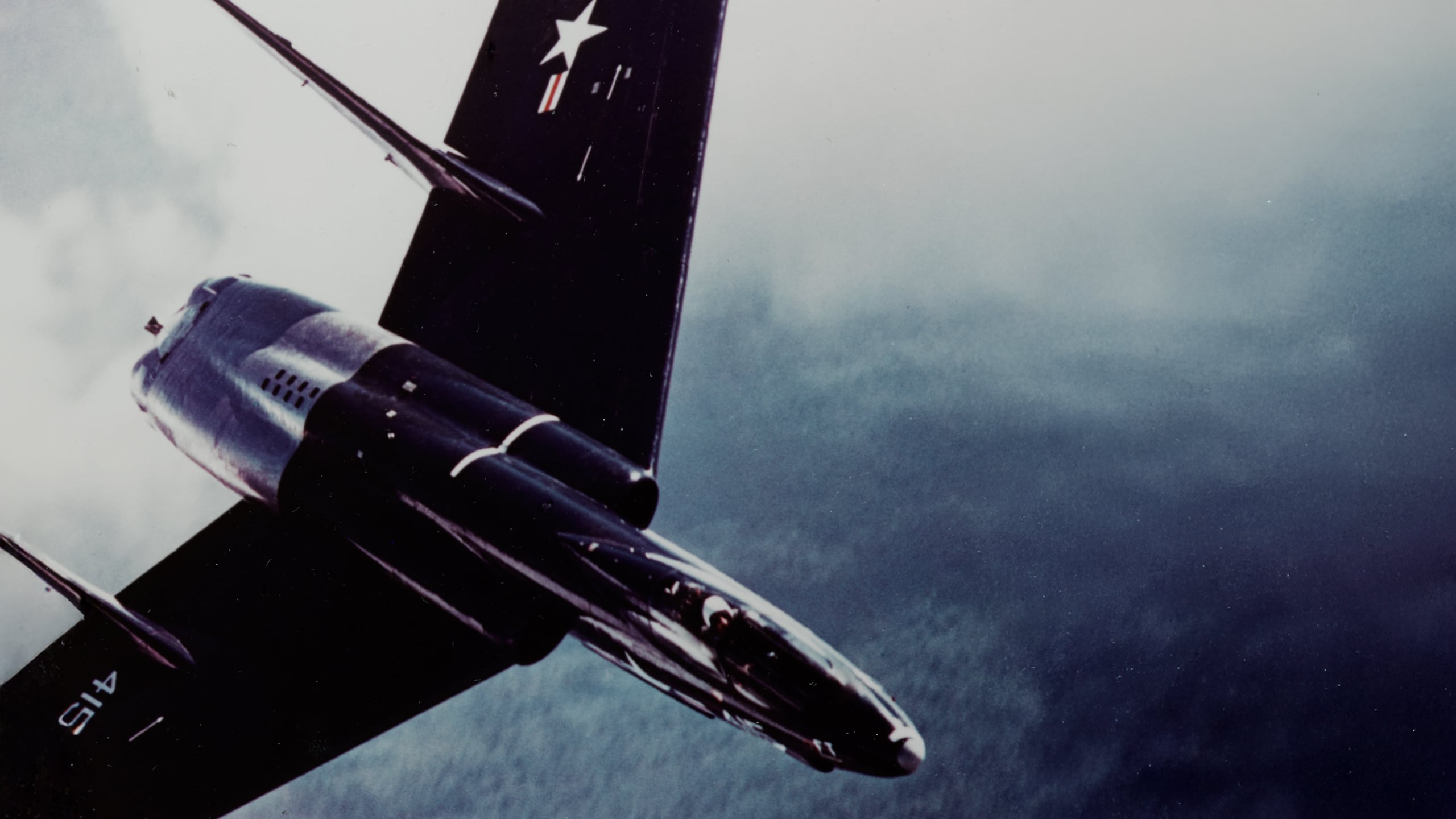
For some, the Vought F7U Cutlass was an innovative jet fighter set to propel the U.S. Navy into air dominance during the Cold War. For many others, the F7U “Gutless” lacked the power to make it a formidable weapon. In fact, some pilots observed that the aircraft’s poor safety record virtually guaranteed the plane was as much a danger to the U.S. Navy as it was to the enemy.
What made the Cutlass a unique design? And what went so wrong that the plane was removed from service after less than a decade of use?
Origins of the Navy’s Tailless Fighter
Development of the F7U Cutlass began in 1945. The world had entered the Jet Age, and the U.S. Navy needed a fighter to dominate the skies in the new era. Respected engineer Rex Beisel had plans for a new swept-wing fighter with an unconventional tailless design. With Vought as the manufacturer, the new fighter was sure to be exactly what the Navy needed.

Beisel was an experienced engineer who had previously delivered the TS-1 biplane: the first fighter built to U.S. Navy specifications. After that, he produced a number of innovative designs including the F8C Helldiver and SB2U Vindicator. His most successful design was the famous F4U Corsair.

Somewhat surprisingly, Operation Paperclip came into play during the development of the F7U. Under this controversial program, German engineer Woldemar Voigt was relocated to the United States at the end of World War II. His experience in the development of the Me 262 jet fighter, Me 264 strategic bomber and the Me 163 Komet helped land him a position with Vought.

It is likely that Voigt’s experience with the development of the Messerschmitt P.1110 and Messerschmitt P.1112 fighters landed him on the F7U project. Both the P.1110 and P.1112 were swept-wing jets using a tailless design — features shared with the Cutlass.

The plane’s design eliminated a traditional horizonal tail. Instead, the aircraft used large, swept wings with a pair of vertical fins: one located on each of the wings. The plane used two Westinghouse J34 turbojets installed along the fuselage of the Cutlass.

Without a doubt, the F7U Cutlass had a sleek, modern look perfectly suited for the times. It was the embodiment of America’s ambitions to rule the sky and reach for planets beyond. Unfortunately, the plane’s performance did not live up to its styling.
Cutlass Performance
The initial Cutlass, dubbed the F7U-1, was to be fast with excellent handling characteristics and a rapid ascent capability. However, early engines were underpowered for the design. New engines were delayed, and the project was almost canceled due, in part, to engine issues. Dubbed the “Gutless” by pilots, raw power wasn’t the plane’s only problem.

Additional problems included issues with the high-pressure hydraulics system, landing gear and airframe strength. On numerous flights, the hydraulics blew out causing a loss of controls. On at least one occasion, the airframe broke in half during a carrier landing. Several test pilots died in the F7U-1.
Eventually, Westinghouse delivered the higher thrust J46 turbojets which could push the Cutlass past the sound barrier. With the new engines, some believed that the Cutlass could best the Navy’s FJ-2 Fury and F9F-6 Cougar in a head-to-head dogfight. Combined with an improved airframe and other tweaks, the F7U-3 was born.

Nevertheless, more than a few pilots felt the plane was still underpowered, which created problems during maneuvers and landings. Westinghouse promised the J46 engines would deliver 10,000 pounds of thrust each. Instead, the delivered engines provided closer to an anemic 6,000 pounds. While more powerful than the J34, they provided substantially less power than needed.
Some pilots, however, liked the capabilities of the newer F7U-3. The improved airframe is said to have been very strong. In the air, the plane was nimble — if underpowered — with a significantly faster roll rate than most other jets. Potentially, this would make the Cutlass a capable plane in a dogfight given enough thrust.

Live The Armory Life. The latest content straight to your inbox plus an automatic entry to each of our monthly gun giveaways!
None of the original F7U-1 fighters made it to service. Almost 300 F7U-3 and -3M fighters did enter service.
Engines Flame Out When Shooting Your Guns
The Cutlass was the first operational Navy fighter that was armed with the Sparrow air-to-air missiles. While other Navy planes would soon be equipped with the same missiles, it did further the F7U’s cutting-edge mystique.

Additional armament included four AN/M3 20mm cannons. On the F7U-1 model, the autocannons were mounted in the fuselage, below the pilot. As the cockpit is forward on the Cutlass, you could say the guns were in the plane’s nose.
With the redesign, the guns on the F7U-3 were moved to the top of the engine fairings above the intake. This created a new problem: when the guns fired, the engines would flame out. Test pilots, including future astronaut John Glenn, reported that the muzzle blast from the 20mm cannons interfered with the engine’s performance and caused flameouts.

It appeared that smoke from the 20mm guns was sucked into the jet engine and caused the flameout. Marine Col. George M. Chinn, the designer of the Mk 19 grenade launcher and an expert on automatic weapons, developed a solution: vents. Potentially inspired by the Cutts compensator used on the Thompson SMG, the vents allowed the smoke to escape from the top of the intake before causing engine failure.
Ship Captains Didn’t Like the Cutlass
In the spring of 1954, the F7U Cutlass entered active duty. Research shows the Vought fighter was assigned to 13 squadrons. Almost immediately, there were problems. Stalls and nose gear issues were relatively common.

In one incident, the nose gear broke free and drove upward into the cockpit during landing. Entering the cockpit, the strut caused the ejection seat to fire. As the nose of the plane was now down, the pilot was not launched up, but forward into the vertical stabilizer of another aircraft. He would eventually die of those injuries.
In July 1955, several Cutlass aircraft encountered issues during carrier qualifications aboard the Essex-class aircraft carrier USS Hancock (CV-19). In the worst of the incidents, an F7U came in too low and exploded into a giant fireball when striking the ramp at the end of the deck. Along with the pilot, three sailors on the ship were killed in the conflagration. It is believed that the pilot was unable to get enough engine thrust during the approach to gain the few feet needed to prevent the crash.

The problems with the Cutlass were so pervasive that the captains of the Hancock and the USS Ticonderoga (CV-14) would order the planes off their ships.
Even the Blue Angels Couldn’t Make Them Work
When the Blue Angels were reactivated in 1951, there was some push to have the team fly the F7U-1 fighters. There was a belief, probably by those who had never flown the plane, that the Cutlass needed to be more visible to the public. As a result, two of the -1 models were delivered to the team. Not part of the normal demonstration team, the planes were used for supplementary demos.

Unsurprisingly, there were incidents.
On one occasion, a Blue Angels Cutlass dropped a landing gear door while the pilot was flying over the crowd. The door dropped right onto the grandstand. Miraculously, no one was injured.

In another instance, a pilot experienced a loss of hydraulics mid-demonstration. Too low to eject, he managed to fly the plane through some trees toward the runway. Some combination of luck, skill and divine intervention allowed him to land without injury.
The team eventually abandoned the Cutlass planes.
Final Thoughts
The Cutlass assumed active duty in 1954. In less than five years, the Navy seemingly couldn’t get rid of them fast enough. A contract for a ground attack version of the plane was canceled, and the fighters were doled out to schools and cities under the guise of promoting interest in aviation. Frankly, it seems the Navy just wanted them gone.

An analysis of the F7U indicated that roughly ¼ of all Cutlass airframes were lost in accidents. Although I’ve not seen the raw data, it has been said that the Vought F7U had the highest accident rate of any swept-wing fighter employed by the U.S. Navy.
I wonder how a similar design would fare with modern technology. With computer-assisted, fly-by-wire designs and more powerful engines, the design might have been a more successful one. While issues with the hydraulics and landing gear may have eventually been fixed, there simply were not more powerful engines available for the Cutlass. And that appears to be the ultimate failure point with the so-called F7U Gutless.
Editor’s Note: Please be sure to check out The Armory Life Forum, where you can comment about our daily articles, as well as just talk guns and gear. Click the “Go To Forum Thread” link below to jump in and discuss this article and much more!
Join the Discussion
Read the full article here