




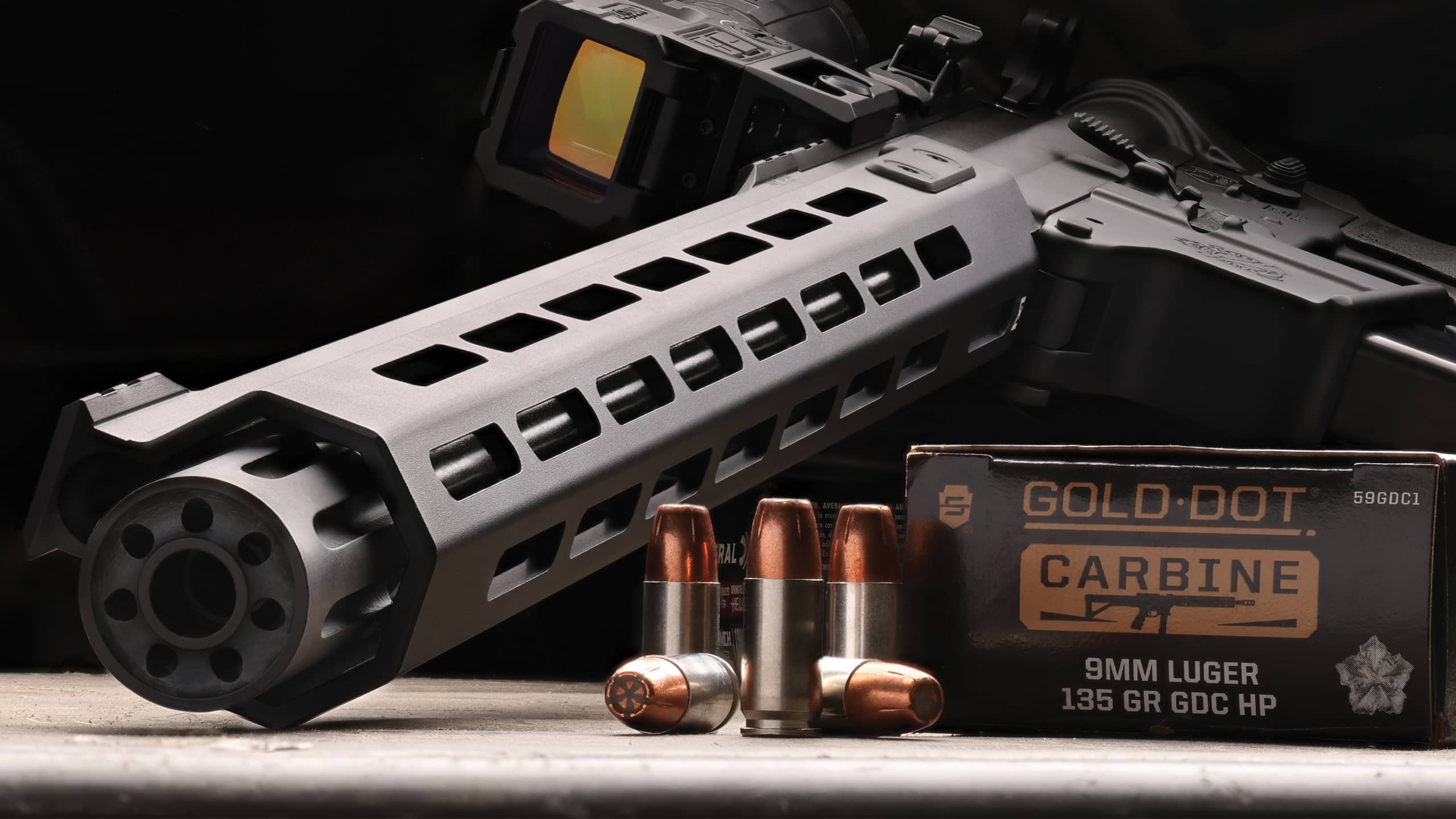
Editor’s Note: In today’s article, author Joe Kurtenbach reviews the 9mm Speer Gold Dot Carbine ammunition in a Springfield Armory SAINT Victor Carbine. Speer provided the ammunition for testing.
When the editor-in-chief of The Armory Life reached out to me and asked if I’d be interested in testing out a new Speer loading — the Gold Dot Carbine 135-gr. 9mm — I jumped at the chance. Speer is a brand with a reputation for quality, and I was very interested in learning more about it. So, I put in a request for a SAINT Victor Carbine 16” 9mm as well as a Hellcat Pro for some comparison testing.
Having tested a variety of pistol caliber carbines (PCC) chambered in 9x19mm Parabellum in the past, I knew it was going to be a fun time at the range. Thanks to the larger format of the SAINT Victor Carbine 9mm, with its 16” barrel and AR-pattern controls, I was confident that the winning recipe would once again prove out: improved handling, increased velocities and better sighting systems to facilitate enhanced accuracy.
I didn’t realize I’d soon be reevaluating my home-defense rig.
Handguns & Home Defense
It’s hardly a stretch to suggest that handguns, including semi-automatic pistols, are the most prevalent personal defense firearms in the United States — and, by extension, the most popular home-defense selections. That doesn’t mean they are the best tool for the job. Qualities such as compact size and light weight are highly valued in a firearm for daily concealed carry; however, those same characteristics offer no benefit to the platform’s shootability. Smaller guns can be harder to sight and handle, and they can recoil more than larger firearms in similar chamberings.

So why are they so popular for home defense? As an old platoon sergeant once told me, “You gotta run with what ya brung with.” Most people aren’t poring through a safe full of firearms to select the best bump-in-the-night bang stick, they’re simply stowing their same carry pistol in a nightstand lockbox.
Pistols can have one serious advantage for home defense, however: their ammunition. Modern self-protection handgun loads, fueled by surging civilian interest and demanding law enforcement standards, have evolved to offer sophisticated bullets that pair ideal penetration with rapid expansion. They have proven capable of stopping fights and mitigating the risk of overpenetration associated with center-fire rifle rounds in confined spaces.
The Better Bullet
One example of cutting-edge handgun ammunition is Speer’s Gold Dot line. The original Gold Dot bullets were born out of the debacle of the 1986 FBI Miami shootout. Without recounting the affair, suffice it to say the terminal performance of the FBI agents’ handgun ammunition proved woefully inadequate. Lead ball ammo could punch holes, and the day’s rudimentary hollow points could expand. Still, performance was inconsistent, and there were no options that could reliably expand and penetrate on impact.

Gold Dot changed that. With its copper jacket electrochemically bonded to the lead alloy core and its cavernous mouth, Speer’s solution offered reliable expansion. It solved the separation issues — jackets from cores — that plagued earlier bullet designs. The unified projectile retained its weight and trajectory better after expansion, resulting in larger, deeper wound channels. A new standard was set.
Speer Gold Dot Carbine
Law enforcement agencies and armed citizens have flocked to Gold Dot since its introduction in the early 1990s, but Speer has not rested on its laurels. Its Gold Dot G2 loads feature bullets similar to the original, but the hollow point’s cavity is filled with a specialized elastomer. The filled tips of the G2 bullets offer faster and more consistent expansion as the elastomer both prevents the bullet from becoming clogged with barrier material — such as clothing — and, on impact, compresses into the cavity and forces the bullet to open and petal.

Along with the new G2 bullets, Speer has worked to tailor loads for popular firearms platforms as evidenced by Gold Dot Carry Gun, intended for compact pistols, and the subject of this article: Gold Dot Carbine. The Carbine cartridges combine a 135-gr. 9mm G2 bullet loaded to around 1,170 feet per second (fps) in a nickel-plated brass case with a sealed primer for reliable, hitch-free cycling and assured ignition. It offers all of Gold Dot’s long-proven street performance, enhanced by the G2 bullet and tuned for the longer barrels and (often) blowback actions of pistol-caliber carbines.
Why PCCs?
The concept of shoulder-fired arms that feed and fire pistol cartridges has been a reality within American ordnance since at least the 1920s, with American submachine guns chambered in .45 ACP. However, modern iterations have sized down both their dimensions and (in most cases) their chamberings.

Often termed “sub guns” or personal-defense weapons (PDWs), such firearms value not only portability but also concealability and are prized for their ability to deliver serious firepower in a discreet package. Springfield Armory’s Kuna pistol in 9mm is a fine example of this class.
PCCs, as we think about them today, however, are a newer invention — or perhaps an older one. These firearms possess decidedly rifle-like qualities, including full-length stocks and barrels, and are more akin to late-19th-century lever actions than the 20th-century sub guns, save for their chamberings.

Live The Armory Life. The latest content straight to your inbox plus an automatic entry to each of our monthly gun giveaways!
The primary advantages of PCCs are their shootability and handling characteristics compared to a handgun. With pistols, shooters must rely solely on their hands to contact and manipulate the firearm. The PCC offers both more real estate and purpose-built contact points to enhance control.
The PCC’s weight, too, is no small advantage. Personal defense ammunition in 9mm or .45 ACP can be a handful in smaller, lighter pistols. But, add several pounds and the aforementioned contact points to the equation, and even full-house 10mm loads are easy and fun to shoot from a PCC.
PCCs possess longer barrels, which offer several advantages. Ballistically, they provide a longer runway for the bullets, allowing more of the cartridge’s powder to burn in a contained environment, thereby increasing the round’s velocity compared to its typical pistol-barrel performance.

The extended barrel also allows a longer sight radius — a boon to accuracy when shooting with iron sights. Those sights, too, tend to be finer and more adjustable than pistol-mounted irons, allowing the PCC to be effectively zeroed to its ammunition. And, if iron sights aren’t preferred, the larger size of the carbine compared to a pistol offers more options for mounting optics from reflex sights to variable-power riflescopes.
One exemplar of the current class of pistol-caliber carbines is the Springfield Armory SAINT Victor Carbine in 9mm. Offering the familiar handling and control characteristics of an AR-pattern rifle, the SAINT Victor’s 16” barrel is surrounded by an aluminum handguard sporting full coverage M-Lok accessory slots.
Flip-up iron sights are included to take advantage of the extended sight radius, but the aluminum upper receiver also includes a length of Picatinny rail for mounting optics. It’s 9mm direct-blowback action feeds from Colt-pattern 32-round magazines that fit securely in the dedicated 9mm aluminum lower receiver.
A Perfect Pairing
Although I knew I was working with premium products, I had no inkling that my expectations would soon be left in the dirt (or, more aptly, a pile of nickel-plated brass, strewn over the range’s gravel deck).

My priorities for range testing were threefold: First, I wanted to test the Victor and the Gold Dot ammo at distance for accuracy; three five-shot groups at 50 yards, as prescribed by The Armory Life’s testing protocol. Next, I wanted to measure velocity to determine how much speed the Victor’s longer barrel was wringing out of the 9mm cartridge. As a control, I would also capture the ammunition’s velocity when fired from the 3.7” barrel of a Springfield Armory Hellcat Pro.
Finally, using Clear Ballistics 10% ordnance gel, I wanted to examine the terminal performance of the Speer ammunition, both in terms of penetration and expansion. Lacking the velocity and, thus, energy of centerfire rifle ammunition, defensive pistol loads must rely on these mechanics to deliver lethal, fight-stopping performance. As previously proven by the bonded hollow-point bullets in Speer’s Gold Dot ammunition, the key is weight retention to power penetration to critical depths, and bullet expansion to increase the diameter of the wound channel.
Accuracy Testing Results
To conduct my testing, I topped the SAINT Victor with a Holosun AEMS Pro X2 Green reflex sight and a Holosun HM3XT magnifier on a flip-up mount. I’m an avid user of Holosun’s handgun sights, but this was my first time with the AEMS Pro X2. Its lenses were clear, and I had no problem seeing the circle-and-dot reticle, even in direct sun. This is a combo I’ll be coming back to for future builds.
Penetration Testing Results
Having zeroed the rifle at 50 yards, I set about conducting accuracy and velocity testing. Right away, a problem emerged. All three of my five-shot 50-yard groups measured less than an inch, and two of the three were less than .75”. I quickly realized the SAINT Victor 9mm had a severe identity crisis. Given its specifications, it was clearly born to be a pistol-caliber carbine. And yet, the firearm was demanding to be called a precision rifle.

The overall average for the three five-shot groups was .74 inches. At 50 yards, that translates to 1.41 MOA. In my experience, most AR-style PCCs turn in 2 to 3 MOA performance, so this was a robust showing. Clearly, despite their defensive pedigrees, both the carbine and the ammunition proved to be match-grade offerings.
Velocity testing, too, yielded positive results. Often, I feel, the advertised velocities from ammunition makers are on the optimistic side. So, although the Gold Dot Carbine is listed at 1,170 fps, I was anticipating slightly slower measured velocities. I was wrong. The 10-shot average through the Saint Victor’s 16” barrel clocked in at 1,189, which is really moving for a 135-gr. 9mm bullet.

For comparison, I also checked velocity through the 3.7” Hellcat Pro. I got an average reading of 1,021 fps — significantly slower than through the carbine, but still as fast or faster than comparable ammunition tested in compact pistols. Also of note, the standard deviation was just 5.2, exceptionally low in my experience, especially for pistol cartridges, and proof of highly consistent manufacturing.
Finally, it was time to test penetration. To do this, two 16” Clear Ballistics Shooter Blocks were arranged end-to-end, offering 32 consecutive inches of 10% ordnance gel. The results were picture perfect. At 50 yards from the SAINT Victor, the Gold Dot Carbine bullet penetrated to a depth of 19.75” and presented ideal flower-like expansion. Ditto the results at just three yards, with 19” of penetration. It was really revealing to see such similar results at both distances.

I also tested penetration with the Hellcat Pro pistol at three yards, and Speer’s bullet again performed as advertised. The petals deployed, and penetration was exactly 16” — the expanded bullet was lodged halfway out of the first gel block. In each case, no shearing or separation was observed, and the average recovered weight of the three bullets was 131.25 grains, or better than 97 percent of their original weight. Not only was weight retention stellar, but the bullets also expanded to 0.581” — a nearly 64-percent increase from their original .355” diameter.
Conclusion
In truth, I did not doubt that the Gold Dots would expand. That’s what they do. And I anticipated a great experience with the SAINT Victor 9mm because, well, PCCs are a lot of fun to shoot. But I was absolutely floored by the accuracy results. For a home-defense option that is more shootable than a handgun, Speer’s Gold Dot Carbine and Springfield Armory’s Saint Victor 9mm may be a perfect pairing.
Editor’s Note: Please be sure to check out The Armory Life Forum, where you can comment about our daily articles, as well as just talk guns and gear. Click the “Go To Forum Thread” link below to jump in and discuss this article and much more!
Join the Discussion
Featured in this article


Read the full article here