




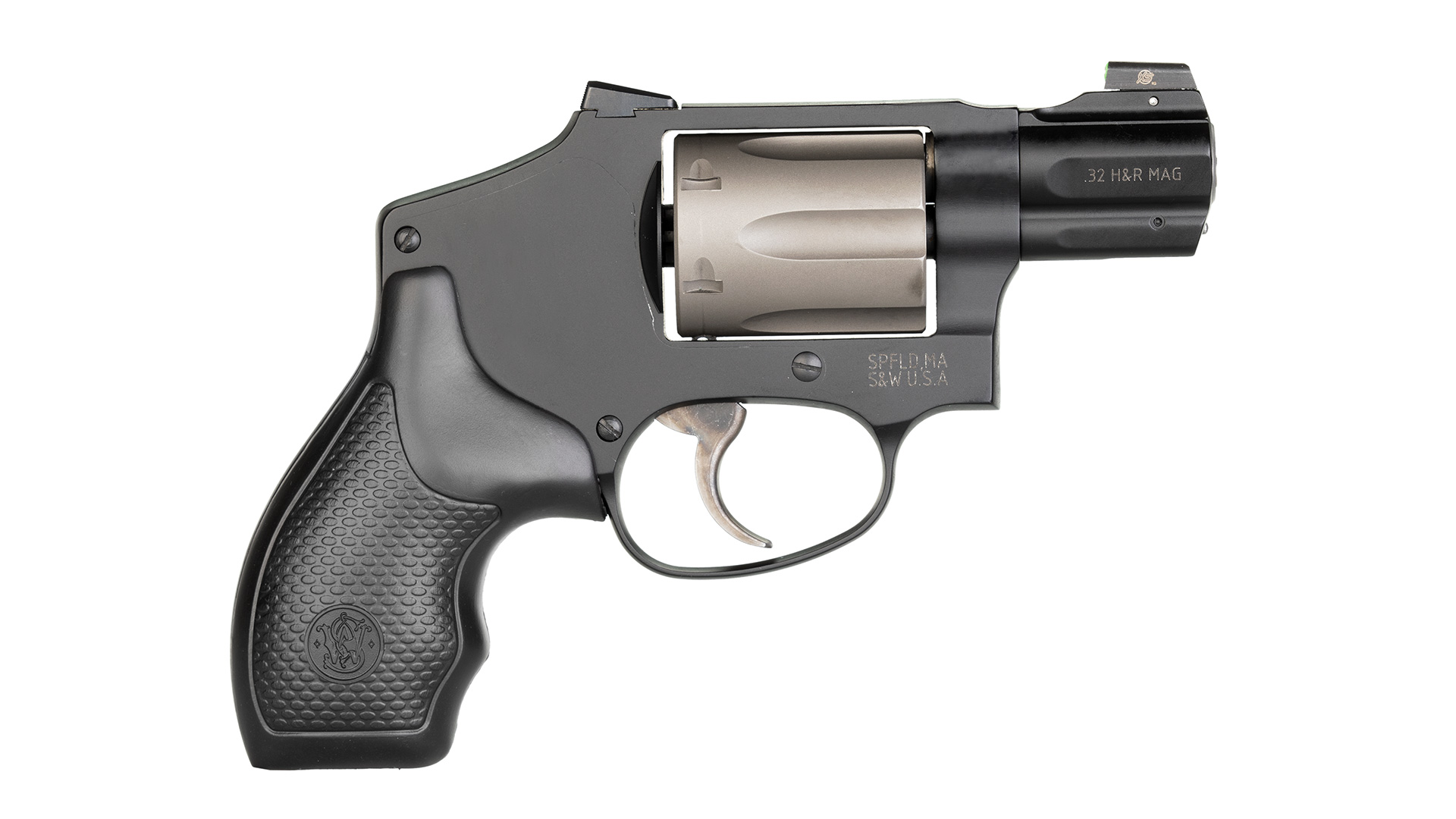
Earlier this year at The Shootist’s Holiday at NRA’s Whittington Center in Raton, NM, I met Jason Cloessner, who calls the shots at Lipsey’s Guns regarding what firearms the company wanted specifically modified by the manufacturer to be sold only as a “Lipsey’s Special.” One of his choices this year is a 2-inch-barreled, J-frame Smith & Wesson Model 432 chambered in.32 H&R Mag.
The most intriguing thing about Cloessner’s decision was that the small-caliber revolver would be presented to the shooting world by Lipsey’s as a defensive gun. In 1986, when the .32 H&R Mag. cartridge was introduced, the cartridge was viewed as a casual companion for the occasional family fishing or camping trip. Time flies and the wheels turn.
Cloessner’s next challenge was how to optimize the new gun for its role in the (dare I say it?) tactical world. A phone call to the folks at American Fighting Revolver (AFR) got the ball rolling. This interesting revolver-dedicated organization is mostly comprised of retired-cops-turned-teachers who now travel to different ranges around the country teaching firearm-survival skills with revolvers, some of which are small enough to be easily carried concealed. Perhaps its best-known event is the Pat Rogers Memorial Revolver Roundup conducted annually at Gunsite in November.
The two owners of AFR are former police officer Daryll Bolke along with Army Ranger Bryan Eastridge. Thirty seconds on the range with either of these guys will convince you Bolke did indeed spend a career patrolling the perilous paths of the big cities, frequently in the dark, and armed with only one (or two) snubnose pocket pistols; and we all know that a Ranger’s job description requires frequent visits to non-resort locations around the world. Based on its staff’s real-life experiences, AFR was asked to assist Lipsey’s in providing specifications for the new pistol that would maximize the survival prospects of the gun’s users.
I am very impressed with the resulting sights on the new .32 H&R Mag. The front is an XS Sights dot containing an outer lime-green ring and darker-green inner center dot, which are smaller than the front sight setup on my EDC Model 340 .357 Mag. J- frame. Overall width of the front sight (including the blade) is narrower, allowing it to fit entirely within the rear sight’s large, U-shaped notch. More precise shot placement in ambient light conditions is possible with the 432’s sights. The front sight is fixed, while the rear is adjustable for windage; no elevation changes are possible. The rear is locked in place with a setscrew, thus contributing to its rugged design. Robust sights and fast front-sight acquisition are better than precise but snag- prone and relatively delicate ones for this kind of gun.
Windage adjustable, the Model 432 UC features a U-shaped rear notch that is serrated to reduce glare • A lime-green outer ring encircles the front-sight’s tritium ampule for enhanced visibility • Despite its heavy pull weight, the trigger was smooth and actually pleasant for a DAO revolver• The Model 432 UC sports the standard angled cylinder-release latch • Thanks to its chambering, this J-frame’s cylinder holds six rounds of ammunition • The muzzle of the revolver’s two-piece barrel is crowned • A low-profile design lessens the likelihood of the rear sight snagging on clothing • The rubber boot grip proved compact enough for discreet pocket carry.
The cylinder of the revolver I reviewed is made of titanium (other models are available which helps reduce the gun’s overall unloaded weight to 16.3 ounces, but is strong enough to withstand the pressures generated by the .32 H&R Mag. cartridge. I appreciated the slight chamfer on chamber mouths. Even when reloading single rounds, particularly wadcutters, the chamfer facilitated a round’s initial entry into the cylinder. When you’re using HKS speedloaders or speedstrips, the reloading process is much faster and fumble free. At full ejection-rod stroke, the .32 H&R Mag. empty cases are too long to clear the cylinder mouth. When the gun is held in a horizontal position while the ejection rod is pressed all the way to the rear, a significant part of the empty case remains inside the chamber. If the gun/cylinder is dirty, a vigorous smack on the ejector rod might send the cases airborne out the rear of the chambers, but possibly not. I think of Clint Smith’s advice: “When reloading, you’re either praying to Jesus or screaming at Satan: elevate the muzzle to unload empties, depress the muzzle to load.” It’s a basic (and very important) survival lesson dealing with the effect of gravity.
Other variants of the Model 432 UC include G10 grip panels with the gun, along with a tool for removing them. Smith & Wesson’s standard “boot grips” with the firm’s iconic logo on each panel came on my sample. The G10 grips have no logo and appear larger in a rather deceptive manner. The bigger grips don’t appear to increase the overall width of the gun, but rather cover the backstrap, thus extending the shooters’ reach to the trigger. In addition, the right panel of the larger grips reached farther up the side of the frame, covering much more of the gun’s surface. The end result, I imagine, is a more comfortable grip and a much smoother and consistent trigger pull.
The trigger on my sample is the old combat style with a smooth, curved surface. In terms of concealability, the 432 UC was easily carried concealed in the strongside front pocket of the jeans I wear 95 percent of the time.
I have to say, I loved the trigger pull, and the more I shot the gun, the smoother the trigger became. I don’t consider myself a trigger snob, but I am a little fussy when it comes to Smith & Wesson J-frame revolvers that can only be fired double action. While noticeably heavy, the Model 432 UC is the best out-of-the-box J- frame trigger I’ve used.
Don’t get too excited when I talk about “precise shooting” though; this is a short-range DAO revolver meant for defensive use. Shooting from 10 yards, most groups hovered around 3 inches—good enough for self-defense in a pinch, but not exactly Bullseye accuracy. J-frames are built with surprising precision, but they are difficult guns to shoot well. As evidence, a set of Crimson Trace Laser- grips was briefly mounted prior to firing a few rounds of Hornady Critical Defense. Between using the laser and staging the trigger, five-shot groups dropped to around an inch and a half.

The two-piece barrel was a mystery until it was learned that it eases installation at the factory. The steel barrel doesn’t have to be “clocked” to the twelve o’clock position, whereas the aluminum shroud can be without risk of damaging the frame.
A few years back, I had lunch with three retired cops, all of whom had taken up second careers as gunwriters or editors. We were all carrying Smith & Wesson J-frame revolvers in our pockets. I believe all four of us were carrying only the five rounds of ammo in the guns on our persons, there were some ammo in each truck. Everything I have read indicates that “mouse gun” covers calibers below .38 Spl. The .32 H&R would qualify; the .38 Spl. does not. Welcome to the new millennium. Now your pocket revolver carries more rounds of ammo, conceals as easily as ever, has features tuned by experts to improve your probability of survival, and proudly carries the moniker of “Mouse Gun.”


Read the full article here