




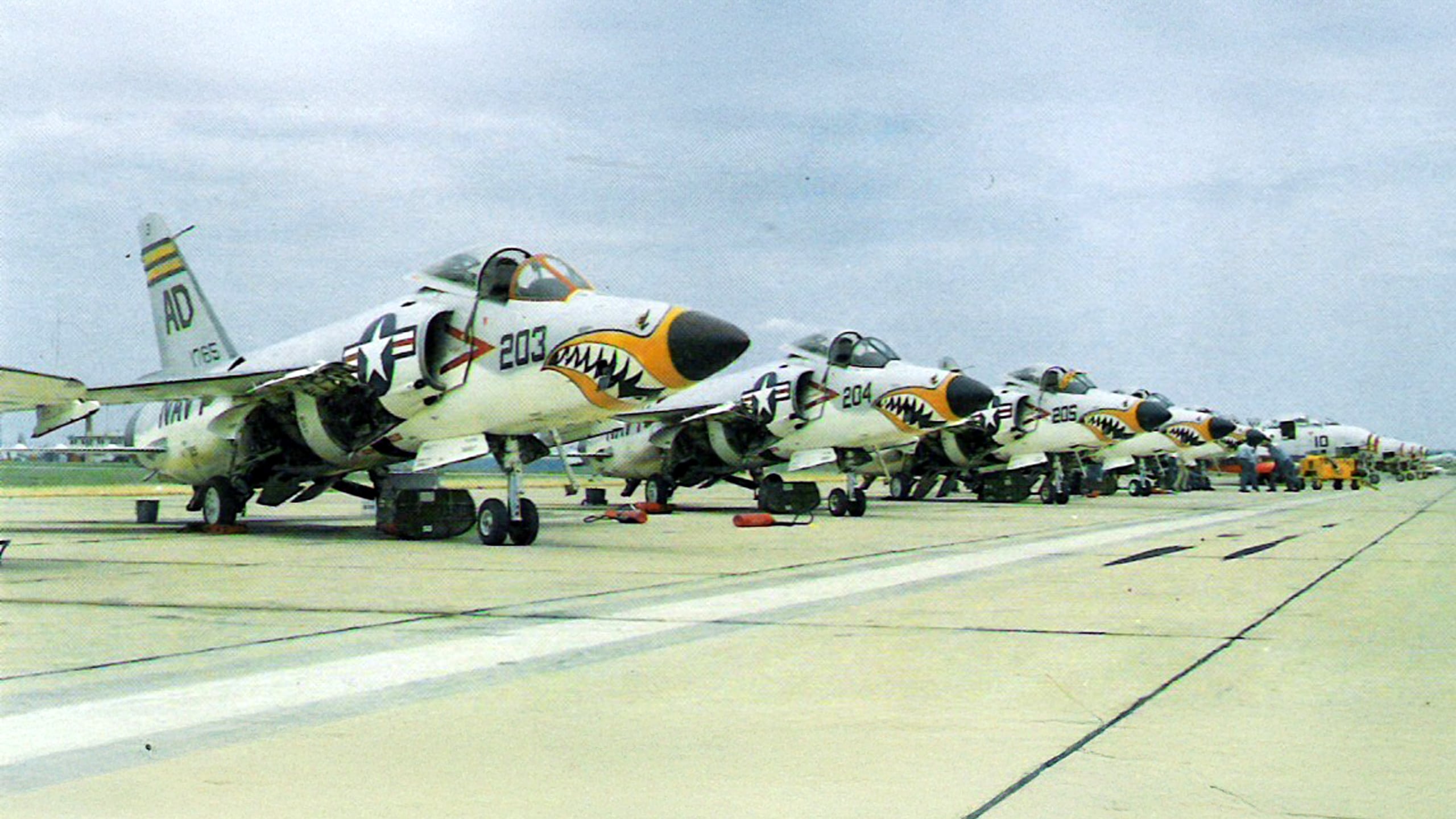
At the close of the Korean War, the U.S. Navy recognized that the rapid pace of jet aviation demanded a new generation of carrier-based fighters. Existing aircraft were quickly becoming obsolete as speeds climbed toward — and beyond — the sound barrier, forcing naval planners to rethink air superiority in the jet age.
Grumman’s answer was the F-11 Tiger, a lightweight, high-performance fighter designed specifically for carrier operations. The sleek Tiger became the first Grumman aircraft to break the sound barrier and briefly held the world altitude record at 76,939 feet, cementing its place as a technological milestone in early supersonic naval aviation.
The F-11 Design
The Tiger was initially intended to be an improved version of the F9F-6 Cougar, but the program turned into a totally new aircraft. If that sounds familiar, check out the F-102 Delta Dagger and the F-106 Delta Dart. Grumman engineers used the area rule (Coke Bottle Fuselage) while designing the Tiger, which, together with its thin swept wings, reduced drag by almost 25%, and gave it excellent performance.

The area rule is a principle of aerodynamics that minimizes drag by ensuring a smooth distribution of an aircraft’s cross-sectional area along its length. By tapering the fuselage, the aircraft’s cross-section changes slowly, preventing the formation of shock waves and reducing drag at supersonic speeds.
F-11 Tiger Armament and Power
The Tiger’s armament included: 4×20 mm Mk 12 cannons with 125 rounds per gun. Four hardpoints with a capacity to carry the Aero 6A or Aero 7A “Rocket Package” or AIM-9 Sidewinder air-to-air missiles.

The Tiger was powered by the Wright J65 W-18 turbojet engine, which was a copy of the Armstrong Siddeley Sapphire built under license. The prototype first flew in July 1954 with a non-afterburner version of the J65. Despite this, the Tiger nearly reached Mach 1. The second prototype with the upgraded engine reached Mach 1.1. With the potential for great speed, the Navy proceeded with the purchase of the Tiger.
The standard J-65 engine was in use with several Navy aircraft at the time and was reliable, having accumulated thousands of flight hours. The issue with the engine began when the Tiger design called for supersonic speed. The addition of an afterburner caused reliability issues.

Live The Armory Life. The latest content straight to your inbox plus an automatic entry to each of our monthly gun giveaways!
In 1955, the Tiger was initially designated the F11F. It was redesignated as the F-11 Tiger under the 1962 United States Tri-Service designation system.
Faster Than a Speeding Bullet
The F11 was a fast aircraft. So fast that, on September 21, 1956, during a test flight, it shot itself down! During a test firing of its 20mm cannons, test pilot Tom Attridge fired two three-second bursts while in a shallow supersonic dive.

As the cannon rounds slowed, the Tiger continued its dive at 880 mph, overtaking them, and they were ingested into the engine, causing a flameout. The Tiger was forced into a crash landing, and Attridge sustained serious injury with a broken leg as well as several broken vertebrae.
Carrier Duty
The Tiger entered service in 1956 aboard several carriers, but its service life was short. There were issues with the J-65 engine, which was unable to deliver enough power to fully develop the airframe’s potential.

Additionally, fuel consumption was high, and the fuel capacity was low. Since no radar was installed, the Tiger was limited to day operations and was not capable of sustained supersonic flight when configured for combat operations.
Stiff Competition
Competition was stiff, and the development of the LTV F-8 Crusader, the “Last of the Gunfighters”, and the McDonnell Douglas F-4 Phantom were in hot pursuit of the Tiger. The US Navy saw what was coming down the pipeline and purchased only 199 Tigers, the last of which was delivered in January 1959.
Making Changes to the F-11
There were attempts to improve the Tiger. In an effort to save the program, Grumman engineers knew the fix was a better engine. In early 1955, Grumman submitted a proposal to the US Navy to modify two F-11s under construction by fitting them with the new, cutting-edge General Electric J-79 engine and create the F11F-1F Super Tiger.

The J-79 was intended for use in the Navy’s new interceptor, the McDonnell Douglas F-4 Phantom. The J-79 was 250 pounds lighter than the existing J-65, and produced 2,600 pounds more thrust without afterburner and 3,750 pounds more in afterburner. It was basically the same size as the J-65, so that no significant modifications would be required to the engine bay/fuselage. The main change was enlarging the inlets to provide the J-79 with increased airflow. The other significant change was the fitting of a larger nose, which allowed installation of the AN/APQ-50 all-weather radar.
When finished, the Super Tiger was deemed an excellent fighter. Prototype #2, which recorded a Mach 2.04 top speed, but it was too late to save the Tiger. The Navy was purchasing the F-8 Crusader, while the USAF was investing heavily in the F-104 Starfighter, another Century Series aircraft. The Navy opted out of the program, cancelled the reconnaissance version F-11F-1P, and moved on.
Sent to Training
By 1961, the Tiger was slowly being replaced by the F-8 Crusader and the F-4 Phantom, and was removed from carrier duty and reassigned to training. The remaining Tigers were turned over to the Naval Air Training Command, and new pilots gained supersonic flight experience after completing advanced jet training in the TF-9J Cougar. The new pilots were then sent for transition training in active status combat jets.

While the Tiger was removed from combat service, its agile design secured it a spot on the Navy Aerial Demonstration Team, the Blue Angels, from 1957 to 1969. The Tiger replaced the F9F-6 Cougar, which in turn was replaced by the F-4 Phantom II.
The End of the Road
Due to its poor performance compared to the F-4 Phantom II and the F-8 Crusader, the Tiger’s career as a frontline jet fighter was short-lived, lasting only four years. As a trainer, the Tiger lasted until 1967, and by 1969, all Tigers were retired, making their final journey to the boneyard.

In 1973, two F-11A models that the Blue Angels had previously flown were taken from the boneyard by Grumman for use as testbeds. One was modified to test in-flight thrust control systems, while the other was left stock as a chase plane. When Grumman completed the evaluation, the two Tigers were returned to Davis-Monthan Air Force Base.
Editor’s Note: Please be sure to check out The Armory Life Forum, where you can comment about our daily articles, as well as just talk guns and gear. Click the “Go To Forum Thread” link below to jump in and discuss this article and much more!
Join the Discussion
Read the full article here