




As World War II progressed, Germany struggled to keep up in the battle against the growing numbers of Allied tanks. While the Wehrmacht’s anti-tank guns were the most formidable weapons of their type on the battlefields of Europe, the cost to manufacture the guns and their ammunition became an unbearable strain for the Reich’s economy. Consequently, the Germans sought lower-cost options, and these new weapons focused on the use of powerful hollow charge warheads in a rocket projectile. Range and accuracy were sacrificed for economical mass production.
Most famous among these developments were the 8.8cm Raketenpanzerbüchse 54 “Panzerschreck”, and the various sizes of the Panzerfaust anti-tank grenade launcher. Combined, these short-range but highly effective AT weapons accounted for the largest percentage of Allied tanks destroyed in the last year of the war. Both could penetrate the armor of any Allied tank, provided they achieved a solid hit. The Panzerschreck (with shield) weighed a hefty 24 pounds unloaded but could engage targets out to 150 meters. The Panzerfaust weighed less than 14 pounds but had an effective range of just 60 meters.

Neither was an optimal solution, but by late 1944 these short-range weapons had become the new normal for German anti-tank units. A US intelligence report from late 1944 noted: “Although the German bazooka and the Panzerfaust have a very definite military value, they and the larger rocket weapons are now employed on such a large scale because shortages of materials, labor, and industrial facilities prevent the Germans from producing the requisite number of conventional artillery and antitank weapons. For instance, the average anti-tank company, which formerly was armed with from 9 to 12 anti-tank guns, now has either about 3 guns and 36 bazookas, or no guns and about 54 bazookas. Probably the Panzerfaust is the most useful of these weapons, enabling the infantry squad and comparable units to stop Allied tanks.”
The Püppchen
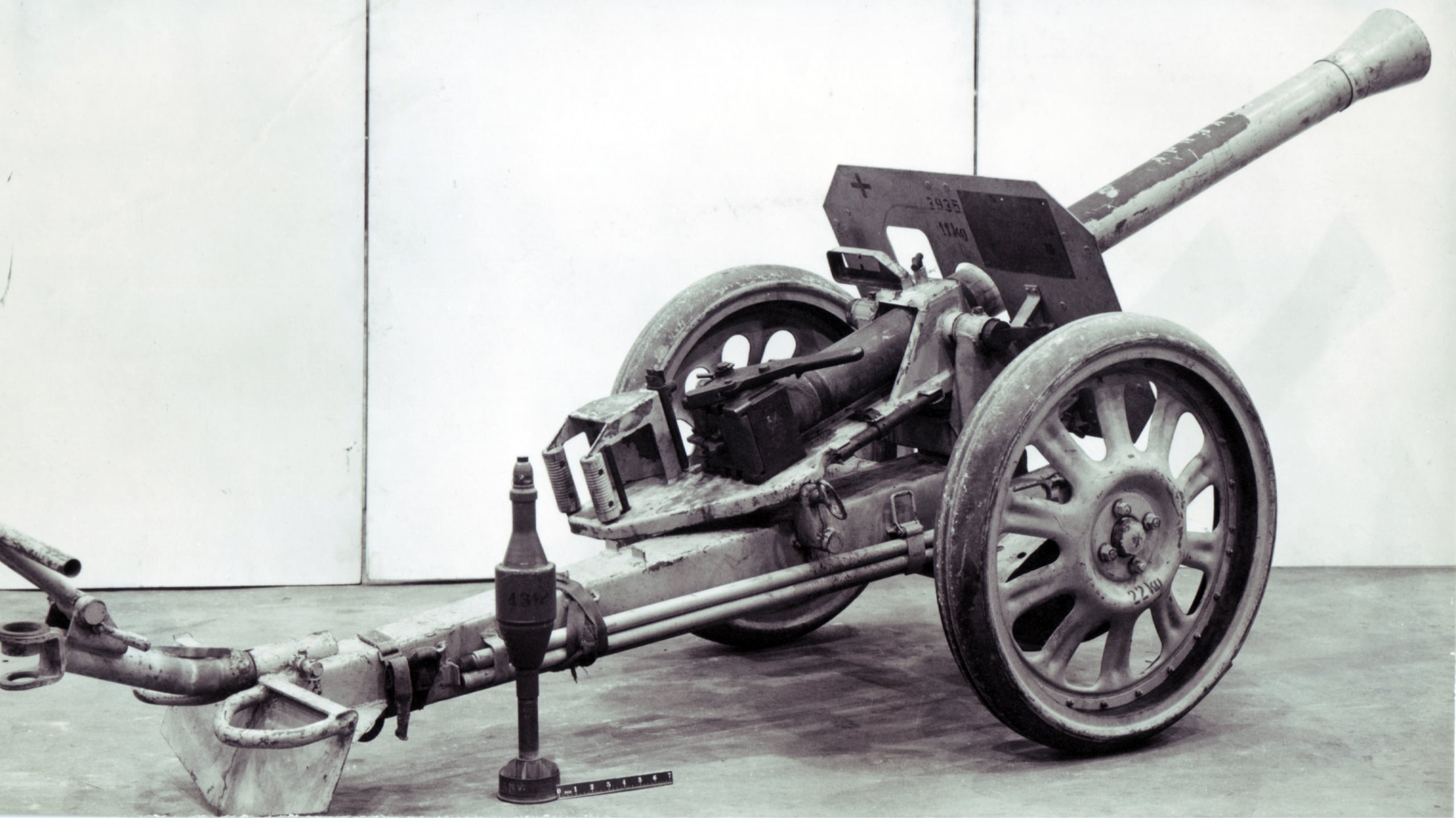
At first glance, the 8.8 cm Raketenwerfer 43 Püppchen (“Dolly”) appears to be a tiny artillery piece. In fact, it is a development of the Panzerschreck — intended to give the anti-tank rocket launcher greater range and accuracy. The 315-pound carriage-mounted weapon used a new rocket, the RPGr4312, which replaced the Panzerschreck electrical ignition system with a percussion cap igniter.

The Püppchen was loaded through a sliding breechblock, and on firing the exhaust gases were contained within like a normal artillery piece. The barrel pivoted on a pintle which allowed for simple aiming and easy target acquisition. The carriage wheels could be removed to lower the profile, and skis could be added for transport across snow. Firing instructions were printed directly onto the gun shield.

The Püppchen offered more stability as a firing platform than the Panzerschreck, increasing accuracy and providing an effective range of approximately 500 meters (and a max range of 750 meters). However, there was nothing that could be done about the dramatic firing signature of the rocket launcher. It was unlikely that a Püppchen crew could get off more than a couple of shots before they were observed, and targeted or overrun.

Recently, The Armory Life managing editor Richard Johnson and I were reviewing some film of Volkssturm defenders in Konigsberg during early 1945. In scenes of the Püppchen firing, we noticed considerable jump each time a rocket was launched. These weapons are normally described as “recoilless”, which seems a bit generous. The gunner would still need to re-lay the gun on target after each shot.

The Püppchen‘s small carriage was not suited to be towed by normal vehicles, but rather by horse teams or an ultra-light tractor like the Kettenkrad. The US “Intelligence Bulletin” reported on the Püppchen in the November 1944 issue:

“The Püppchen, a carriage-mounted rocket launcher with breechblock also fires the 88-mm rocket. Although the Püppchen has wheels, the gun can be fired from little sleighs to achieve a very low silhouette. While the Püppchen has a range of 770 yards, it is very lightly built and is likely to smash up when towed by motor vehicles.”

Live The Armory Life. The latest content straight to your inbox plus an automatic entry to each of our monthly gun giveaways!
Other than the wheeled carriage, the Püppchen could be equipped with skis for use in the snow. A US Ordnance report from March 1945 described the use of skis: “Ski mounts, instead of the conventional wheels, have been found mounted on the 8.8cm Raketenwerfer 43, which bears the nickname “Püppchen”. Due to the fact that the Püppchen is designed for rapid wheel disassembly, the changeover from wheels to skis can be accomplished in approximately thirty seconds. An iron ring is attached at each end of the skis for the attachment of towing ropes.”

The report also notes that the skis were 54 inches long and 7.5 inches wide. A significant advantage of operating the Püppchen without its wheels was the extremely low profile of the weapon — just 2 feet 11 inches high. As the Püppchen’s barrel pivoted on a pintle, much like a machine gun on a tripod, this gave a gunner with steely nerves a good opportunity to get a first shot-kill from a well-sited ambush position.
US Ordnance Description
“This weapon is a closed breech rocket launcher which fires a rocket projectile. It is transported on a two-wheeled carriage and may be fired from the carriage or from firing segments to lower the silhouette. If necessary, it may be readily disassembled into seven loads for transport. A cone-shaped gas deflector is fitted over but does not protrude beyond the muzzle. The piece is aimed by grasping two handles fitted to the left rear of the cradle and aligning the open sights on the target. The rear sight is adjustable from 180 to 700 meters. The launcher fires from a closed breech which is operated by a handle on top of the breech ring. Opening of the breech cocks the hammer which is held in firing position by a sear. When the projectile has been inserted and the breech closed, a squeeze of the right handle depresses the sear, releasing the hammer. A safety device fitted to the left of the firing pin in the center of the breechblock must be turned to “F” position before the launcher can be fired. An additional safety feature prevents the hammer from striking the firing pin unless the breech is fully closed. The small shock of recoil developed by the rocket gases against the closed breech is transmitted directly to the spade. Ammunition used with the rocket launcher is a modified version of the 8.8 cm rocket projectile, having a percussion primer instead of the electric type. The rocket is fitted with a base plate with a protruding rim to seat the round in the tube. The base plate and primer are the only parts of the round which are extracted after firing.”

A March 1945 “Intelligence Bulletin” report on German rocket weapons included the following details on the use of the Püppchen:
The Püppchen (“Dolly”), a carriage-mounted rocket launcher with breechblock, fires the same 88-mm rocket that is used with the Ofenrohr. The breech prevents any flash to the rear while firing is in progress. To lower the Püppchen silhouette, the wheels may be removed and the piece left standing on two sled like rests. In preliminary positions the ground is dug out so that the horizontal section of the lower carriage and trail will lie below the surface. For an all-around prepared position, circular trenches with an inner radius of about 2 feet are prepared. The barrel is left just clear of cover, as is done in the case of the preliminary positions. The lower carriage is dug in and the trail wedged, so that the piece can be fired at an angle of 180 degrees. Positions are prepared in defilade or on reverse slopes and are well camouflaged. In general, enemy doctrine governing the preparation of positions and the conduct of fire is similar to that for the Ofenrohr, except that only two projectors of the Püppchen type are considered necessary for satisfactory interlocking fire. The maximum effective range of the Püppchen is considered to be 220 yards, although badly dispersed fire up to 275 yards is possible. For this reason, the Püppchen, like the Ofenrohr, is employed in the foremost infantry positions. For added protection from artillery fire, the launcher may be detached from its carriage and removed to a shelter some distance away from the prepared position. Alternate positions are prepared only when the terrain restricts the field of fire and provides good cover for the maneuvering piece. In such terrain each position is constructed so that the Püppchen can be run in and out on wheels. Since the Püppchen is harder to conceal than the Ofenrohr, the Germans believe that it is necessary to furnish the larger weapon with antitank protection in the form of obstacles, natural or artificial, supplemented by mines. Because the Püppchen’s carriage is not strong enough to stand up under motor towing at high speed, and since horse-draft sacrifices valuable time and involves the problem of replacing animal casualties, the Püppchen generally is transported on trucks and is used only in positional warfare. The 88-mm rocket used in both the Ofenrohr and the Püppchen is heavy enough to cause ammunition-supply difficulties in battle. (A box of three rounds weighs 24 pounds.) This is why the Germans try to build up supplies in all main and alternate positions.”

Conclusion
At this stage of the war, the die was cast for Nazi Germany — it was unfortunately a matter of how many lives would have to be spent for them to realize it. Was the 8.8 cm Raketenwerfer 43 Püppchen a sound design? By the standards and situation the Germans faced that time, most certainly. Could it stem the tide of Allied armor bearing down on the Reich? Clearly, no.
Editor’s Note: Be sure to check out The Armory Life Forum, where you can comment about our daily articles, as well as just talk guns and gear. Click the “Go To Forum Thread” link below to jump in!
Join the Discussion
Read the full article here