




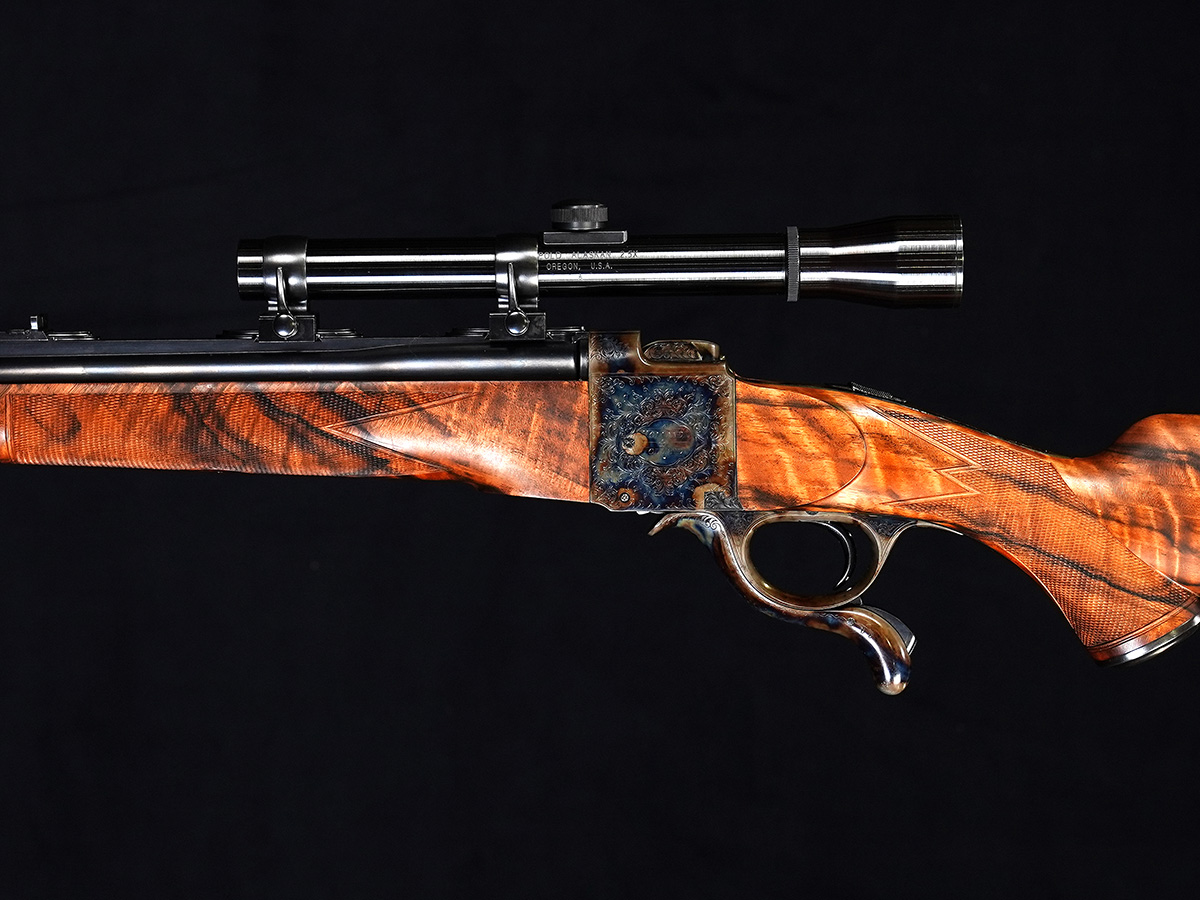
The American Custom Gunmakers Guild dives into what it takes to make gorgeous custom and engraved guns.
American firearms have woven themselves into the national tapestry since European settlers found their way to the East Coast of America hundreds of years ago. Many setting foot on new soil brought their trade knowledge with them: furniture makers, metal and woodworkers, all eager to begin carving out a life in their new country. While some immigrants hung out their shingle as a continuation of their livelihoods in Europe, many found work in the fledgling American firearms industry, bringing generational skills and knowledge to the embryonic trade. Furniture makers became stockbuilders, machinists barrelmakers, even farm equipment manufacturers set their sights on fulfilling their new country’s burgeoning need for firearms.
And America’s gun trade hasn’t looked back since, building on and improving traditional methods to become a bastion of firearm manufacturing efficiency. While the benefits of mass-producing guns can’t be argued with, there is a select group of artisans who still prefer to build firearms one at a time. They can be found not on a stool in an assembly line or a lengthy corporate roster, but laboring over a multitude of their own machines and tooling, creating all or part of a custom gun for a discriminating client. A custom or bespoke gun is handmade to the customer’s specifications and highlights numerous talents of the builder or builders and incorporates several trade disciplines, including custom stock or grips, barrel, metalwork and engraving to name a few. When done by a skilled hand, the firearm will exceed expectations and not feel like adding another piece of steel to the gun safe but more like welcoming a new member of the family.
The ACGG Is Born
In the interest of expanding and passing on the custom gun trade in the U.S., the American Custom Gunmakers Guild (ACGG) was founded. Several people from the industry began sharing booth space at an NRA show in the early 1980s, hosting gunmakers to meet with prospective clients and others interested in the trade. In 1983, recognizing the benefits of banding together, a small group of forward-thinking individuals each pitched in $100 and formed the first iteration of the Guild as a corporation in Texas; the inaugural show was held shortly thereafter.
The ACGG quickly found its footing and has continued to expand over the years, becoming the preeminent organization for American custom gunmakers. The members help and learn from each other while becoming masters of the craft, driving up the bar for custom gun work across the nation. The Guild website reads:
The mission of the ACGG is manifold. As an entity, the ACGG will strive to function as a venue for the exchange of ideas concerning the craft and promote public awareness of custom gunmakers and their craft. While promoting the betterment of custom gunmaking, we еstablish standards of excellence within the field of custom gunmaking and ethical guidelines to benefit those who create and use custom guns. ACGG nurtures and develops the next generation of custom gunmakers. ACGG follows through on its pledge by working with gunsmithing schools across the country, having professional members give guest lectures and presentations throughout the year to students new to the trade.
The vision of the ACGG is to be the preeminent entity in the United States for custom sporting firearms knowledge, skill, craftsmanship and artisanship. The ACGG aims to be the go-to organization for those seeking knowledge of custom sporting firearms or wishing to have a custom sporting firearm crafted.
With this in mind, the Guild created an ethics board that ensures a potential client’s investment will be protected by holding member’s work to the standard its become known for; if there’s ever a concern, a buyer can contact the board for remediation.
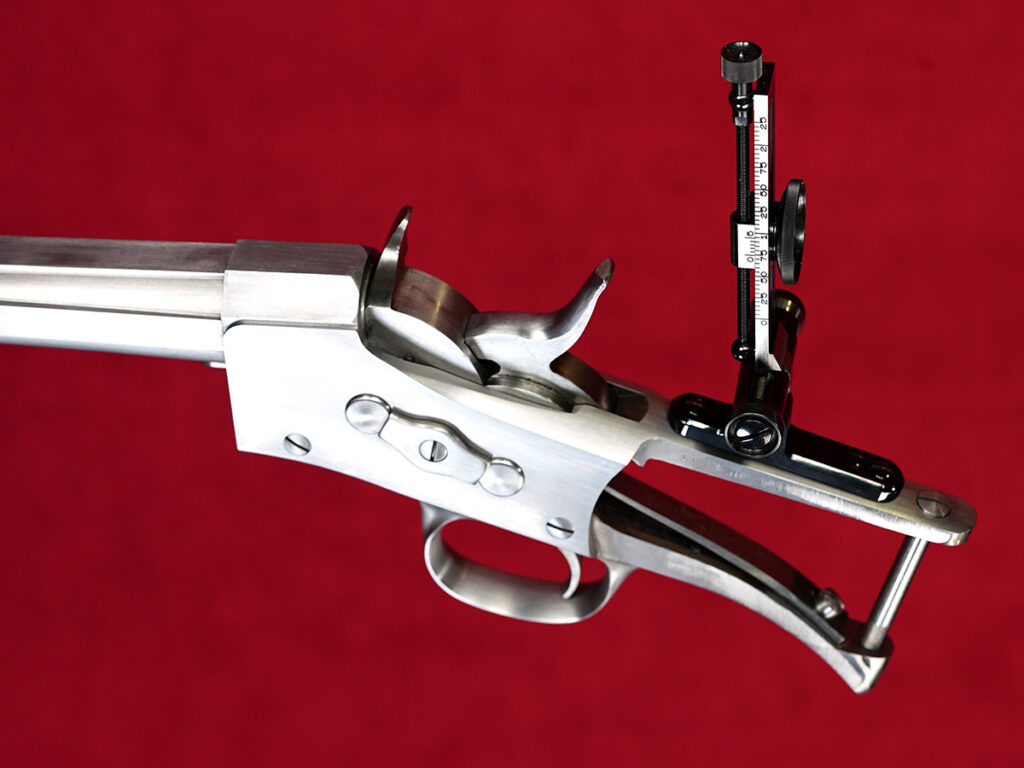
The Guild has two categories of membership: Associate and Professional.According to the Guild: Accomplished gunmakers are few and far between. But you’ll find most of them are members of ACGG. And they’re all ready to pass on the craft and keep this fine art alive. You are invited to join as an associate and enjoy the fellowship of others who appreciate firearms crafted by hand from exquisite wood and fine metal with intricate design and attention to every detail. As an associate member, you will be part of a unique association that helps ensure that the art of combining wood and metal into collectible and usable firearms continues. We invite anyone who appreciates this work to join as an associate. Associate members can join online at ACGG.org for a modest yearly fee.
Professional members must be an associate for a minimum of one year and submit samples of their work to be voted on by other professional members at one of the shows attended by a quorum of members. Professional members are craftspersons who actively work in the custom gunmaking trade and are willing to pass on their knowledge and experience to associate members eager to learn this unique craft. Both memberships receive access to the quarterly publication of the Guild, Gunmaker. Edited by Dave Norin, a Guild professional member, it’s brimming with how-to articles, current and past projects of members, and other useful information for those interested in the custom gun trade.
Recognizing that custom gunbuilding doesn’t neatly fall under one umbrella, the Guild has a variety of categories for members to join in. Trades represented and able to test for professional membership are: stockmaker, barrelmaker, pistolsmith, metalsmith, metal finisher, engraver, checkering specialist, toolmaker and casemaker. All of the requirements for work to be tested can be found on the ACGG site. Once accepted at the professional level, the member will enjoy the benefits of having their work featured on Guild social media if desired, access to Guild forums, as well as discounts at certain industry sites and businesses. For those who have questions about the membership process, the ACGG has several points of contact to help facilitate, all found on the website.
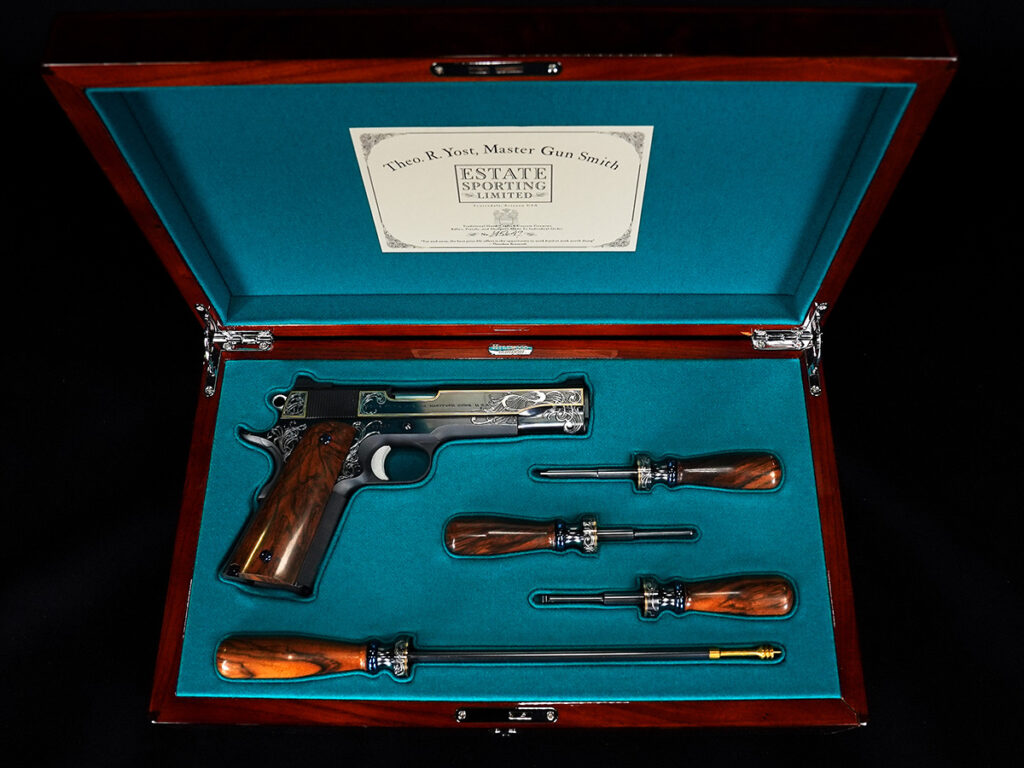
As a new addition to the Gun Digest, this series will focus on a different ACGG category each year, giving an introductory look into what it takes to master the art of custom gunmaking. This year’s focus is stockmaking; let’s pull back the curtain on this Old World craft and dive in.
Stockmaking
Inherent in the process of stocking a custom firearm is a tremendous amount of artistic freedom. From wood selection to laying out stock lines and choosing a checkering pattern and finish, the stock is the equivalent of a race car chassis, steering wheel, and accelerator. One must only sit behind the wheel to get a sense of the balance and artistry of a top-tier performance machine.
Dennis Earl Smith, aka “The Stock Doctor,” and arguably one of this country’s most talented gunmakers, put it succinctly, “You build the gun to the shooter.” Length of pull, pitch, cast and toe measurements are planned for, documented and laid out well before any chips are made. The result born, after weeks or months of labor and numerous steps documented below, is a firearm that points instinctively like an extension of the body and can raise goosebumps with its accoutrements.
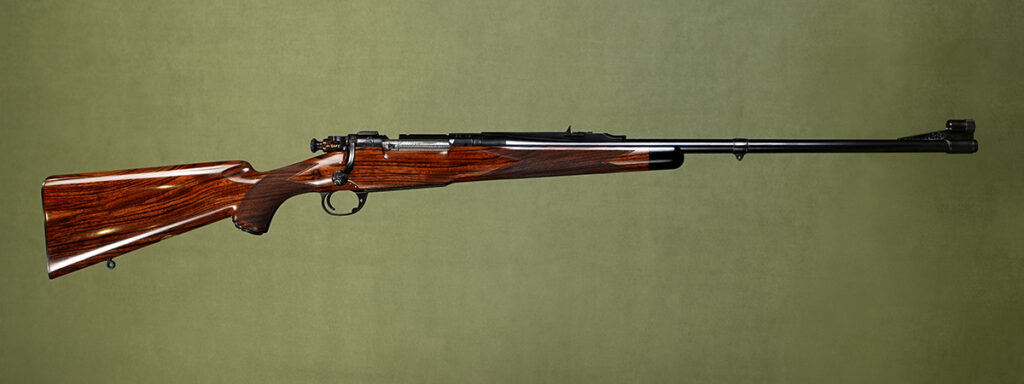
A complete, finished project can be nothing short of awe-inspiring, but what goes into the creation of such snappy, well-appointed firearms? The first step in crafting a one-of-a-kind gun begins when a job is commissioned and wood is chosen for the upcoming project.
Wood Selection
While there may seem to be innumerable options when one starts looking for a stock blank for a project, most custom firearms are stocked in some type of walnut. Sharon Dressel of Yakima, Washington—a Guild professional member and purveyor of gunstock blanks—was kind enough to tour the author through her inventory and point out different characteristics of the wood gunmakers look for and why. Perusing row upon row of blanks, Dressel would occasionally pull a piece out and, with a practiced eye, point out characteristics she’d been describing like the sought-after fiddleback, crotch feather and marble cake pieces, referring to different grain structure in the wood.
According to Dressel, a specific stock blank is chosen for various reasons. These can include: type of wood (there is a plethora of walnut types, each with their own characteristics, with four varieties: California English, Turkish Circassian, Bastogne, and Black being widely used for stockmaking), uniformity of grain structure (for even workability throughout the inletting and shaping process), whether the blank is slab, quarter, or rift sawn (referring to how the grain is presented in the blank), as well as any “figure,” meaning visually obvious wood characteristics that add to the wood’s appeal. Moisture content and how the blank was dried and aged also play a role as improperly dried wood has ruined more than one stock job. With an appropriate blank chosen for the project, it’s time to move on to the layout.
Stock Layout
Layout refers to taking an individual shooter’s measurements and transferring that information into stock dimensions complementing the shooter’s form, style and body type. When fitted correctly, a custom gun won’t feel forced when mounted, it will feel like it’s going home, and the difference in performance and handling can be quite astounding.
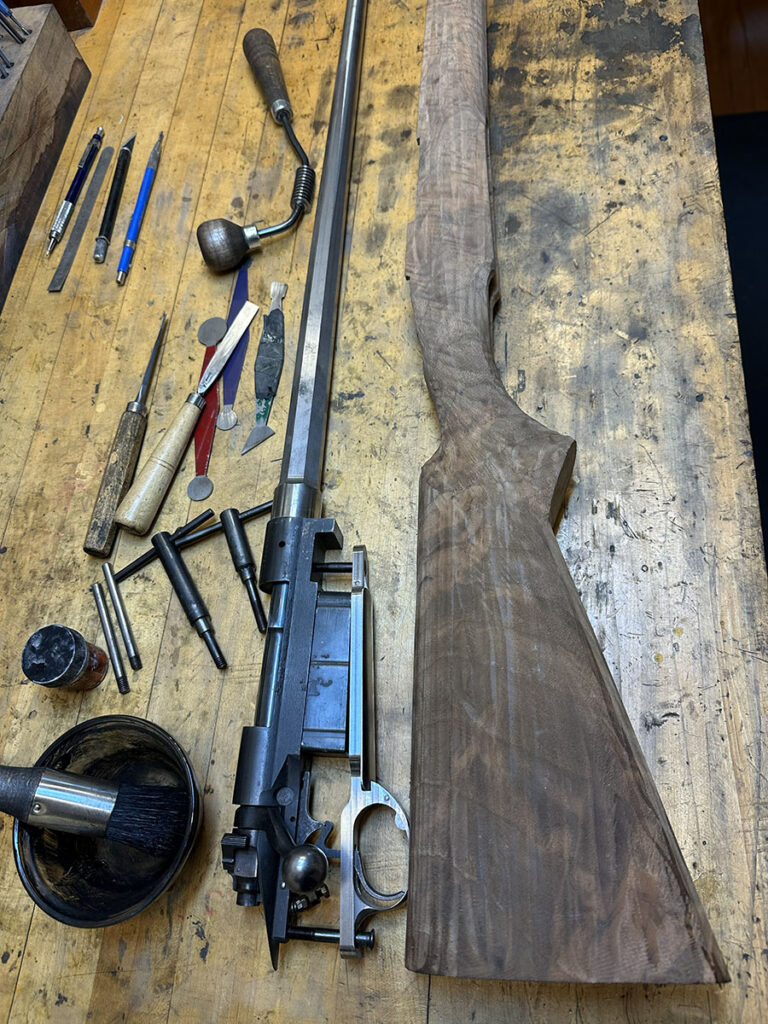
Numerous books have been written on gun measurements, as well as the “how” and “why” for arriving at said measurements for a project. Michael Yardley’s Gunfitting is an excellent resource and starting point to help understand the intricacies that go into measuring a stock for a specific shooter. When practical, stockmakers start with a pattern stock first, observing the client’s shooting style, and make fine adjustments before beginning the build on a fine piece of wood.
Once the rough measurements are taken, it’s time to build a roadmap of sorts to avoid project creep. The stockmaker will trace the top metal onto a piece of graph or butcher paper, then begin to draw the stock profile onto the corresponding metal tracing. Once roughed in, they’ll ensure all the dimensions are correct for the length of pull, cast, toe, pitch, etc. Now, with a life-size drawing, they design and sketch the stock details, paying attention to how the metal and wood lines correspond with each other. Drawing complete, the tracing is cut out and transferred to the stock blank with a pencil, making sure the figure and grain flow in the blank corresponds to the location of the tracing. With the wood marked, a saw is used to cut around the border leaving the material slightly proud of the lines.
Inletting
Now that the extra material is removed, the centerline of the bore measurement and the trigger location are marked, to be used to verify dimensions recorded on the tracing. With the initial measurements done, the buttplate is laid out and marked with the corresponding pitch, cast and toe measurements. The grip and forend cap locations will be located and marked as well if the project requires it. Next, the top and bottom metal can be set by carefully using scrapers, chisels, gouges and other handtools to bring them into the wood. Inletting black [ink] is brushed on the metal surface that contacts the wood to be removed, a black transfer on the wood indicates a high spot to be brought down. Although a painstaking and tedious process, the receiver and barrel should seat with nominal, uniform tolerances—measured in thousandths of an inch—throughout when finished.
Shaping
The metal is set in the stock and all measurements are verified. Now it’s time to start bringing the comb, forend and wrist lines that were sketched on the tracing into the stock and merging them into one piece of art. Flow lines drawn in grease pencil help to keep uniformity and prevent too much material from being removed as areas are blended together by chisel and plane.
Sanding
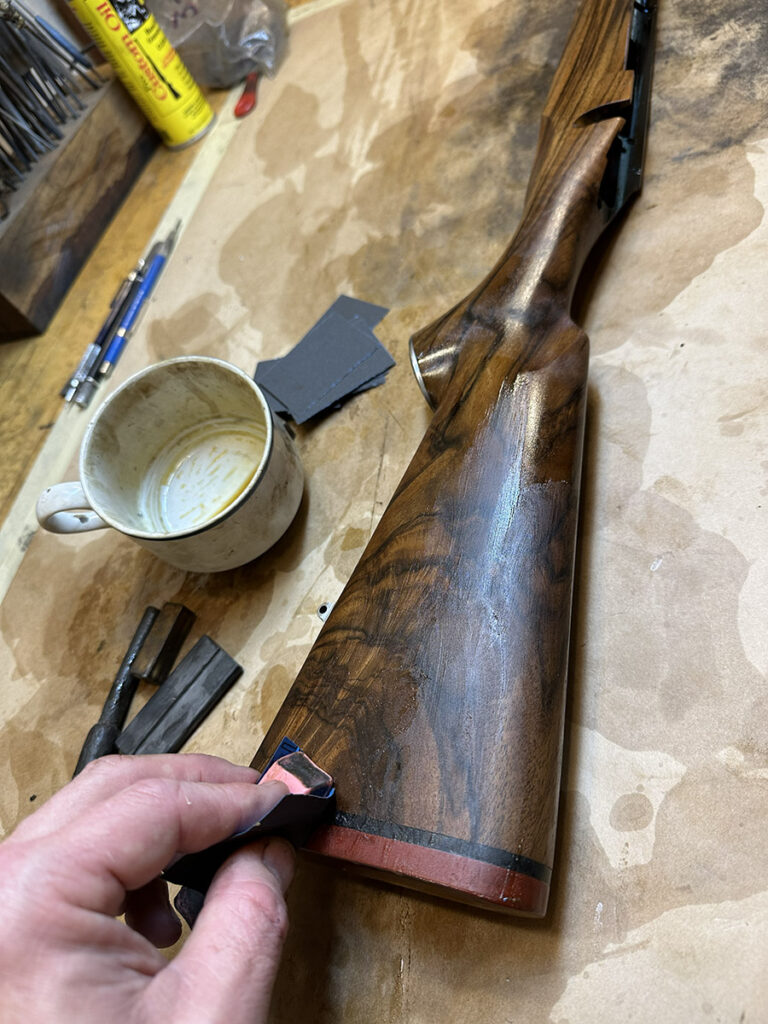
Rough sanding incorporates rougher grit sandpaper (150-280) and must be done carefully to not roll or dull edges that were cut in the shaping process. With care, this step will remove the final, thick layer of wood needing to be sanded, with each finer grit removing the previous round’s deepest mark. Whiskering between sanding takes place until the maker is satisfied with the result.
Whiskering is accomplished when warm water is rubbed onto a stock by rag or hand, then allowed to dry, raising the worked, broken wood fibers to be sanded off; it can take numerous times between sandings before all of the damaged grain is raised and sanded smooth to the touch.
Finish sanding is next. Progressively finer sandpaper (320-2000) allows the sander to finish prep their work for sealing and finishing while removing very little material from the stock.
Finishing
While wood can be cut and transformed into beautiful, purposeful material for stockmakers, it doesn’t lose its proclivity for gaining and losing moisture throughout its life cycle from tree to blank to stock, thus, it requires a suitable finish for the environments it will be exposed to.
Personal preference dictates a choice between an “in the wood” or “on the wood” finish, although hand-rubbed oil-urethane finishes rule the day when it comes to the custom gun world. An “in the wood” finish is applied over many days and many coats, allowing time for the finish to soak into the wood fibers before another coat is applied. These are generally considered complete after the stock absorbs less than a drop or two per coat when rubbed into the wood, indicating the pores are full of oil. A coat of wax can be applied at this point to add an additional layer of protection. An “on the wood” finish is as the name suggests, layered on the exterior of the stock with minimal absorption yet generally faster drying times and higher luster. All finishes, like automotive paint, will need to be touched up and taken care of occasionally to get the long-lasting protection desired for a custom gun.
Checkering
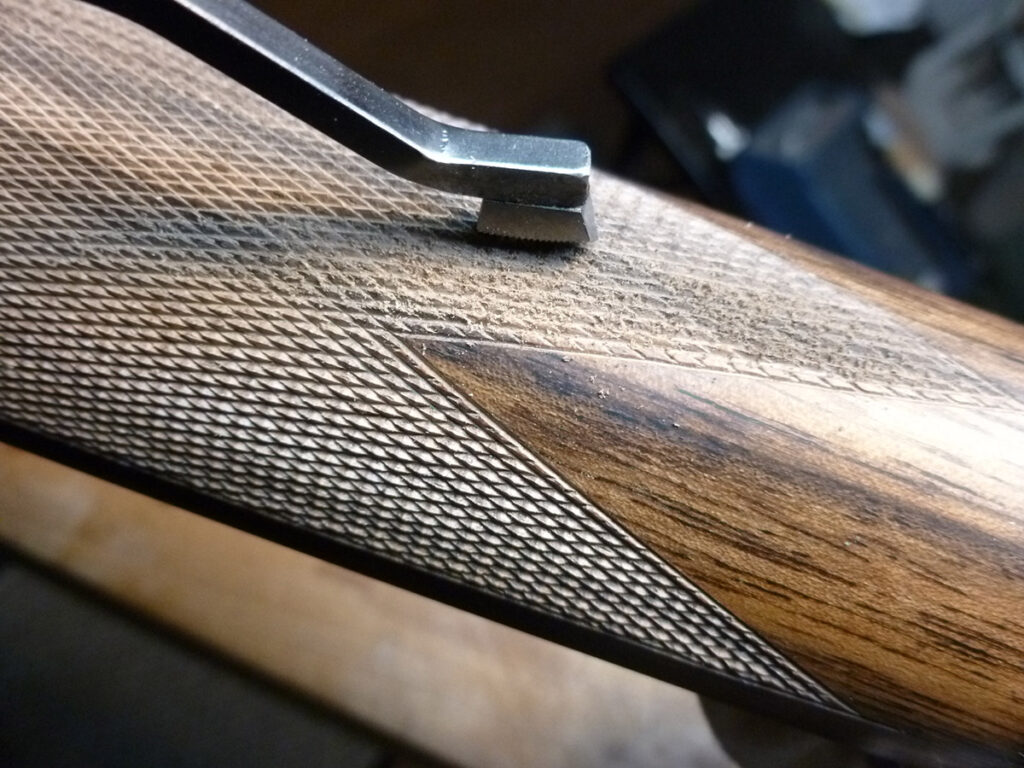
Checkering, at its most rudimentary, is a tactile way to better grip a firearm; at its finest, it’s exquisite art mixed with functional beauty. It’s also the last step in the custom stock but it can ruin it just as surely as the first. Given that, many custom gunmakers prefer to send their work to checkering specialists who can adorn the newly crafted stock appropriately. Those who do their own choose from two options: hand or power checkering. The hand checkering method uses a series of tools to lay out lines per inch (lpi) and diamond ratio of the checkering; when satisfied, the artisan traces a pattern onto the stock before cutting several “master lines” to help guide the layout. Power checkering is laid out the same way but instead of scratching in lines one or two at a time by hand, checkerers hold a tool reminiscent of a dentist’s drill, with a choice of different power options and a small wheel that cuts the lines as it rides over the workpiece. Custom checkering jobs, depending on their incorporated features, can take tens of hours to complete correctly and, conversely, are ruined in one careless slip of a tool.
After passing through the stockmaker’s hands, a custom gun is well on its way with a major component complete. Before the project is done, it will pass across more artisans’ benches: a barrelmaker will carefully turn a piece of metal stock into a one-of-a-kind tube, a metalsmith will use contours and lines to seamlessly join barrel and receiver together, adding custom touches to triggers, scope rings and more. The metal must then be finished, with a variety of choices and processes, the builder is only hindered by their imagination. While some gunmakers prefer to keep most or all of the building process in-house, the American Custom Gunmakers Guild has categories for vetted, professional members that are experts in their chosen fields and often collaborate on projects together.
Conclusion
A custom gun, whether it be a shotgun, pistol or rifle, hearkens back to early America and the craftspeople who had a hand in helping a young country find her feet. The many disciplines it takes to craft a firearm are being honed, nurtured and passed on in a host of shops across America as gunmakers live out the ACGG words: Accomplished gunmakers are few and far between. But you’ll find most of them are members of ACGG. And they’re all ready to pass on the craft and keep this fine art alive.
If you’re interested in learning more about the custom gun world or in joining the American Custom Gunmakers Guild, check out ACGG.org for more information.
While recognizing there are many ways to skin the proverbial cat, this article strives to highlight general workflow ideas provided by Guild members and the author’s research. It features “building from the blank” and not semi-inletted or duplicated stocks, although the process is similar.
Editor’s Note: This article is an excerpt of Gun Digest 2025, 80th edition.
More On Gunsmithing
Read the full article here