




Those of us who spend time in the world’s woods, wadis and wetlands rapidly learn about fieldcraft. Whether we’re out there camo-clad in training for war or hunting up some meat for the freezer, there are certain tactics, tips and procedures that we internalize through good or bad experiences in the field.
Military folks preparing for ground combat missions learn to travel light and never get caught short of water or ammo. Civilian woodsmen or hunters learn to improvise shelters and stay upwind of target game.
The Wrong Tool?
Fieldcraft obviously varies with purpose, but there’s a common denominator: A good knife is often your best buddy. During my years in uniform, it seemed like I was always in the hunt for just the right blade to carry and use in the field. Back in the early ’60s, prior to the big Vietnam buildup, certain Marines were issued the battle-proven K-Bar.

The knife became a status symbol for officers, senior NCOs, and crew-served weapons gunners who rated the K-Bar along with a pistol as their sidearm. The knife was considered garrison property and had to be returned to supply when orders sent a Marine to another billet or command.
This situation led to what I call the great blade binge among Marines. As funds allowed, we plunked down sparse dollars on gear and gadgets that imparted a close-combat killer image. All sorts of bad-ass blades started appearing on our field equipment. Few of them were much worth a damn, but it was a case of form over function and local shops were fully stocked with knives of dubious quality that made us look like ruthless killers. Vietnam heated up rapidly and combat experience in Vietnam taught us that a good field knife needed to be a useful tool before consideration as a weapon. And then came Rambo.

The 1982 film starring Sylvester Stallone as a disgruntled and mistreated Vietnam Veteran struck a nerve through military ranks. Rambo was an avatar for those of us who came home from a controversial war and were mostly ignored or too often vilified. Much of what the Rambo character did in acts of self-defense or vengeance was accomplished using a tricked-out, oversized knife that sent shivers of delight through military ranks. The great blade binge was revised, and we all went looking for knives that were cool. Never mind that most of them were also outrageous and virtually useless as working tools in fieldcraft.
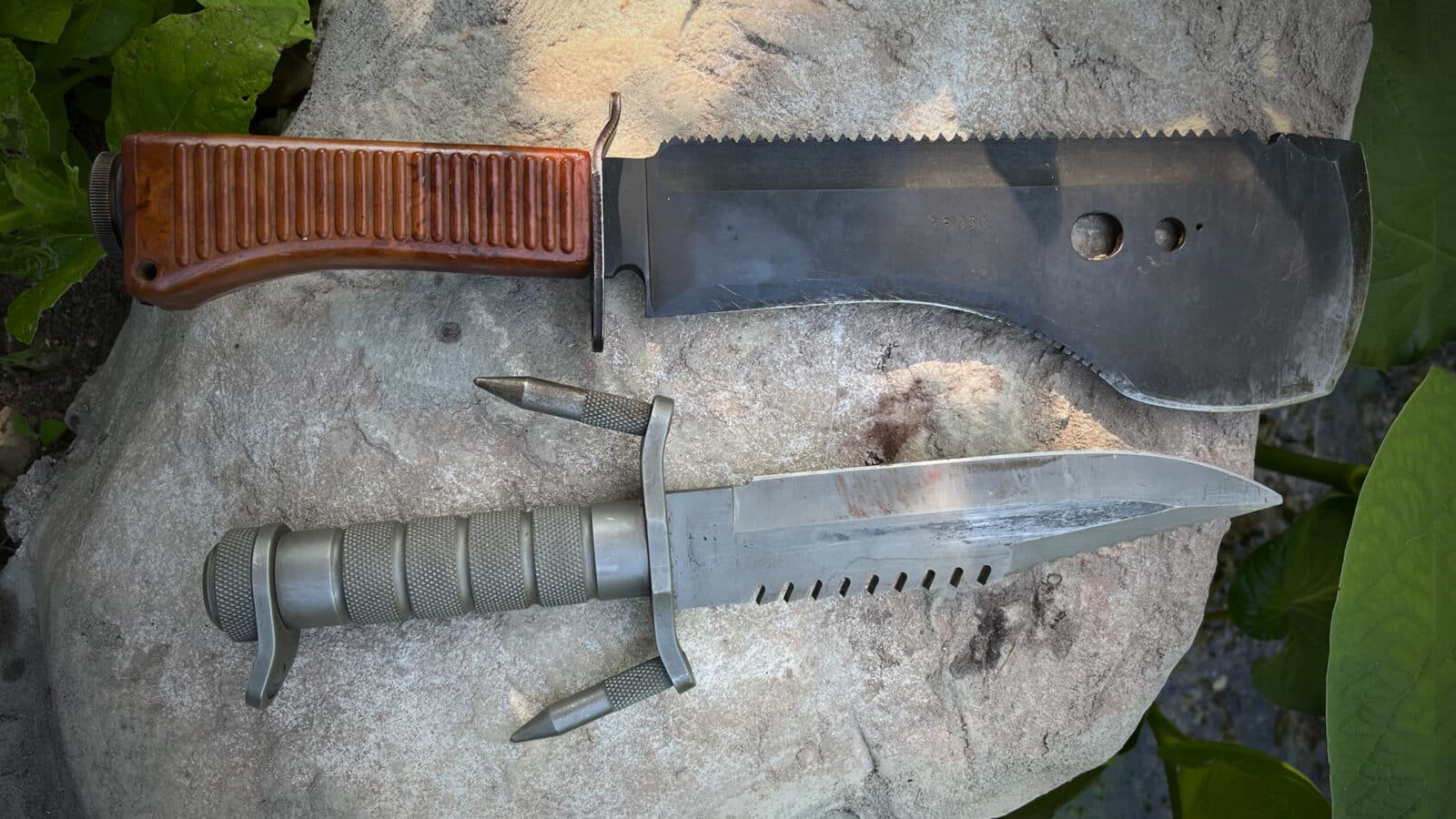
I’m forced to plead guilty here. Over the years, I collected a lot of crap that was supposed to be the ultimate edged tool/weapon for use in the field. An egregious example was a Buck knife featuring vicious — and virtually useless — serrations along the spine and clip point. It had a hollow handle for storing survival stuff like matches and little fishhooks, etc. The knife also featured a pair of detachable metal prongs screwed into the cross-guard that were supposed to turn it into an improvised climbing piton with a line attached to a lanyard loop in the handle. It was a quality product as you’d expect from a distinguished maker like Buck, but none of the touted features worked worth a damn, and the blade weighed just short of a metric ton.
And the Right One?
As I became more experienced and realized that mano y mano edged-weapon encounters with an enemy were a very remote possibility, I returned to practical factors in the great knife hunt. Things like weight, handiness and sound manufacture from quality steel became prime concerns.

And the more I fooled around looking for the perfect field knife, the more often I came full circle and wound up looking at the ubiquitous K-Bar. It was a classic combination of utility and lethality and you could get one to call your own for a relatively affordable price. Available now from Ontario Knives is a K-Bar variant that can be used on the M-16/M-4 family of rifles as a bayonet.
My own ancient K-Bar became the blade of choice for field work from that point in my quest and on through training around the world. It never let me down. It was originally an issue item in Vietnam that was declared a combat loss with the help of a friendly supply sergeant and has been by my side for the past 50 years.

Sharpened on both the belly and clip point, my K-Bar is such a trusty field companion that I began to worry about using it to lever, hammer and puncture. It was perfectly capable of such chores, but if I broke the blade or damaged the washer-stacked leather handle, I’d be heartbroken.
These concerns led me into the fixed-blade tool shed. I remembered incidents in the Battle of Hue City during Tet 68 in Vietnam. Fighting our way through enemy houses and buildings, we often had to pry open things like windows, shutters, or locked sheds. That resulted in many broken K-Bars. While shopping around and talking to knife nerds, I came across a maker named Ray Ennis (now deceased) who made a handy, ultra-rugged chisel-ground knife that was just what I wanted. I have yet to meet a field task involving forceful levering or plain brute-force work that the beefy Ennis knife can’t handle. And it’s light enough not to be a burden in packing for field forays.
The Russian Connection
I also have added a very unique Soviet blade to my collection for the hacking, slashing and wood cutting that’s occasionally required.
There are many solid machete-type blades that can handle such work, and even some little wire saws that are sometimes useful. Each has defects and drawbacks. What I found myself needing was something that had the working edge and heft of a machete, minus the length and limited swing radius, and plus a functional sawtooth edge. The answer surprisingly came in the form of a multi-purpose tool purportedly issued to Russian Special Forces (Spetsnaz under the Soviet organization). It’s called the Taiga, which is loosely translated as the vast forest wildlands of Russia and Canada.

It would certainly be handy in those wilds or any other areas where fieldcraft requires heavy work that’s precise enough to demand good damage control. Just under a pound and a half and a little over 14” long, the Taiga is a beast of a hand tool. It features two sharpened blade surfaces along the belly and across a chiseled forward edge. It will clear a firing point or help build an improvised shelter in a hurry. The spine of the tool features one of the best and most effective sawtooth surfaces I’ve ever encountered. It blazes through dry and green wood like a buzzsaw.

Live The Armory Life. The latest content straight to your inbox plus an automatic entry to each of our monthly gun giveaways!
The Taiga has a hollow composite handle with a compartment for survival supplies, as desired. Unlike other Russian military designs, this composite material handle is ergonomic and comfortable in the hand. The handle features raised ribs for improved grip. There are a number of lanyard and alternate mounting holes in the blade and the cross guard, which makes the tool very versatile. Hidden at the top of the grip is an awl or spear point that can be reversed and used to drill holes in bamboo or framing wood that requires lashing.
[Don’t miss Randy Wilson’s article on the Cold Steel Spetsnaz Shovel.]
A tool like the Taiga is a good thing to have in your pack when you can’t wield a machete or carry a chainsaw. It’s beefy but ultra-handy. It’s also intimidating if that’s a requirement. Doesn’t take much imagination to picture what this thing could do in a close encounter with another human or an angry animal.
Another Level
With these blades in my gear, I could handle most fieldcraft challenges, but there were always those fiddly little chores for which the K-Bar and the Ennis blade (as well as the Taiga) were just too big. I played around with multi-tools but found most of them uncomfortable to use. It seemed to me that they were just packing too many tools into a tight space. Handles hiding multiple awls, saws, files, and scissors tended to raise blisters, and many of the tools were prone to breaking or bending out of shape in rough fieldcraft chores.

That said, one multi-tool made by SOG was handy enough for me to toss it in my pack. The feature that was most attractive in the SOG Power Lock model is a bias cut in the fork where the handles meet when the tool is opened. It’s advertised as a design for crimping blasting caps, but I found it perfect for quickly stripping insulation off wires. And the SOG multi-tool has hinged covers over all the little handle gadgets which make it more comfortable to use for lengthy tasks.
There are multiple times in my life when I just enjoy wandering through the woods and marveling at nature’s brilliance. Most of these jaunts wind up with me collecting interesting sticks, branches or junked items that catch my eyes. Working or fashioning these finds has me reaching for a knife in a pocket. That led me to search in the wide world of folding utility knives. While working on the final episode of Band of Brothers, we traveled to Switzerland and shot on locations that were designed to resemble Hitler’s Eagles Nest in Berchtesgaden. My staff hauled me to a local shop that sold original Victorinox Swiss Army Knives. We were right there in the Swiss Alps, so why not?

They ordered a specially engraved version of the crimson-handled knife, touted as the multi-purpose, all-in-one utility knife for discerning gentlemen. It was a nice gesture and a beautiful pocketknife, but it was not tough enough for fieldcraft. The plastic handles were prone to damage, and most of the available tools tucked into the handles were too easily bent or twisted out of useful shape. The fold-out scissors couldn’t handle paracord or much of anything other than paper. And the corkscrew was useless unless I wandered across some wino’s secret stash in the woods. Back to the search.
On the Journey
There are literally thousands of handy and hard-working folders available on the market, but my instincts turned me toward things the military considered rugged and reliable enough for use by people who are notoriously tough on field gear. What I found was a couple of very practical folders, including an electrician’s knife in the old TE-33 wireman’s kit and the current US and NATO issue M-2205 pocketknife.

Neither is flashy nor intimidating. Both are well-made, rugged and reliable tools worth their weight in virtually any fieldcraft endeavor. Most of the 2205 all-metal folders are stamped “US” on one of the handles. Over the years, I found a version marked USMC, which cemented the deal.

When I wander the woods, that 2205 or the military electrician’s knife is in one pocket or another. Both are rugged, reliable and proof positive when it comes to fieldcraft that simple is superb and plain is beautiful.
Editor’s Note: Please be sure to check out The Armory Life Forum, where you can comment about our daily articles, as well as just talk guns and gear. Click the “Go To Forum Thread” link below to jump in and discuss this article and much more!
Join the Discussion
Read the full article here