




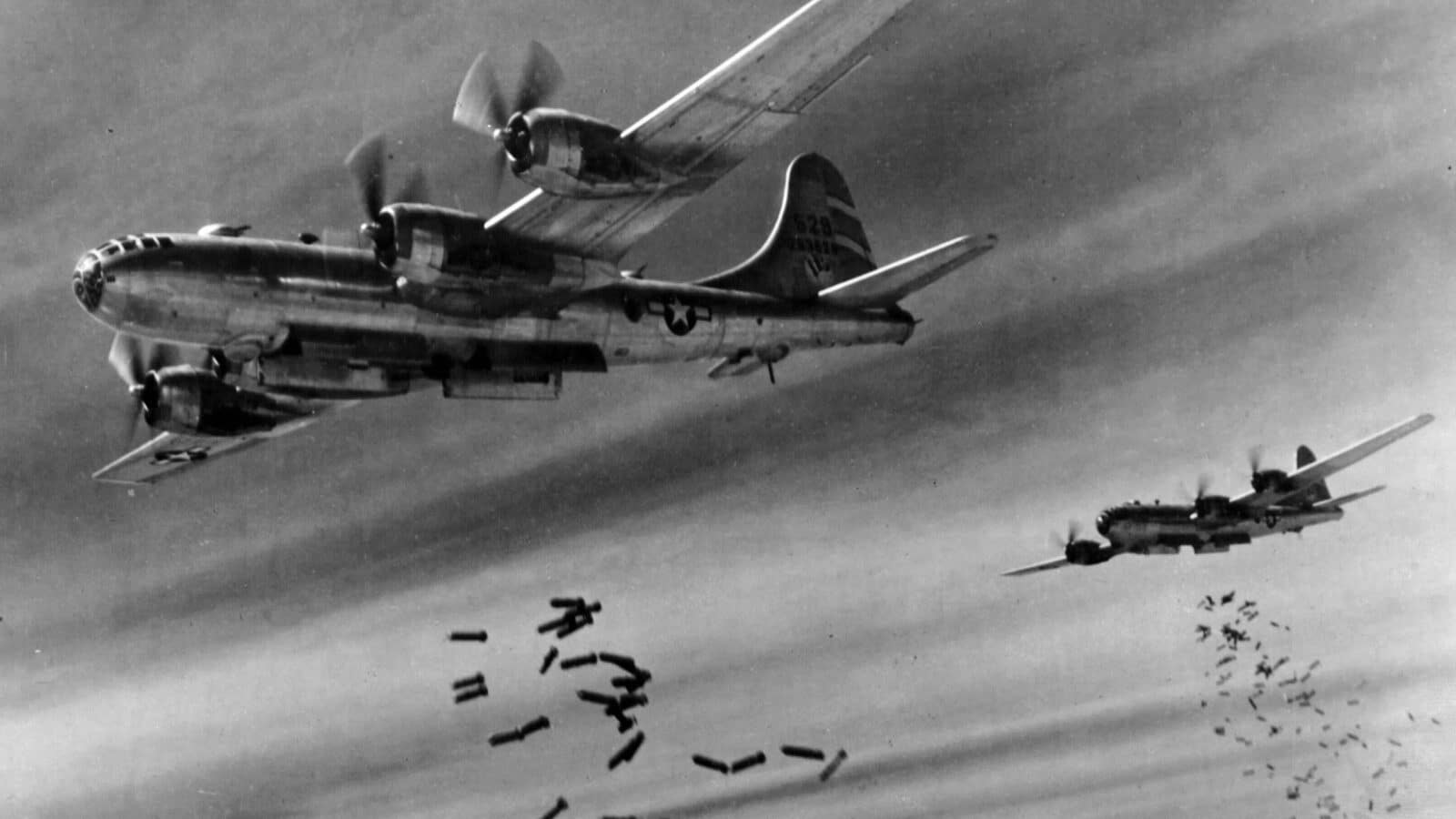
In January 1940, World War II was just four months old. Even so, the US Army Air Corps requested designs for a “Super-bomber”, a four-engine aircraft with a 20,000-pound bomb load and a 2,000-mile range. Boeing already had its B-17 “Flying Fortress” in production, introduced into Air Corps service in 1938. Boeing submitted the design for its “Model 345”, in competition with Consolidated Aircraft’s “Model 33”. The Consolidated aircraft would become the obscure B-32 Dominator. Meanwhile, the Boeing design was destined for fame as the B-29 Superfortress.
While Boeing’s B-17s were leading the strategic bombing offensive over the Third Reich, the Boeing B-29 became locked in a stateside struggle for production capacity. During May 1941, Boeing received their initial order for 14 test aircraft, with 250 production-model bombers to follow. In January 1942, the order was increased to 500 B-29s. At first, the big aircraft were designated “Very Long Range” (VLR) bombers — the Superfortress moniker did not become official until March 1944.

Whatever you called them, the B-29s were expensive. From the initial design to final production, the Superfortress commanded a super-budget, exceeding $3 billion. By comparison, the Manhattan Project budget came in at about $2 billion. The cost of the atomic bomb, along with the aircraft that would ultimately deliver it, added up to a number that few Americans of the era could even conceive of — it cost little for the Axis to start the war, but there would be Hell to pay by both sides to end it.
The Battle of Kansas
Building the B-29 proved far more complicated than anticipated. There were frequent overheating issues with the new R-3350 engines. The pressure seals around the sighting blisters, cockpit, and fuselage windows needed better fitting to maintain integrity during the B-29’s high-altitude missions. There were issues with the electrical system, and the wing structure needed reinforcing. Finally, there were problems with the newfangled, analog-computer-assisted sighting system for the remote-control gun turrets. The Superfortresses were becoming disappointing “hangar queens”.

After the second B-29 prototype crashed with a full crew on February 18, 1943, a complicated series of updates was required. These changes became so frequent and complex for the sophisticated new bomber that the B-29s were being flown directly from production facilities to modification centers! Many of the centers lacked proper facilities (and qualified personnel) to handle the work.

When the calendar turned to 1944, B-29s were being built by the dozen, but only about 15% were airworthy. At this point, General Hap Arnold intervened for the first time regarding the B-29, ordering production experts from Boeing factories to the modification centers. Consequently, about 150 B-29s were made ready during March-April 1944, enough to equip the first bomb groups forming for operations in the Pacific.
Getting Over the Hump
The first B-29s to see combat were based in India and, through a promise made by President Roosevelt to the Chinese government, in southern China as well. To use the bases in China, the new XX Bomber Command had to do much of the hard work of supplying itself. Several B-29s were stripped down and used as makeshift cargo aircraft to carry fuel and bombs to the rudimentary Chinese fields. These supply missions were flown over the Himalayas — the difficult, dangerous route known as “Over the Hump”.

B-29s began to arrive in India during April 1944, and their first flight over the Hump was on April 24th. Superfortress squadrons slowly built strength over two months to conduct combat missions — their first on June 5th, when 77 B-29s flew from India to hit targets near Bangkok, Thailand.

On June 15, 1944, nearly 70 Superfortresses left bases near Chengdu, China, to strike the steel works at Yawata, Japan, the first time Imperial airspace had been penetrated since the famous “Doolittle Raid” during April 1942. A dozen B-29 raids struck Japan between July 1944 and the beginning of January 1945. During this time, additional strikes were carried out on Japanese installations in Singapore and Bangkok. By the end of January 1945, the B-29s were withdrawn from China, and their last mission from India was flown on March 29, 1945. After that, the Superfortresses relocated to new bases in the Central Pacific, among the Marianas Islands.

From a strategic standpoint, the XX Bomber Command’s mission was not particularly successful. However, many lessons were learned about the new bomber, and the six months of combat trials prepared the men and machines for the bombing campaign soon to come from the Marianas.
High Altitude Bombing, Low Results
It may be surprising to some, but the initial attacks on Japan from bases in China, coupled with the high-altitude campaign flown from bases in the Marianas (11-44 to 2-45) produced negligible results. In the words of a 1953 USAF report: “The daylight bombing campaign against Japan was not only a failure, but an abject failure. After 2,000 high-altitude sorties, not even one of the 11 main aircraft factories in Japan had been destroyed. Such a complete failure demands an explanation.”

In late January 1945, an operations analyst provided a detailed report to the Chief of Staff of the XXI Bomber Command on the reasons for the dismal bombing results. The primary fault was the bombers’ consistent failure to reach the initial point (IP). This was exacerbated by an abnormally high 30 percent abortive rate.
The high-altitude missions resulted in very high fuel consumption, and when the bombers failed to reach the IP, they frequently bombed targets of opportunity as their fuel supply dwindled. The fuel shortage was connected to failures on the part of the pilot, engineer, or navigator — including faulty navigation, and chronic radar malfunction. In some instances, airplane commanders deliberately chose a different IP other than the one assigned at briefing.

The bombing runs were assessed as particularly sloppy: too often, the B-29s remained above the ordered bombing altitude to escape Japanese AA fire. These changes were not communicated to the bombardier in time to adjust the bombsight data. Bomb-run headings varied widely among the squadrons, sometimes by as much as 60 percent. The differences in bomb-run headings pointed to poor formation flying, which was worsened by poor takeoff sequencing. Finally, the bomb-release technique was graded as very poor, with icing and other weather conditions at high altitude affecting visibility and timing, which drove the “cumulative lag” in bomb release.

Live The Armory Life. The latest content straight to your inbox plus an automatic entry to each of our monthly gun giveaways!
The report also noted “a preoccupation with fighters” contributing to less-than-impressive results across the board. Even though Japanese interceptors struggled to deal with the massive B-29s at high altitude, their aggressiveness was concerning. Beginning in August 1944, a few Japanese pilots opted for suicide ramming attacks on B-29s, and while this Kamikaze tactic was rare, it certainly had a dramatic impact on the bomber crews. In total, it is believed that ramming attacks destroyed nine B-29s and damaged about a dozen more by the end of the war.

Mother Nature also played a role in disrupting the B-29’s daylight raids. The winds at high altitude over Japan were up to 200 miles an hour, stressing the skills of pilots and navigators, and degrading the performance of even the best bombardiers.
Something different needed to be done.
Changes in Altitude (and Attitude)
It is not an exaggeration to say that the switch to night raids and fire bombing by the B-29s changed everything. In 1953, the USAF Historical Division produced a highly detailed report titled “The Development of Night Air Operations 1941-1952”. This represents the mostly untold story of the B-29’s success as a conventional bomber.

“It was in the strategic bombing of Japan that the Air Force really used night bombing as a policy. The transition to night operations was made somewhat unwillingly, but it achieved results far greater than expected. In its main phase, this night bombing was merely a further development of tactics and doctrine already practiced by the RAF in its bombing of Germany. It was, to be sure, more effective than British bombing because Japanese cities were not defended so well as German targets, and because Japanese cities were so built as to be extremely vulnerable to incendiary attack. and because the B-29 was a faster plane than the British heavies, yet capable of carrying a tremendous bomb load.
Nonetheless, the “Fire Blitz” as the incendiary bombing program was called, did not involve radically new tactics or principles. Before the end of the war, however, the Twentieth Air Force had carried out two revolutionary developments. One of these was a program of aerial minelaying on a far greater scale than had ever been attempted before, and which proved highly effective. Secondly, with improved radar devices, the 315th Wing of the Twentieth Air Force destroyed, for all practical purposes, Japan’s petroleum industry with 15 extremely accurate night precision bombing missions.”
Night Bombing Clues
US aircraft flying weather reconnaissance over Japan by night regularly reported that “Japanese night defenses were entirely inefficient” during those flights. The 479th Group reported that when Japanese night fighters were airborne, “They never found our aircraft, but seemed to fly around blindly firing an occasional burst of tracers, as though trying to draw return fire, so that it could locate our craft.”

With Japanese night defenses proven to be weak, night bombing was clearly indicated as a solution to the B-29’s bombing accuracy problem, and incendiary attacks on large cities seemed to provide the best opportunities. The inefficiency of Japanese night-fighters had been shown by the success of the USAAF’s nightly weather-strike sorties. Japanese searchlights had proved to be relatively inefficient, with intelligence indicating they depended on visual contact for AA gun control. Japanese radar was also relatively inefficient. Japanese automatic weapons (25mm) were completely ineffective above 5,000 feet and their barrage balloons were moored below that level.
Go Low and at Night
At first, General LeMay’s decision to use the B-29s at low level and at night was considered an outrageous risk. In fact, the General’s plan was well researched and supported by verified intelligence data.

To avoid weather difficulties at high altitude and to increase bomb load, the B-29’s altitude would come down to less than 10,000 feet. To further increase the bomb load, all the guns and ammunition were removed.
After the first mission, the .50 caliber tail MGs with 200 rounds of ammunition were restored, and this was the only defensive armament normally carried on B-29 night missions for the remainder of the war.

The five incendiary raids of March 1945 caught the Japanese by surprise and were technologically unprepared, as Washington gave the go-ahead for the use of napalm incendiaries against Japan’s lightly constructed cities. Area bombing would not strike major factories, but it would impact the many small manufacturing sites interspersed among the civilian population. As the British had learned in their nighttime area-bombing of German cities, “de-housing” a large portion of Japan’s labor force would also degrade Japanese production.
Japan’s Lack of Foresight
A USAAF report titled “Survey of Japanese Anti-aircraft Artillery,” produced in late 1945, confirms General LeMay’s decision to send his B-29s in at low altitude.

“There can be no question but that the Japanese high command failed to properly estimate their requirements for air defense of the homeland. Due to their isolated location, they did not visualize the possibility of serious air attack. To the extent that there was an appreciation of requirements for air defense, it was generally considered that the Air Forces would provide this defense. Little importance was attached to antiaircraft artillery. Quoted below comments of a few of the many witnesses interviewed on the subject”.
Lt. General Ito, 4th AA Division: The understanding of the necessity for anti-aircraft artillery was lacking in the higher headquarters of the Japanese Army. “It was not appreciated that the winning or losing of the war would hang on aircraft.”
Major General Kawaii, 3d AA Division: “Before the war, there was very inadequate recognition of the importance of antiaircraft artillery. This realization did not come about until the bombings began.”
Major Komuratani, Imperial Headquarters: “Antiaircraft artillery at the beginning of the war did not do too well on hitting American planes, so air defense passed almost completely to the Air Force. Later, however, the Army found they should have made more anti-aircraft artillery as it was impossible to produce enough fighters. This was decided during the time of your large-scale bombing attacks. We did not then have the establishments or the time to make additional antiaircraft artillery.”
With reference to a query as to why no improved weapon had been designed to replace the Type 88 75-mm gun, designed in 1928, and still the principal mobile gun in the Japanese anti-aircraft artillery, Colonel Oshima, of the 2d Army Laboratory replied: “We didn’t think about revising our anti-aircraft guns because they weren’t so important in Japan until recently.”
Ineffective Responses
The Japanese could exercise little operational control over their anti-aircraft defenses at night or under poor visibility. Since their radars were practically useless for gun-laying and they depended almost entirely on searchlight illumination, they were limited to firing on targets of opportunity.

There are many instances where the Japanese were unable to fire a single round of aimed fire against large night raids when the raid was overcast. There are instances of raids by a hundred or more planes when the anti-aircraft artillery ammunition expenditure was less than 100 rounds.
Tokyo Meetinghouse
The sum of what XXI Bomber Command had learned over nearly four months of battling Japanese flak, fighters, and weather was added to the known inflammability of Japanese cities. The result was revolutionary.

Lowering the bombing altitude from above 25,000 feet to below 9,000 feet, the mission planners gained greater accuracy and increased bomb loads. Winds became more manageable at about 25 knots. Cloud coverage was less of a problem, and better radar scope definition offered more precise navigation and aiming points.
Most importantly, the lower altitudes used less fuel in the B-29’s gas-guzzling engines, and this in turn allowed heavier bomb loads. Each bomber could now carry nearly 14,000 pounds of munitions — and every ounce of their bomb load was dedicated to incendiaries.

This is how “Operation Meetinghouse”, the B-29 strike on Tokyo during the night of March 9-10, 1945, became the most destructive bombing raid in history. More than 100,000 Japanese were killed as 16 square miles of the city were consumed in a firestorm.
Much of central Tokyo’s industry was contained in small cottage-industry shops, and the fire blitz reduced the capital’s industrial output by more than half. The city was devastated, and more than one million residents were without food or shelter.

The tragic calculations show that the Tokyo raid dwarves the Dresden (2/45: 35,000 deaths) and Hamburg (7/43: 43,000 deaths) firebomb raids, and in terms of casualties, it exceeds both the Hiroshima (70,000 deaths) and Nagasaki (40,000 deaths) atomic bomb attacks.
During the Operation Meetinghouse briefings, the Superfortress crews were highly skeptical, with some considering the mission almost suicidal. Although 325 B-29s took off, only 279 bombed Tokyo, as 26 aborted and 20 bombed alternate targets. Losses were higher than normal, with 14 bombers shot down and 42 damaged. But the results were finally impressive.

Recon photos revealed that 16.7 square miles of Tokyo had been burned out. Having seen the tremendous flames during the mission, and the photographic proof in the following days, the crews “were anxious for more of that sort of raid”. Resistance had been unexpectedly light, as night-fighter interceptors had flown around aimlessly, while searchlights waved in vain across Tokyo skies.
The Boeing “super bomber” that was being derided as an expensive disappointment became an important symbol of American power, technology, and global military might even before the atomic bomb.

After “Meetinghouse”, XXI Bomber Command carried out a series of incendiary raids against Japan’s largest urban areas, which concluded on June 15th. Six experimental night missions were flown against precision targets, and from April 7th until the end of the war, precision daylight strikes were carried out at medium altitude against precision targets. Many of the daylight missions were escorted by long-range P-51 Mustangs based on Iwo Jima.
The B-29s supported the massive Okinawa invasion fleet with daylight, tactical attacks against Japanese airfields on Kyushu (to suppress Kamikazes) from mid-April to mid-May. The Superfortress crews became ever more proficient in night attacks, with incendiary raids on secondary Japanese cities from June 17th, and a wildly successful series of night precision bombing by the 135th Bombardment Wing that devastated the Japanese oil industry. Another major Superfortress success came in the aerial mining of Japanese harbors and coastal shipping lanes.

This entry from the May 1945 “Air Intel Summary” described the varying levels of Japanese air opposition:
“Resumption of large-scale B-29 attacks against industrial and fuel targets met interception of varying intensity, with the strongest consisting of 180 attacks by 142 aircraft against 455 B-29s attacking Nagoya on 14 May. The succeeding Nagoya attack on 17 May by 443 B-29s met with weaker aerial opposition. Two B-29 attacks against fuel targets met interception varying from nil to 75 aircraft. In addition to the bombing toll being exacted by the B-29s, and reflected in reduced production figures, P-51s have conducted fighter sweeps over the Tokyo area, destroying or damaging 42 aircraft on Atsugi airdrome on 17 May without encountering any interception.”
The End of the End
The last phase of the B-29 operations involved the two atomic bomb attacks, which destroyed Hiroshima and Nagasaki and ended the nightmare of World War II. General LeMay’s confidence in the B-29 had paid off, and the Superfortresses avenged Pearl Harbor by bombing and burning the Empire of the Rising Sun into a permanent eclipse.
Editor’s Note: Please be sure to check out The Armory Life Forum, where you can comment about our daily articles, as well as just talk guns and gear. Click the “Go To Forum Thread” link below to jump in and discuss this article and much more!
Join the Discussion
Read the full article here