





Passing into the realm of the up-there requires not only a mindset change but also a good change of clothing. Waterproof, burly, and breathable, the best hardshell jackets provide it all for your next foray into mountaineering, backcountry skiing, alpine climbing, or just downright miserable weather.
After many seasons spent above treeline, I winnowed my closet down to the most capable shells on the market in 2026. Included are jackets for every alpine mission, from burly alpine armor like my top pick, the Arc’teryx Beta AR, to budget-minded shells like the Patagonia M10 Storm that will get you in and out in one piece.
During testing, my team and I sought out high-mountain terrain that would sufficiently test the weatherproofing, durability, and livability of these jackets. We paid special mind to long-term performance over 24-hour periods, and our testing included input from alpine enthusiasts of every stripe, from current American Mountain Guides Association-certified guides to weekend warriors. Below, I’ve gathered the best hardshell jackets that made the grade during our travels.
Editor’s Note: We updated our Hardshell Jacket guide on January 4, 2026 to add the North Face Papsura as our best ‘Fast and Light’ hardshell choice. We’ve also updated our testing feedback on several different shells as the market shifts to using the new GORE-TEX ePE membrane — a PFAS-free design that is just as waterproof as the old material, but requires more frequent washing to maintain its effectiveness.
The Best Hardshell Jackets of 2026
Best Overall Hardshell Jacket
9.1/10 Rating
Best Budget Hardshell Jacket
7.0/10 Rating
Best Hardshell for Extreme Alpinism
9.3/10 Rating
Best Hardshell Jacket for Ski Mountaineering
7.5/10 Rating
Best Fast and Light Hardshell
8.9/10 Rating
See more picks
-
Versatile feature set -
Unique raised collar for weather protection -
Built with GORE-TEX Pro ePE membrane -
Lightweight at only 1 pound (tested men’s medium) -
Rugged exterior shell fabric absorbs abrasion
-
Price -
New version of GORE-TEX Pro ePE needs to be re-waterproofed more often -
No two-way front zipper
-
Super lightweight for the protection it provides -
Relatively budget price -
Two-way front zipper -
Chest pockets are different sizes for storing both gloves and smaller kit -
Wrist cuffs have a polyurethane lining to grip and stay put
-
H2No membrane isn’t the most waterproof out there -
DWR finish will need to be refreshed more often -
No pit zips
-
Burly 100D outer face fabric paired with GORE’s new ePE Pro -
Excellent water-resistant zippers -
Integrated RECCO reflector -
Roomy fit accommodates large insulation layers underneath -
Fairly light for the protection provided
-
Quite expensive -
Breathability isn’t the best for very high-output activities -
New DWR finishes won’t impress those familiar with the old stuff
-
Lightweight and flexible shell -
Soft merino wool inserts on interior collar -
Impressive breathability -
Integrated stretch in fabric
-
More trim cut won’t work for everyone, or for layering much underneath -
Fine-toothed zippers can be difficult to move -
Left-handed main zipper
-
Quite lightweight at 8 ounces -
Highly breathable air-permeable membrane -
Climbing-specific fit and features -
Non-PFC DWR finish
-
Crinkly 7D material can be a bit noisy if you’re paying attention -
Won’t be as waterproof as other hardshell jackets -
Price
Other Hardshells For the Sharp End
The hardshell jackets I’ve highlighted above are the six our team of climbers, skiers, and expedition adventurers leans on the most in our travels, but they aren’t the only worthy options out there. Check out the list below of solid alternates that we’ve tested and trusted in the backcountry.
-
Hadron LCP face fabric cuts weight significantly while retaining strength -
GORE-TEX ePE 50D membrane across the shoulders and sleeves -
Excellent articulated cut -
Generous helmet-compatible hood -
Newly added RECCO reflector and internal dump pocket in 2025
-
TorsoFlo pit-to-hem zips provide incredible ventilation -
Four front of jacket pockets -
Helmet-compatible hood -
Dual separating front zipper -
Great value for the feature set and materials
-
Won’t be as weatherproof as a GORE-TEX Pro shell -
75D exterior fabric is tough, but doesn’t move the best
-
3L Toray membrane works impressively well -
Lightweight at less than 1 pound -
Nice roomy fit to accommodate layers underneath -
Reflective details -
Hood is nicely adjustable and helmet compatible
-
Pit zips only zipper in one direction -
Not widely available to try on -
Won’t be as bombproof as a GORE-TEX Pro shell
-
Protective drop hem and wrist collars -
Patterned face fabric design for increased durability -
Unique ‘X-open’ pit zip design -
Articulated cut
-
Limited adjustability in hood -
Price
-
Zero PFC build, down to the GORE-TEX ePE membrane -
Two generous chest pockets, with clean profile -
Hood gasket is insulated with synthetic fill -
Wrist gaskets seal out snow -
Jacket hem is cut for space to clip kit to harness
-
Breathability isn’t the best for high-output endeavors like ski touring -
Pit zips are a little small
-
Smart feature set execution -
Helmet-compatible hood with impressive adjustability -
Two-way front zipper -
RECCO reflector
-
Front pockets share volume, which can get a bit snug -
Sizing is a bit small
-
Excellent breathability -
Hybrid fabric mapping bolsters moisture venting -
Soft suede inserts in hood
-
Overall waterproofing suffers a bit for the breathability -
Heavier overall
Hardshell Jacket Comparison Chart
| Hardshell Jacket | Price | Material Construction | Waterproofing/Breathability | Pockets | Weight |
|---|---|---|---|---|---|
| Arc’teryx Beta AR | $650 | 40D/80D 3L GORE-TEX ePE Pro | 28,000 mm / <13 RET | Two handwarming pockets | 1 lb. |
| Patagonia M10 Storm | $379 | 30D 3L H2No Performance Standard | N/A / N/A | Two Napoleon chest pockets | 10.9 oz. |
| Outdoor Research Headwall Jacket | $469 | 75D 3L GORE-TEX ePE | 28,000 mm / <13 RET | Two handwarming, two Napoleon chest pockets | 1 lb., 1.6 oz. |
| Arc’teryx Alpha SV | $900 | 100D 3L GORE-TEX ePE Pro | 28,000 mm / <13 RET | Two Napoleon chest pockets | 1 lb., 1.4 oz. |
| Ortovox Westalpen 3L Jacket | $640 | 3L Toray Dermizax NX | 20,000 mm / 28,000 g/m² | Two Napoleon chest pockets | 1 lb., 1.3 oz. |
| The North Face Papsura Jacket | $350 | FUTURELIGHT 3L | N/A / 75,000 g/m² | Two handwarming pockets | 8 oz. |
| Arc’teryx Alpha Jacket | $700 | 40D/20D 3L GORE-TEX ePE + Hadron LCP | 28,000 mm / <13 RET | Two handwarming pockets | 13.1 oz. |
| Himali Monsoon Jacket | $460 | 3L Toray Dermizax | 20,000 mm / 20,000 g/m² | Two handwarming, one interior | 15.4 oz. |
| Norrøna Trollveggen GORE-TEX Pro Light | $699 | 40D/70D 3L GORE-TEX ePE Pro | 28,000 mm / <13 RET | Two Napoleon chest pockets | 1 lb., 1 oz. |
| Patagonia Super Free Alpine Jacket | $599 | 40D 3L GORE-TEX ePE | 28,000 mm / <13 RET | Two handwarming pockets | 14.8 oz. |
| Rab Latok Mountain GORE-TEX Pro | $550 | 40D/80D 3L GORE-TEX ePE Pro | 28,000 mm / <13 RET | Two handwarming, one Napoleon chest pocket | 1 lb., 1.8 oz. |
| The North Face Summit Torre Egger | $590 | 20D/70D 3L FUTURELIGHT | N/A / 75,000 g/m² | Two handwarming, one Napoleon chest pocket | 1 lb., 3.8 oz. |
How We Tested the Best Hardshell Jackets
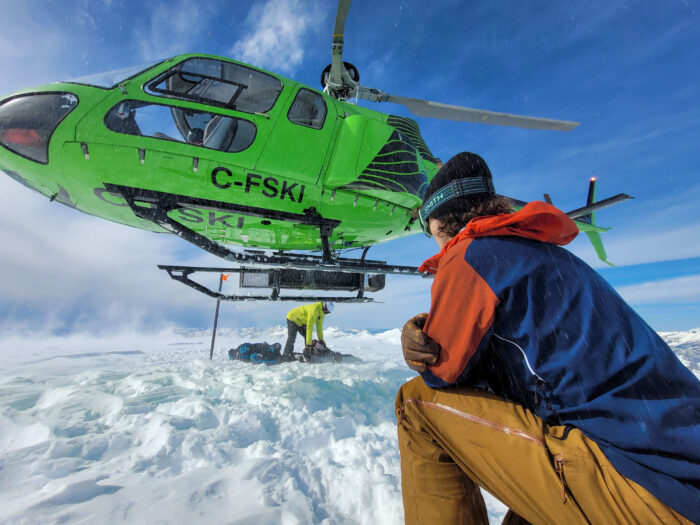
From the craggy tumbles of the Rockies to the snow-plastered granites of the Sierra, GearJunkie hosts a healthy number of alpine climbers, skiers, and mountaineers who know the sting of a bad turn in the weather — and how to guard against it. Our collective knowledge is brought together here to help guide your next hardshell jacket decision.
Our Testing Process
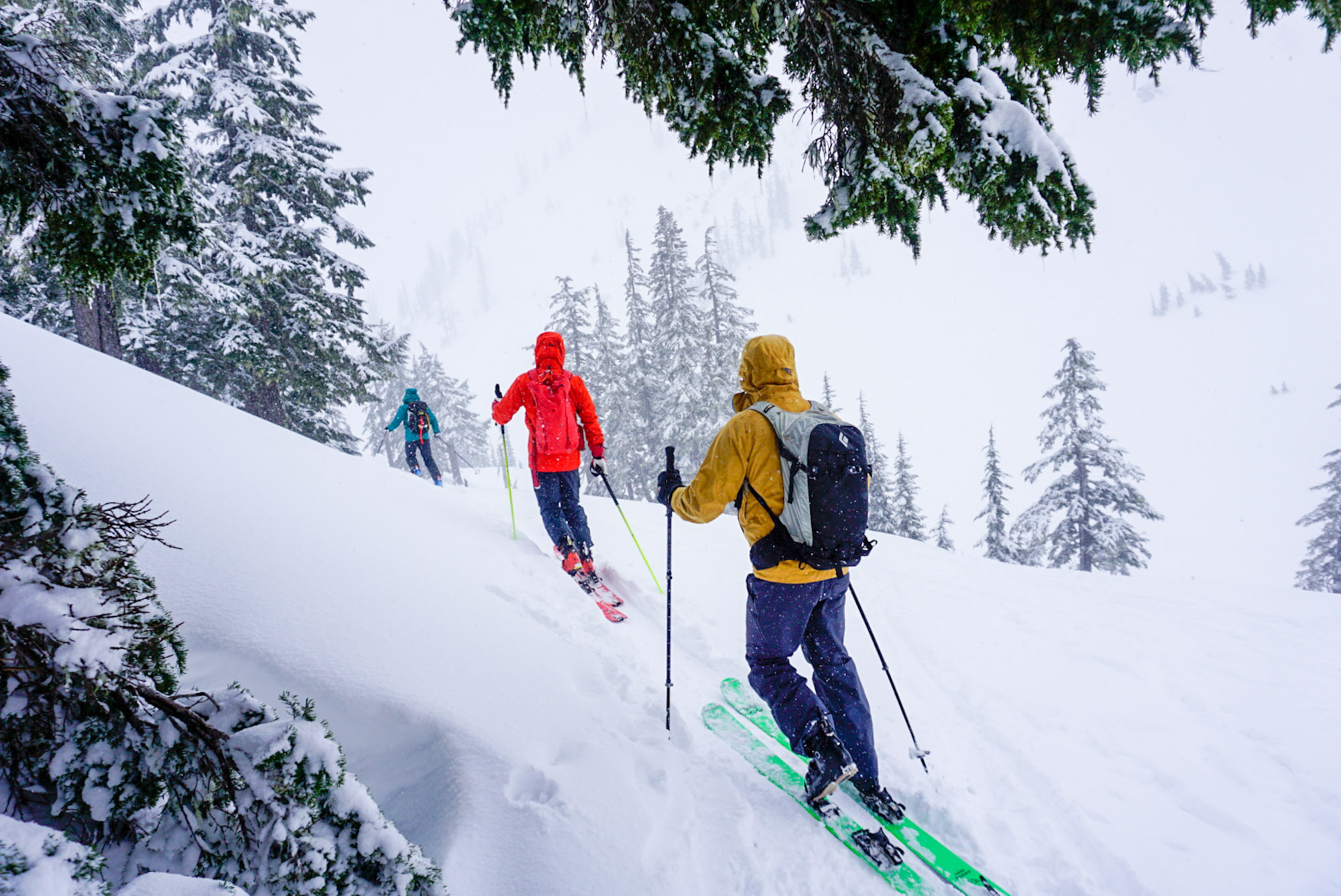
- Field testing: The majority of our testing takes place on alpine climbing objectives in the North Cascades, with the 10,786-foot hulk of Kulshan (Mt. Baker) serving as our most standard test bed. We use the popular glacier routes on Kulshan to challenge these jackets in quasi-standardized field tests, averaging similar 5,000-foot vertical gain days in different shells. From walk-ups to WI3 alpine ice, we test the waterproofing, durability, and mobility of these shells. One of our testers also hails from Alaska, where she guides both mountaineering and backpacking objectives. She’s tested hardshells on Denali ascents, during packrafting expeditions in the Brooks Range, and while climbing and skiing in her backyard, which happens to be the head of a glacial valley where windstorms and blizzards are par for the course.
- Waterproofing shower challenge: Our bench testing begins with our standard shower test, where we wear hardshells while standing directly under the shower, which acts as a simulated rainstorm, for 10 minutes. Afterward, we check for moisture ingress inside the jacket, giving us a good idea of the quality of the waterproofing and seam sealing.
- Weight and packability verification: Weight and packability are also tested with the help of our scales and a standard 5-liter stuff sack. We like to independently verify these numbers to ensure accuracy, and often find that brands can slightly inflate their numbers.
- Our hardshell jacket rating system:
- Weather Protection: 30% weighted. We take the results of both field and bench testing into account when rating for weather protection, and also consider the material protection you’ll receive from burly face fabrics. Alpine climbing can be a contact sport, after all.
- Breathability: 30% weighted. Breathability is rated both with any mechanical venting closed and opened, and compared against known performers to understand where on the scale they land.
- Comfort & Fit: 20% weighted. After fit and mobility testing on a few different climbers, we compare notes and rate for comfort and fit. Soft-facing materials in the collars, wrist closures that stay closed, and a long draping cut in the rear all amount to a higher rating.
- Weight: 20% weighted. Finally, we rate these jackets on their overall weight. We’re willing to carry a bit more weight for extra weather protection when conditions are grim, so we don’t weigh this metric as heavily against a jacket’s overall rating.
Our Expert Testers and Testing Locations
I, Senior Editor Nick Belcaster, am the principal tester of this review, and reside beneath the sheer rise of the North Cascades of Washington State — the perfect test bed when seeking out both precipitous vertical relief and poor weather. My gear testing ranges from camping tents to kayaks, but I also test rain jackets for GearJunkie, meaning I see all types of poor weather forecasts as an opportunity to challenge these shells.
In addition, I have prepared and outfitted many alpine climbers setting out on expeditions in the grand ranges of the Karakoram, Alaska Range, and Andean Cordilleras — guiding their equipment choices to best prepare them for weeks spent under unkind elements. I, along with several AMGA mountain guides, have spent years in the mountains to assess the worthiness of a range of hardshell jackets.
Alaskan mountain guide Chelsey Cook tested several women’s hardhells for this guide. She’s tested everything from four-season tents to pee funnels and enjoys thrashing gear in the Alaska Range, as well as the numerous peaks in her own backyard. She looks for hardshells that will stand up to the renowned wind and weather of the mountains she plays in for numerous seasons, and prioritizes gear that fits women’s bodies.
Contributor Seiji Ishii also rounds out our testing team, and with multiple first ascents on ice in Alaska, he’s the sharp end of our spear in hardshell testing. He’s taken multiple shells deep into the backcountry where failure isn’t an option, and that experience informs his opinion.
Buyer’s Guide: How to Choose a Hardshell Jacket
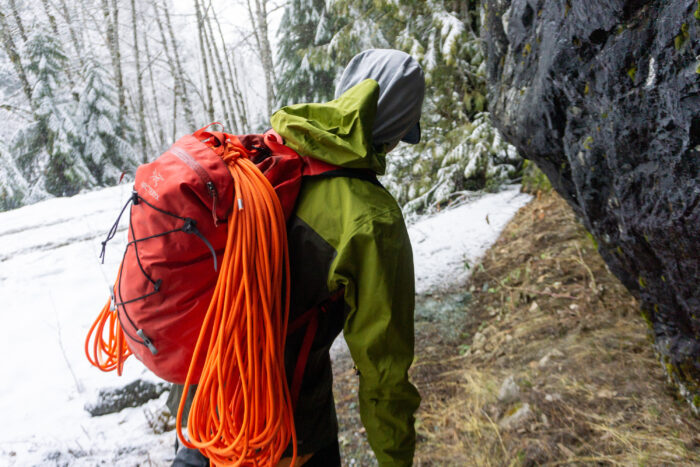
When it comes to hardshell jackets, the beauty of having a shell that is simply tough lies in its utility across various outdoor activities. We’ve worn our hardshells in everything from in-bounds resort skiing to ice climbing to braving storm swells in a dinghy.
The flip side of this versatility, of course, is the general confusion that arises when deciding which hardshell jacket is right for you. Below, we’ve delved into the details and backed it up with science to unravel exactly what makes a hardshell jacket so durable.
We should note here the close cousins of the hardshell jacket — the softshell (or wind shell) jacket, as well as rain jackets. Hardshell jackets exist at the storm-battered fringe of the spectrum, where ultimate performance gives way to packability and weight. They often opt to add rather than subtract features, and prioritize ability in the mountains over all else.
If you’re looking for more ski styling, take a look at our Best Ski Jackets gear guide. And if ultimate performance is trumped by packability and versatility on your next outing, our Best Rain Jackets guide should steer you in the right direction.
Waterproofness
Let’s rip the bandage off quickly here — given enough time, pressure, and wear, nothing is truly waterproof. However, given new and novel advances in textile technology, hardshell jacket manufacturers can get remarkably close. To better understand this dance, a little science is warranted.
Waterproofness is a measure of the amount of water that a fabric can resist before it yields and allows it to pass through. Testing of waterproofness has been standardized, and waterproof fabrics will be subjected to these tests for over 24 hours to ensure long-lasting resistance. These tests will produce a number known as the hydrostatic head of the fabric, with greater figures relaying a stronger resistance to water over the long term.
While rain jackets boast waterproof ratings ranging from 5,000 to 20,000 mm, hardshell jackets typically maintain a minimum of 20,000 mm waterproofing, with specialist membranes often reaching the 30,000 mm mark. It is important to note that waterproofness and breathability are two metrics pulling in opposite directions of one another, and that superior water resistance will require some concessions in the breathability department.
- 5,000 mm: Where technical rain outerwear for outdoors adventures begins
- 5,000-10,000 mm: Waterproof under light rain or snow and no pressure
- 10,000-15,000 mm: Waterproof under many conditions, except under pressure
- 15,000-20,000 mm: Waterproof under heavy rain and snow
- >20,000 mm: Waterproof under heavy rain, snow, and pressure
When the rubber meets the road, the waterproofness of a hardshell jacket comes down to not only this rating, but also the interplay between fabric construction, DWR finishes, and design aspects such as a tight drawing hood or snug wrist cuffs.
Breathability
Not every moment in your hardshell is going to be a static shiver bivy, and during the times you’re grinding out vert in your jacket, you’ll be sweating. Our bodies do this in order to cool ourselves down, but without built-in ventilation in our hardshell jacket, that moisture has nowhere to go — and overheating can occur.
In order to circumvent this, modern waterproof fabrics incorporate a certain amount of breathability into the weave, which can also be measured. These numbers can be stacked against each other to give an idea of relative breathability between different hardshells.
MVTR and RET Testing
The Moisture Vapor Transmission Rate, or MVTR, has been the industry standard for some years when it comes to measuring the breathability of waterproof membranes. This rate can be measured through several different tests, but the most common metric used is expressed in g/m²/24 hours. Higher values on the MVTR test denote a better ability to pass moisture.
More budget-minded shells often host a lower MVTR rating, which may be slightly below the standard 20,000 g/m² rating we prefer in jackets designed for high-output activities. At the other end of the spectrum, specialized shells like The North Face Summit Torre Egger boast incredible values of 75,000 g/m².
The RET, or Resistance to Evaporation rating, has gained momentum in recent years, with the new GORE-TEX Pro membranes being notable adopters. This rating utilizes a simulated perspiration test, and the values presented here are the inverse of the MVTR, with lower values indicating a higher ability for moisture transfer.
A jacket with a RET value of <6, such as the Mammut Nordwand Advanced HS Jacket, will really pump out perspiration and is rated as extremely breathable on the RET scale. Fabrics with a RET score of between 6 and 12 land in the highly breathable camp, and ratings of >12 are only moderately breathable.
Waterproof Membranes
Waterproof membranes vary in their construction and claims, but all operate on a similar premise: keep rain from getting in, and keep perspiration moving out. Laminate membranes, like GORE-TEX, use an expanded film of specialty material known as polytetrafluoroethylene, or ePTFE, to accomplish this.
These ePTFE membranes have over 9 billion pores per square inch, each 20,000 times smaller than a water droplet, but 700 times larger than a water vapor molecule. This allows the membrane to resist water from the elements, but diffuse perspiration as it builds within the shell.
The other majority share of waterproof membranes are made using a very thin sheet of polyurethane, which is naturally hydrophilic and maintains breathability through diffusion. These membranes have historically been monolithic, meaning that they lack any pore structure, but new technologies are producing air-permeable membranes which pass air freely.

GORE-TEX Pro 2.0
The pinnacle of high-performance waterproofing since 2007, GORE-TEX Pro has been the gold standard that many reach for when undeniable weather protection is needed. Whereas traditional 3-layer GORE-TEX requires a thin polyurethane lining to protect its membrane, the Pro version lines itself with a Micro-Grid backer, and is made of several ePTFE membranes bonded together.
Since 2020, GORE-TEX Pro has been available in three different technology flavors, which not only allows for a better application while retaining high waterproofness, but provides for hybrid designs across a jacket to best apply certain attributes where they are needed.
- Most Breathable: Better thought of as the ‘old’ Pro rolled forward, the Most Breathable variant utilizes lighter 30D face fabrics to bump up the membrane’s breathability to a RET score of <6 — and maintains the stellar 28,000 mm waterproof rating.
- Most Rugged: Made to be abused, jackets built with the Most Rugged technology use face fabrics from 70D to 200D to really stand up to abrasion. The breathability is inhibited a bit at a RET of <9, but this is still solidly within the highly breathable rank.
- Stretch: Able to stretch up to 12 to 20%, GORE-TEX Pro Stretch textiles can be used in areas of a jacket where mobility is key, such as between the shoulder blades or arms. The concession comes in terms of breathability, which comes in a RET value of <13.
GORE-TEX 3-Layer ePE
The biggest news in waterproof membranes in recent years, the new ePE membrane from GORE-TEX meets the demand from manufacturers for an environmentally friendly PFC-free membrane (note: the ‘F’ in ePTFE stands for fluoro) by pivoting their expansion technology to use polyethylene instead of polytetrafluoroethylene. In doing so, GORE has been able to strip out the PFCs from within the membrane and still hit the 28,000 mm waterproof rating that GORE-TEX is known for.
But just as sure as there is no free lunch, the ePE membrane has to make a concession somewhere for its eco-chops, and that somewhere is in the breathability. At a rated RET of <13, jackets made with this material won’t be moving as much moisture as GORE-TEX Pro Most Breathable (<6), or even the middle of the road Most Rugged (<9).
Because of this, mechanical ventilation like underarm pit zips will be essential to keeping dry from the inside. Undoubtedly, ePE is going to be the next big thing in rainwear, however, it will remain to be seen if the industry can pry itself away from the undeniable performance of GORE-TEX Pro membranes.
Toray Dermizax NX
Dermizax NX is a polyurethane-based waterproof membrane that touts impressive breathability numbers — up to 40,000 g/m² — but perhaps more impressively hasn’t had to cut waterproofness in order to do so. At a rated 20,000 mm, this membrane balances the scales well.
Proprietary Membranes
Recent years have seen an influx of proprietary membranes brewed up specifically for manufacturers, allowing them to tweak and fine-tune parameters to suit their use.
The North Face’s FUTURELIGHT membrane is among the new and exciting air-permeable membranes that have begun to take hold of the market. This version utilizes “nanospinning” of polyurethane in order to create a matrix of the material that is big enough to allow air to pass, but also sized to prevent rain from making its way in.
Other notable proprietary membranes used in hardshell jackets today include Patagonia’s H2No Standard Performance, as well as Helly Hansen’s LIFA Infinity Pro.
Fabric Layers and Face Fabrics
No waterproof membrane exists in a vacuum, and most will require some protection on either side in order to work as designed. While 2- and 2.5-layer designs are common in rain jackets, most hardshell jackets worth its salt will be made with 3-layer construction.
This construction will include a waterproof membrane, as well as an interior textile backer to protect against body oils, and a face fabric to resist abrasion and host a DWR finish.
Face Fabrics
Combined with a hearty waterproof membrane, face fabrics are what make hardshell jackets truly hard. Ice and rock can chew up weaker shells with ease, so most hardshell jackets will be made with a thicker denier face fabric to shore up their overall durability. The expedition-ready Arc’teryx Alpha SV Jacket was the burliest contender in our showdown, with an impressive 100D face fabric.
Many hardshell jackets will use a hybrid face fabric design to gain the best of both worlds, opting for a more burly denier in high-wear areas such as the shoulders and sleeves, and using a lighter weave elsewhere to cut weight. In our testing, we found that an 80D/40D split was the most commonly used.
It’s important to note that face fabrics also play a large role in both breathability and waterproofing. The thicker a face fabric is, the more difficult it is to expel moisture, which is why some jackets like The North Face Summit Torre Egger use a lighter face fabric under the arms to really keep moisture moving.
Durable Water Repellent Finish (DWR)
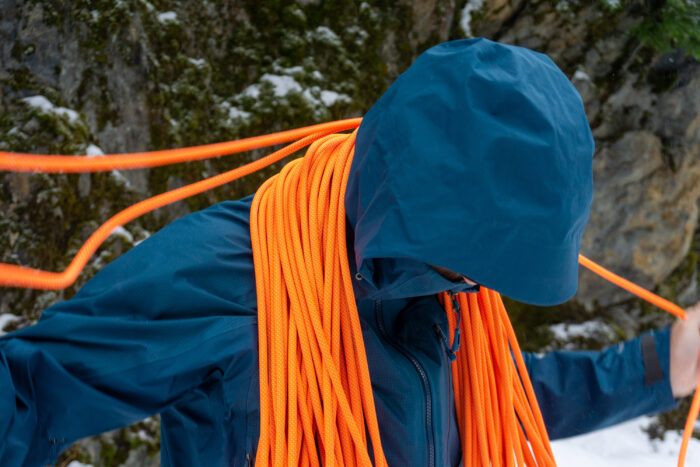
Like the moat before the castle, a durable water-repellent finish is the first line of defense against rain ingress in a hardshell jacket. These hydrophobic applications are what cause the “duck’s back” look of a new rain jacket shedding water, and are important in protecting the waterproof membrane from being overwhelmed prematurely.
DWR finishes also play an important role in maintaining the breathability of a hardshell. After extended use or pressure, water can push past the DWR and soak into the face fabric, creating a physical barrier that prevents perspiration from being expelled. Keeping your DWR finish fresh can help prevent this, as well as frequently cleaning your hardshell to rid it of body oils, sunscreens, and dirt.
DWR finishes have historically been created from nasty polyfluoroalkyl substances called PFAS, which are heat-, oil- and water-resistant. Once released into the environment, PFCs/ PFAS, also known as forever chemicals, essentially remain there forever, entering the food chain and drinking water. High PFAS exposure has been linked to harmful health effects and the EPA has deemed that two PFAS are likely to be carcinogenic to humans.
Numerous states have adopted policies around PFAS use, and several hardshell jacket manufacturers have eliminated the use of PFAS in DWR finishes. Currently, the Patagonia Super Free Alpine, the Patagonia M10 Storm Jacket, and the Himali Monsoon jackets are made without PFAS.
Fit and Construction
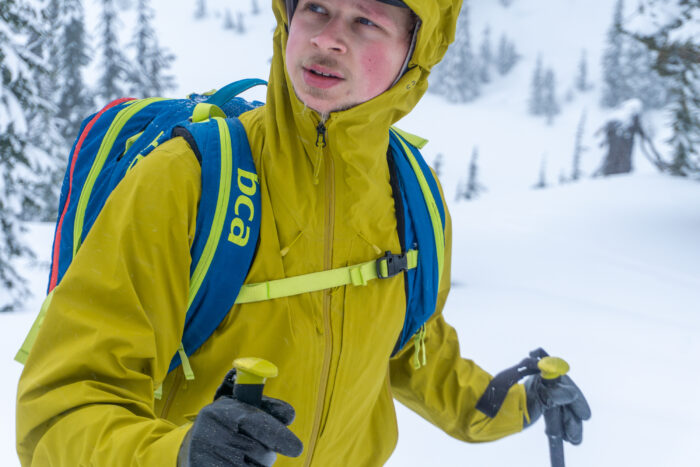
Many of the hardshell jackets in our review sport an “alpine” fit, meaning that they have a bit more space than your typical rain jacket to accommodate more active insulation. Some, like the Ortovox Westalpen 3L, are cut a bit more trim with the high output of ski-mountaineering in mind. Others still are a bit roomier for the other side of the ski equation, when you’ll want to be wearing all the insulation you’ll need for the day at once.
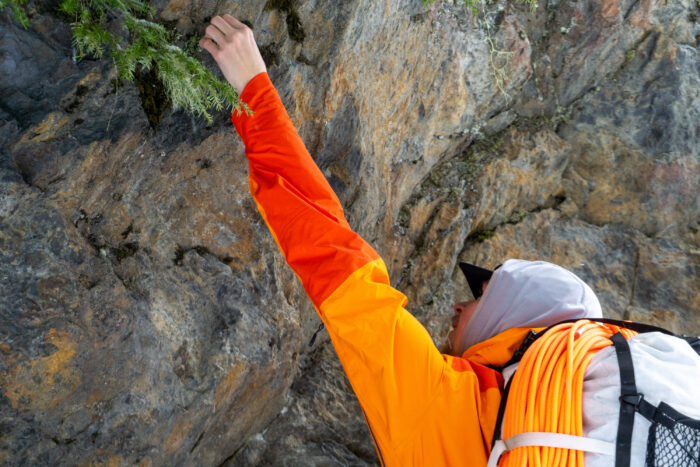
When considering how to size your hardshell jacket, aim for a comfortable fit when wearing all of the layers you’ll wear while on the move — such as a baselayer, active insulation fleece or synthetic jacket, and potentially a softshell jacket. You’ll want to have enough length in the sleeves to be able to make overhead swings of an ice tool without lifting the hem too much.
Hardshells that are specifically designed for female bodies often have more room in the hip and chest. If you like the extra coverage of a longer hardshell, make sure the hem is wide enough to fit freely over your hips. The Women’s Patagonia M10 Storm, in particular, had ample room around the hips, while the Himali Monsoon in the same size was a little tighter. The Arc’teryx Beta AR fell in between the two.
Most alpinists will opt not to size their hardshell to fit over their large parkas, as these are typically deployed when temps are below freezing, and any precipitation you might encounter will be drier snow instead of a soaking rain. However, if you tend to run cold, you may consider sizing up; our tester in Alaska sizes up her harshells so she can comfortably fit a thin down jacket underneath for long and inevitably wet and windy days during the shoulder seasons.
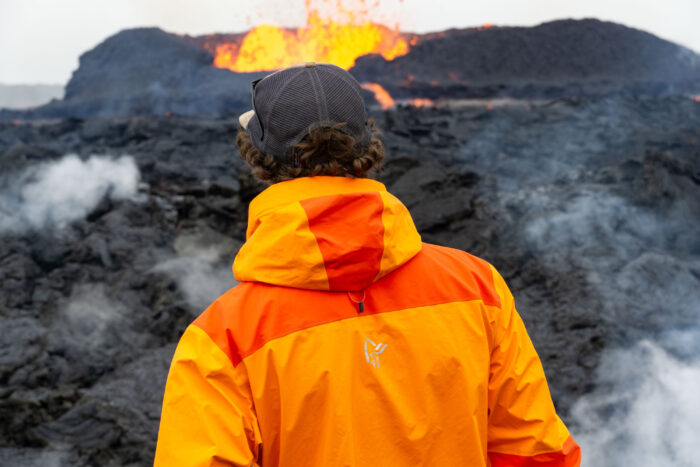
Finally, components like a long drop hem (the portion of the hem that covers your backside), ample sleeve cuffs, and a helmet-compatible hood greatly up the protection that a hardshell jacket provides. We found the Norrøna Trollveggen Pro Light to have the best execution of these features.
Alpine-Specific Features
Two-Way Front Zips
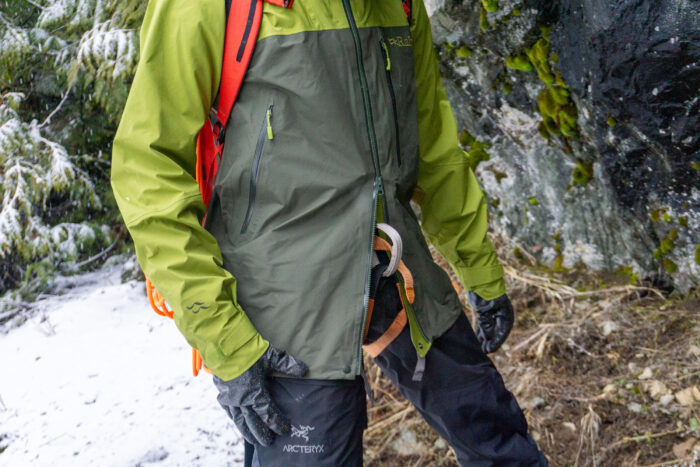
A two-way front zipper can be a major upside for those who spend a lot of time in a climbing harness, as it allows for the belay loop to pass through the shell without the need of tucking in the jacket hem. This can also be employed to increase ventilation during tough climbs.
Helmet-Compatible Hoods
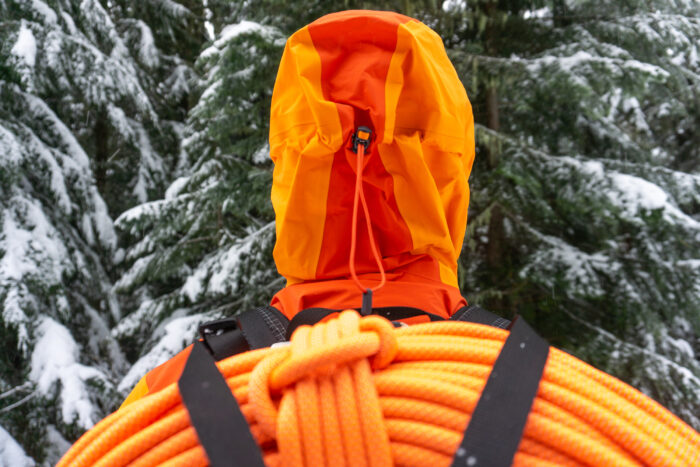
Alpine climbing, mountaineering, and skiing all have their objective hazards, and you’ll want to wear a helmet to help mitigate those. A good hardshell jacket will accommodate for the extra space needed to wear one.
Climbing helmets are generally a bit lower profile than ski helmets, so ideally you should aim to try on your hardshell with your helmet to ensure there are no snug fit issues. Almost all hoods on hardshell jackets will include adjustable cords to fine-tune the fit.
Pit Zips
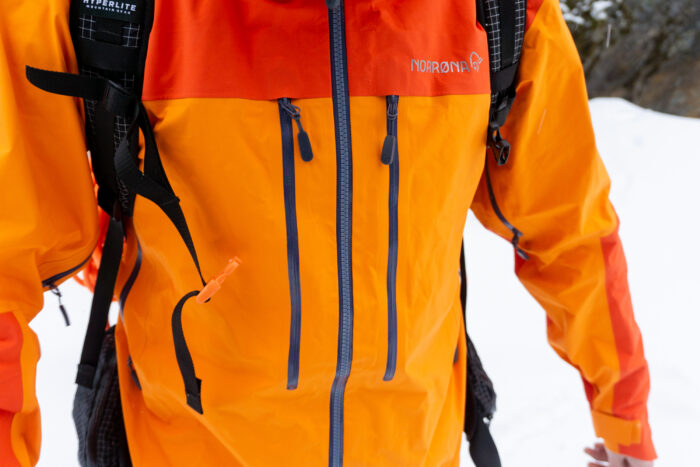
Ventilation in a shell jacket can be essential to avoiding overwhelming the breathability, and the best way to crack open the windows on a hardshell is through the pit zips. These zippers run beneath the arms and can be opened during times of high exertion to vent off perspiration, all without exposing the climber to the elements.
While most zips in our review open with a two-way closure, the Norrøna Trollveggen Pro Light impressed us with its novel ‘X-open’ design that places the zipper pulls at either side of the zipper, as opposed to running together. This prevented the openings from catching the wind like sails.
Pockets
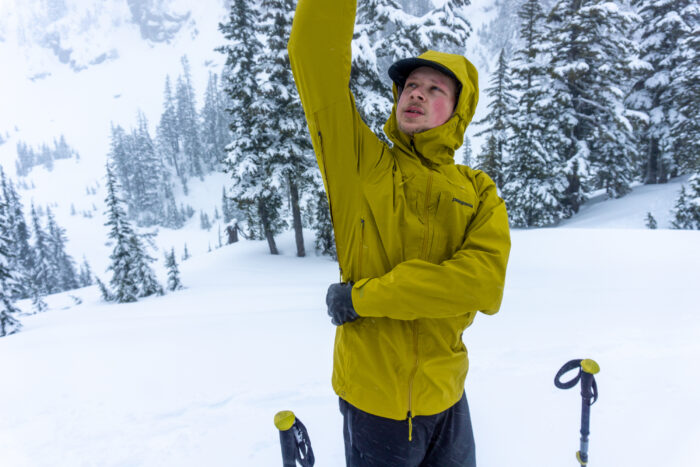
Exterior pockets on hardshell jackets come in two designs: those made for hand warming, and those made for storage. Hand-warming pockets are less often employed on hardshell jackets, as the activities they are designed for often don’t leave much time for standing around. One notable exception is the Arc’teryx Beta AR, where a focus on versatility prompts their inclusion.
Exterior storage pockets, in our opinion, are much more important — and most often come in the form of ‘Napoleon’ breast pockets. These pockets are accessed by reaching across the chest, and are placed above the fray of pack straps and harnesses for easy access. If you plan on using your hardshell on longer climbs or mountaineering objectives when you’re constantly in a harness, chest pockets are a must if you plan on accessing them throughout the day.
Finally, consider the zippers of your hardshell jacket’s pockets. Almost all will feature some type of water-resistant zipper, although many will still employ storm flaps, which are folds of fabric that help resist water intrusion.
Weight, Comfort, and Packability
A good hardshell jacket likely won’t be a welterweight champ, but advances in textile tech mean that hardshells are getting lighter and more packable as time goes on. A good example is the Arc’teryx Alpha SV: When this jacket debuted in 1998, it weighed in at 1 pound, 8 ounces, and today, it has trimmed half a pound off the trail weight.
Today, most hardshell jackets hover just north of the 1-pound mark, with some specialized shells like the Patagonia M10 Storm coming in as low as 10 ounces — though at a protection tradeoff. At the opposite end of the spectrum are the feature-rich and The North Face Summit Torre Egger jackets, which were some of the heavier shells.
The comfort of your hardshell shouldn’t be downplayed — not every adventure is going to be full-value, after all — and spending time in your hardshell can be made more enjoyable by a few niceties. High on our list is a microfiber lining on the inside of the collar, as well as a soft-to-the-touch jersey backer on the interior of the jacket.
And since you’ll need to stuff your shell jacket away at times, be mindful of overall packability. Most hardshell jackets won’t have an integrated stuff sack, but will fold well enough into their own hoods. Thinner denier face fabrics will have the edge over jackets made with extra burly weaves.
Price & Value
To be sure, hardshell jackets are not typically cheap. Ranging from $350 all the way to $900(!) for the best-of-the-best, these are certainly investments into protecting yourself from the worst the environment can throw your way. That said, simply nabbing the priciest option won’t net you the perfect hardshell for what you’re after, so consider the routes you’re looking to climb or ski, the climate you’ll likely encounter, and the features you aren’t willing to leave at the belay.
Budget
There is a gradient where rain jackets become hardshell jackets, and we like to see a true 3-layer waterproof membrane, helmet-compatible hood, and alpine-friendly features such as high chest pockets and chunky wrist closures before calling a shell as such. Paying between around $350 and $450 with get you a solid budget hardshell, with GORE-TEX ePE membrane being standard these days.
The downside of going with ePE is that the membrane breathability is a little more stuffy at a RET of <13, but savvy shells like the Outdoor Research Headwall ($469) get away with it by adding huge vent zips. The Patagonia M10 Storm ($379) is also a great budget option, though there are no pit-zips or two-way zippers. The Himali Monsoon ($440) is on the upper end of the budget spectrum, but the extra cost gets you pit zips, a two-way zipper, and a more protective hood.
Mid-Tier
Paying between $550 to $650 will open up plenty of more features, waterproof membrane options, and tougher exterior textiles. GORE-TEX Pro ePE is the standard here, though there are some specialized membranes like the FUTURELIGHT on The North Face Summit Torre Egger ($590) that perform as well. You’ll often see more alpine features here, such as two-way front zips, large internal stuff pockets, and nicer waterproof zippers.
The Arc’teryx Beta AR Jacket ($650) has been our mid-tier top pick for a few years now, and it’s got all the right stuff: a versatile feature set, burly 40/80D face fabric blend, and a great fit for layering beneath. If you only need one hardshell, it’s hard to go wrong here.
Premium
Paying $700+ for a hardshell means you’re into some serious stuff outdoors, and need a jacket to keep up. The Arc’teryx Alpha ($700) is tailored for the rigors of ice and mixed climbing, and use different blends of GORE-TEX ePE Pro to get there. In the Alpha, you’re paying for a super lightweight but extra tough Hadron LCP face fabric.
The $900 Arc’teryx Alpha SV is a pricey jacket, no doubt, but it’s also about the toughest shell we’ve ever put our hands on. The 100D face fabric has turned away errant stabs from ice screws, and the cut is tremendously good, with plenty of articulation for swinging tools overhead.
Frequently Asked Questions
The difference between a hardshell and a softshell boils down to breathability and protection. Softshell jackets emphasize breathability, as well as being able to turn a stiff wind and help to retain body heat. Hardshell jackets are made to provide protection from the elements, and while they offer some breathability, they have a limit to how much they can handle.
While GORE-TEX has been the de-facto ruler of the waterproof market since its invention, there are a number of different waterproof membranes of merit that emphasize different facets of the waterproof/breathable equation.
The robust waterproofing of an ePTFE membrane like GORE-TEX is undeniable, but the advent of air-permeable membranes that elevate breathability to previously unheard-of levels will be an attractive option for those who will be climbing or skiing without stopping.
The beauty of a hardshell jacket is its interior volume for layered insulation. Under a hardshell, a typical mountaineer or alpinist might wear something like this: A baselayer top or sun hoody, followed by a thin gridded fleece or synthetic fill active insulation piece.
Because of the importance of keeping a waterproof membrane clean, we always attempt to wear long sleeves underneath our jackets, as body oils can clog the pores of a membrane.
Hardshell jacket sizing typically takes into account that they are meant to be worn over active insulation, and will most often reflect the jacket size you most typically wear in outerwear. Sizing up a hardshell jacket can be an attractive option for those who require more protection, such as skiers, but for alpine climbers and mountaineers, this will often make for excess material.
Some manufacturers have earned a reputation for a specific type of fit, though we would warn against making broad assumptions when deciding on a hardshell based on these alone. Arc’teryx often produces jackets with a trimmer alpine fit, while jackets from Patagonia are a bit boxier. European brands such as Ortovox and Rab also tend to be a bit slimmer.
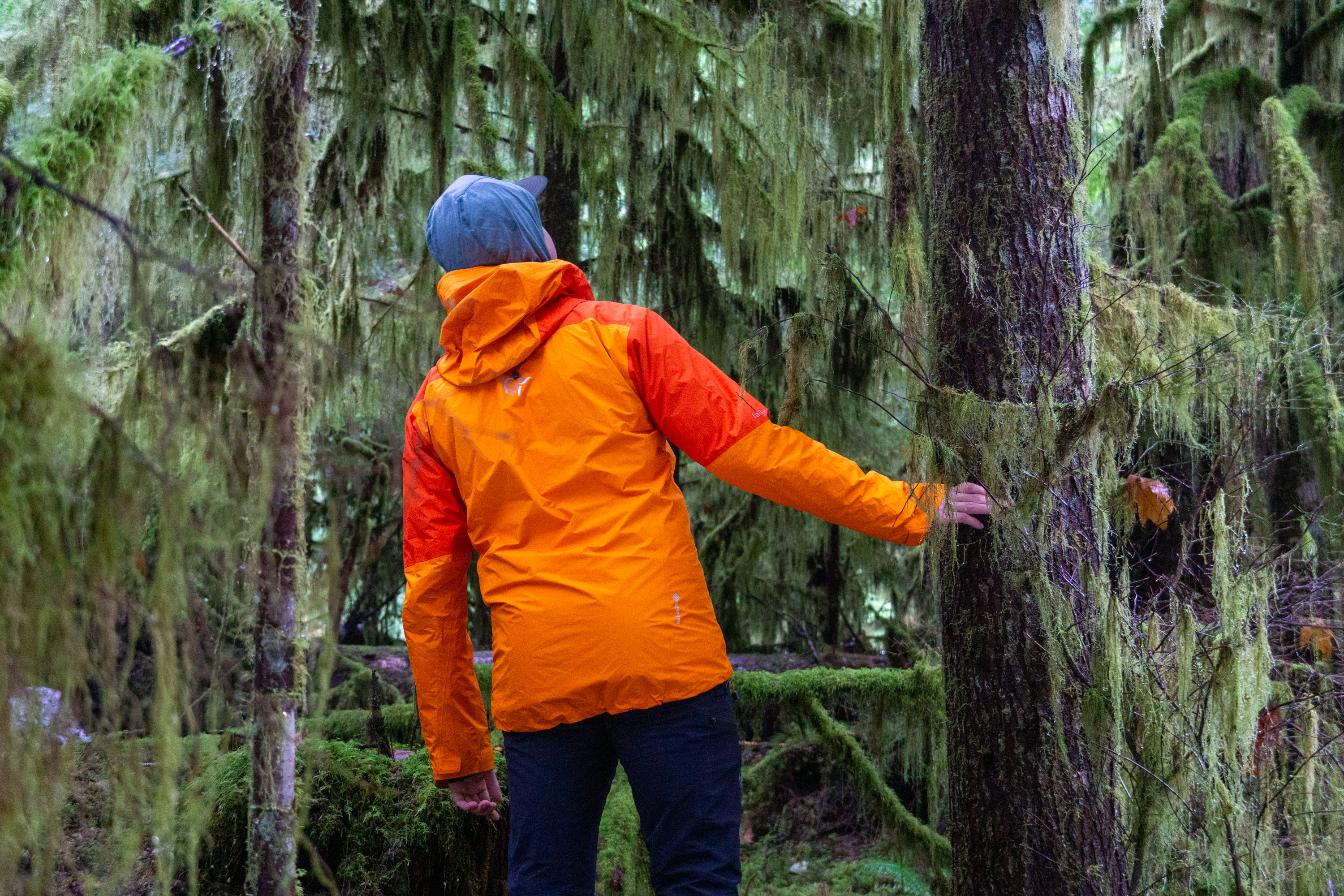
Whether you’re splashing about town or trekking through a monsoon, these are the best rain jackets of 2025.
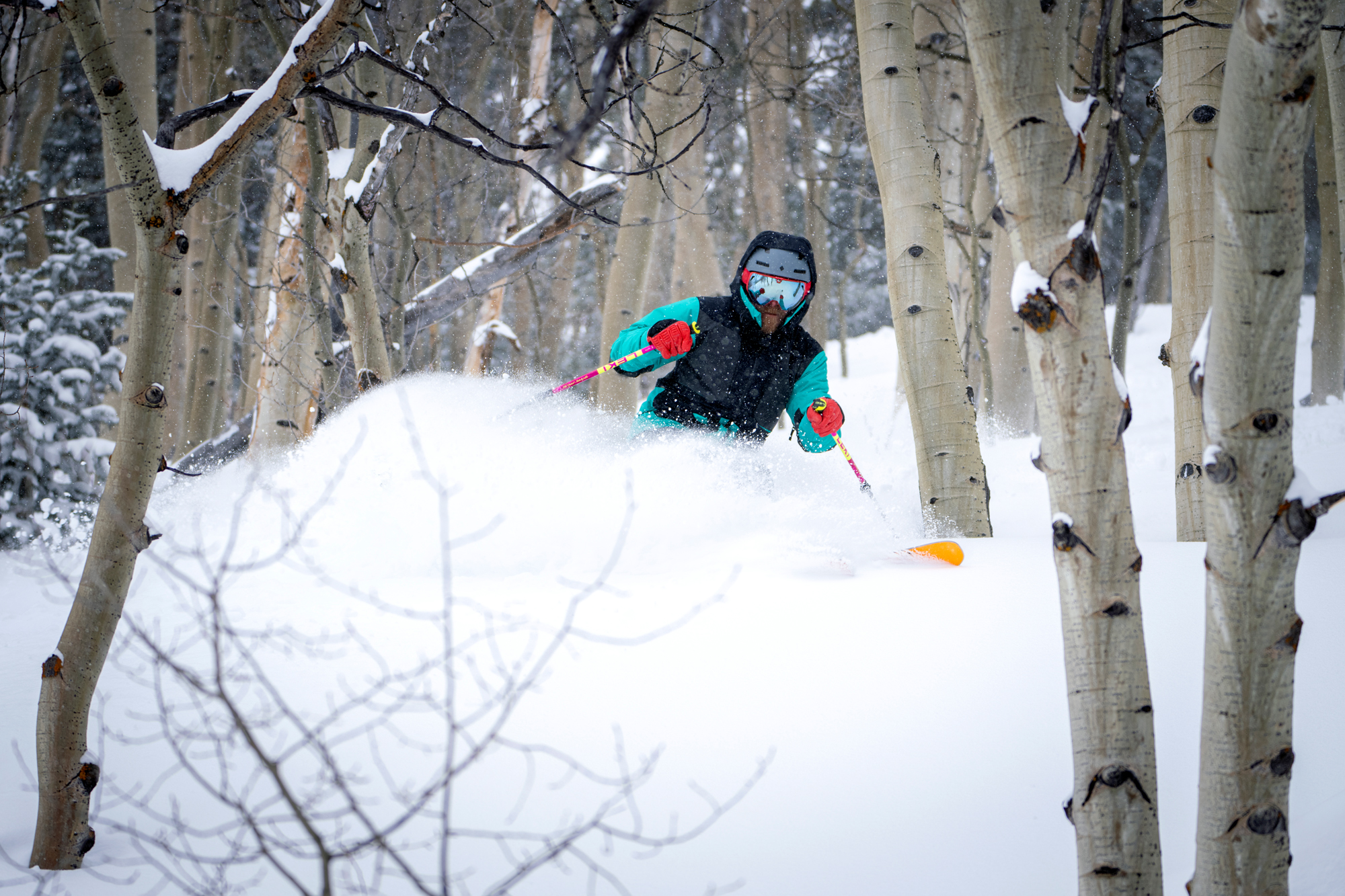
Whether you’re skiing in sunny or stormy conditions, we tested and found the best ski jackets including Patagonia, Arc’teryx, and more.
Read the full article here