




I ran across this great article form the May-June, 1972, issue of Infantry Magazine by Lieutenant Colonel Larry S. Mickel. It concerns the history of the canteen cup, which was near and dear to many a Soldier’s heart from the majority of the 20th century.
Here’s the text:
The Army’s continuing search for a “better” canteen cup is reminiscent of Sir Gawain’s quest for the Holy Grail. Inthat respect, this chalice of infinite use has once again been modified to meet the fighting man’s standards. But before lauding its most recent modification, we should take a look at the developmental history of the canteen cup.
Surprisingly, it wasn’t until 1863 thatthe need for
a cup as personal gear was even recognized. Army regulations ofthatyearstate:
“On marches and in the field, the only mess furniture of the soldier will be one tin plate, one tin cup, one knife, fork and spoon to each man,to be carried by himself on the march.”
Photographs of the period generally show a round cup tied in random fashion to the soldier’s belt.
During a spurt in development of field gear in
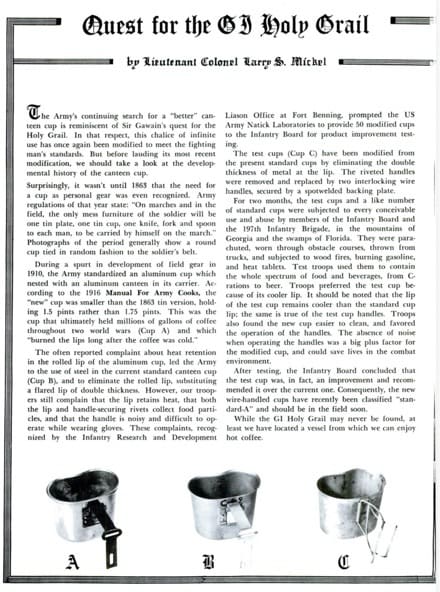
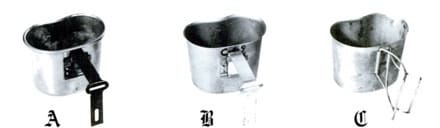
1910, the army standardized an aluminum cup which nested with an aluminum canteen in its carrier. According to the 1916 Manual For Army Cooks, the “new” cup was smaller than the 1863 tin version,hold ing 1.5 pints rather than 1.75 pints. This was the cup that ultimately held millions of gallons of coffee throughout two world wars (Cup A) and which “burned the lips long after the coffee was cold.
“The often reported complaint about heat retention in the rolled lip of the aluminum cup,led the Army to the use of steel in the current standard canteen cup (Cup B),and to eliminate the rolled lip, substituting a flared lip of double thickness. However,our troopers still complain that the lip retains heat, that both the lip and handle-securing rivets collect food particles,and that the handle is noisy and difficult to operate while wearing gloves. These complaints, recognized by the Infantry Research and Development Liaison Office at Fort Benning, prompted the US Army Natick Laboratories to provide 50 modified cups to the infantry board forproduct improvement testing.
The test cups (Cup C) have been modified from
the present standard cups by eliminating the double thickness of metal at the lip. The riveted handles were removed and replaced by two interlocking wire handles, secured by a spot welded backing plate.
For two months, the test cup and a like number of standard cups were subjected to every conceivable use and abuse by members of the Infantry Board and the 197th Infantry Brigade, in the mountains of Georgia and the swamps of Florida. They were parachuted, worn through obstacle courses, thrown from trucks, and subjected to wood fires, burning gasoline,
and heat tablets. Test troops used them to contain the whole spectrum of food and beverages, from C-rations to beer. Troops preferred the test cup because of its cooler lip.
It should be noted that the lip of the test cup remains cooler than the standard cup lip; the same is true of the test cup handles. Troops also found the new cup easier to clean, and favored the operation of the handles.
The absence of noise when operating the handles was a big plus factor for the modified cup, and could save lives in the combat environment.
After testing, the Infantry Board concluded that the test cup was, in fact, an improvement and recommended it over the current one. Consequently, the new wire-handled cups have recently been classified “standard – A” and it should be in the field soon.
While the GI Holy Grail may never be found, at least we have located a vessel from which can enjoy hot coffee.
Personally, I preferred model B. It was lighter than the WW II-style depicted in A but had that same great handle. Plus, all the A-style cups I ever got ahold of were seriously nasty inside with some major corrosion. Either way, you’d have to look out for them in surplus stores as we had already fully adopted the style depicted in example C with the wire handles that would do whatever they wanted unless you grabbed them just right.
You can skip to the end and leave a response. Pinging is currently not allowed.
Read the full article here