




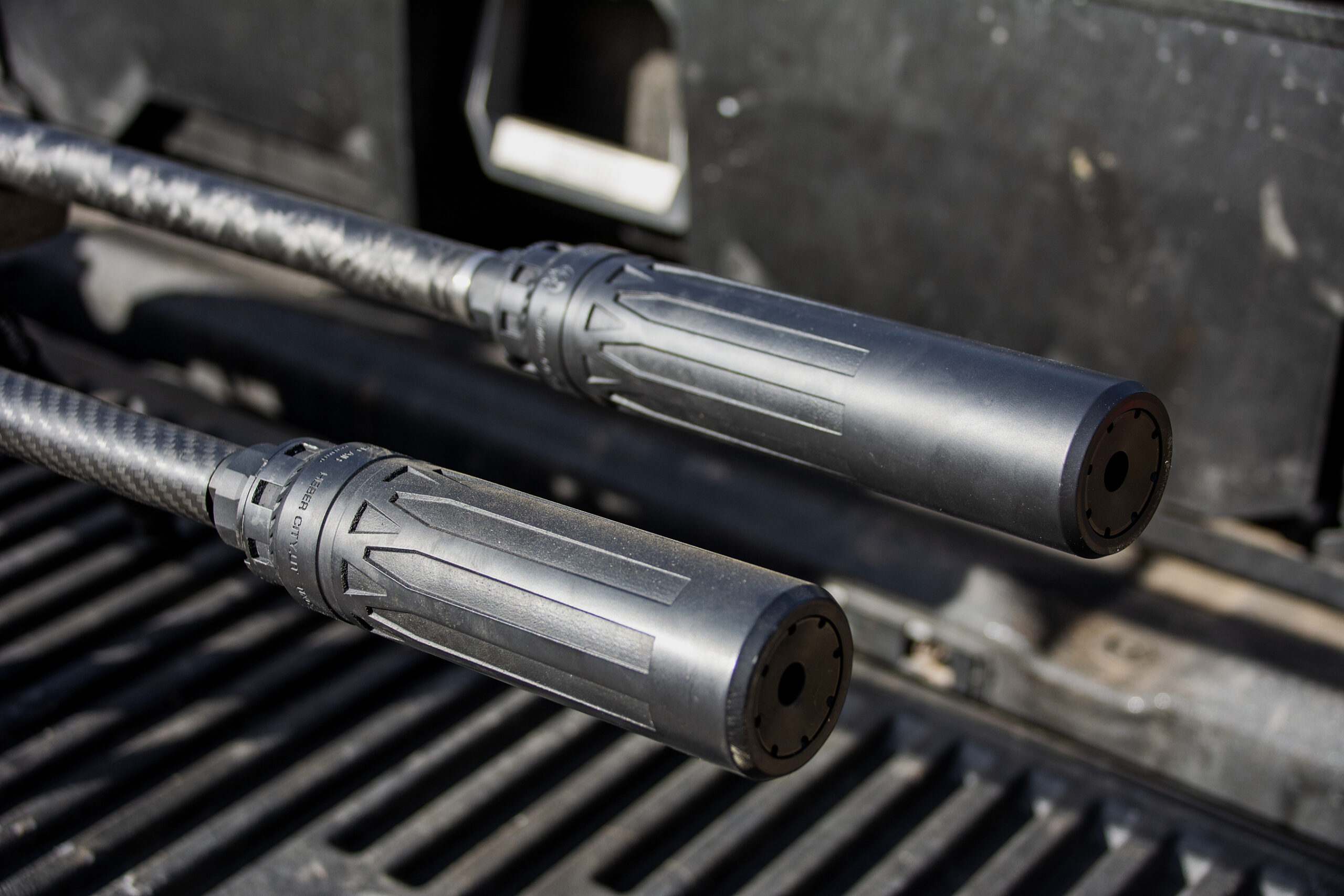
In the world of suppressors, six years is a long time. That’s how long the Nomad Ti family has been around, and its latest generation marks a significant departure from previous designs. It still has the deep tone and versatility we’ve come to appreciate, but instead of being a welded, tubeless can, the new one is fabricated via additive manufacturing — 3D printing in metal.
Dead Air has more experience than most when it comes to additive manufacturing. Their Lazarus 6 and Mojave 9 cans are both made this way and make use of a patented helical baffle design that cuts down back pressure and gas to the face when used on semi-autos. It was a surprise when first looking into the rear of the Nomad to find a traditional-looking clipped baffle stack — if it ain’t broke, don’t fix it, we guess.
There are two titanium variants of the new Nomad Ti in the lineup, the Ti XC and the LTi XC, with the main differences between the two being length and weight. Both have the same 1.76-inch outer diameter, but the body of the L variant is 8.125 inches long, whereas the shorty is 6.25 inches. As a result, there’s a 2-ounce weight delta between the two.

The Nomad has always featured 1.375 x 24 HUB compatibility, so the entire universe of QD attachments is available to the end user. If you opt for Dead Air’s Xeno brake, you’ll pay a 3-ounce weight penalty, but we found this to give a noticeable recoil reduction when compared to a direct thread adapter, particularly on rifles with some ass behind the bullet, such as our 7mm PRC elk gun. At the downrange end of the can, the endcap is replaceable in the event of a bullet strike, so your can won’t be deadlined for long.
We’ve used the original Nomad Ti for a few years now, mainly on hunting rigs ranging in caliber from 223 Rem, through to 300 WM, and despite not feeding muzzle gases through a sacrificial brake, have yet to see any significant erosion on the blast baffle, which is a good endorsement of the Grade 5 titanium raw stock used in its construction.
Read the full article here