




NAVAL AIR WARFARE CENTER WEAPONS DIVISION, POINT MUGU, Calif.
Welcome to the Invisible War
Invisible wars demand visible action. In this arena, coalition electronic warfare, interoperability and spectrum superiority will decide victories in future near-peer conflicts.
Whoever owns the electromagnetic spectrum owns the battlefield.
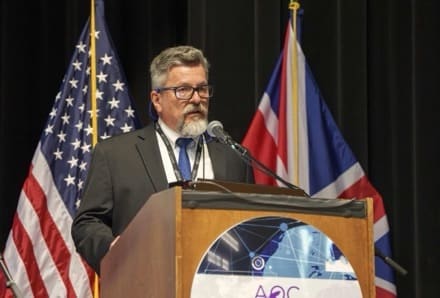
That’s why nearly 500 electronic warfare leaders from the United States, Australia and — for the first time — the United Kingdom gathered at Naval Base Ventura County, Point Mugu, March 11-13 for the 52nd annual Collaborative Electronic Warfare Symposium.
The Naval Air Warfare Center Weapons Division and the Association of Old Crows jointly host the annual symposium under a co-sponsorship agreement. The event focuses on collaboration and innovation in EW, uniting government and industry partners worldwide.
Policies and Platforms Risk EW Static
One of the biggest challenges in coalition EW is getting different nations and services to operate seamlessly in the EMS. Without standardized doctrines, aligned classification standards and compatible technological platforms, coalition operations risk becoming disjointed.
Bottom line: Coalition forces shouldn’t encounter more static from their own policies than from their adversaries.
Coalition EW Steps Up for Near-Peer Showdown
This year’s theme, “Coalition EW in Near-Peer Conflict,” explored interoperability across coalition EW operations, from ground and airstrike to naval combat, in a classified setting. Symposium co-chairs David Wood and Thomas Bluhm, NAWCWD’s lead event planners, guided discussions on enhancing coalition readiness for near-peer conflicts.
This year’s symposium brought together everyone from four one-star military officers and civilian specialists to young professionals in the Engineer and Scientist Development Program.
“Effective coalition EW requires alignment at every level, from senior leadership down to junior warfighters and support personnel,” Bluhm said.
One Team’s Mission to Unite Three Nations
Two years of policy hurdles. Classification roadblocks. Endless coordination challenges.
Dave Mohler, NAWCWD’s Airborne Electronic Attack International Programs lead, and his team overcame them all with one clear mission: bring the United Kingdom into the EW conversation alongside the United States and Australia.
“Our International Programs team is made up of highly specialized and dedicated professionals,” Mohler explained. “It wouldn’t have been possible without my international policy analysts, security specialists, and foreign contact officers”
Mohler coordinated with senior Navy and Department of Defense officials to expand the previously bilateral U.S.-Australia symposium, held since 2015, to include the UK.
Bringing the UK into the fold was critical, as AUKUS enables deeper coalition collaboration.
Established in 2021, AUKUS initially focused on nuclear-powered submarines. Its second pillar prioritized collaborative defense capabilities, including EW — creating the opportunity Mohler needed.
“This was not a simple or easy task,” Bluhm said. “Mr. Mohler and his team worked through many denials and hurdles to secure approvals for this first-ever tri-national Collaborative EW Symposium.”
Mohler emphasized why this expanded partnership matters.
“More than ever, we must acknowledge that the wars of tomorrow will not be deterred, nor fought, alone,” Mohler stressed. “This is the first step toward understanding how we operate together and identifying areas where we can cooperatively develop solutions for the warfighter.”
Thanks to Mohler’s efforts, the three nations now have a clear framework for deeper cooperation, making AUKUS a blueprint for dominating the EMS.
Why Point Mugu Still Leads the EW Fight
For the first trilateral event focused on dominating the invisible fight, you go where history has proven itself — a quiet naval base along California’s coast: Point Mugu.
In April 1951, Cmdr. Clifton Evans Jr. established the Countermeasure-Interference Division, creating the Navy’s first dedicated EW capability — a visionary move that was decades ahead of its time. More than 70 years later, pioneering foresight keeps Point Mugu at the forefront of EW, laying the groundwork critical to coalition EW in the age of near-peer threats.
“In the 74 years since, spectrum warfare technologies have grown exponentially,” Bluhm said. “Denying adversaries the use of their radars, communications and navigation signals while ensuring our coalition allies maintain resilient and effective spectrum operations is best done with our trusted allies.”
With Point Mugu’s legacy established, the focus shifts to next-generation technologies allies are leveraging to close EW capability gaps.
How AUKUS Allies Are Closing the EW Gap
The symposium showcased next-generation EW technologies from government and industry partners across the three AUKUS nations. Highlights included advanced directed energy weapons, such as high-power microwave systems, and compact, low-cost SWaP jammers delivering high performance. Attendees also explored radar alternatives and innovative command-and-control systems for EMS operations.
On day two, gray skies and periodic rain greeted attendees at the Station Theater for the symposium’s strategic panel.
Moderated by Bluhm, the panel featured U.K. Royal Air Force Air Commodore Blythe Crawford, commandant of the Air and Space Warfare Centre; Australian Air Commodore Peter Robinson, commander of Air Combat Group; and NAWCWD’s director of research and development, Harlan Kooima.
“The U.K. delegation is delighted to be attending the Collaborative EW symposium at Point Mugu alongside our U.S., Australian and industry partners,” Crawford remarked. With a smile, he noted that the weather reminded him of his hometown in Lincolnshire, England.
He went on to highlight the strategic importance of the trilateral partnership.
“If we are to fight together, then we need to leverage each other’s technologies, methodologies and processes for spectrum management,” Crawford explained. “We all have discrete expertise in EW. Collaborative approaches are essential if we are to prevail as partners in any future fight.”
Each nation brings powerful EW platforms to the table: the U.S. Navy EA-18G Growler, with its precision jamming; the Royal Australian Air Force E-7 Wedgetail, an airborne early warning system with vast range; and the U.K. Royal Air Force Eurofighter Typhoon, armed with the advanced Praetorian Defensive Aids Sub-System.
Even the best tools fail if they’re not speaking the same language. Disparate systems and upgrade cycles complicate joint tactics, letting adversaries exploit gaps with advanced jamming and spectrum denial.
The U.S.-Australia Next-Generation Jammer, deployed in 2024 with significant Australian investment, provides a proven model for coalition EW synergy and interoperability, demonstrating how allies can eliminate vulnerabilities in the spectrum fight.
AUKUS Shifts from Blueprint to Battlefield
Tight coordination is critical in the congested and contested EMS. Without it, coalition forces risk accidental interference — a self-inflicted jam session.
Robinson sees the symposium as AUKUS in action, turning high-level strategy into concrete, battlefield-ready capabilities.
“AUKUS calls for the three countries to work together to share an understanding of the tools, techniques and technology to enable our forces to operate in contested and degraded EW environments,” Robinson explained.
He noted they’ve moved beyond philosophical debates toward aligning policy, doctrine and joint operational planning—a critical step as threats rapidly evolve.
And the coalition isn’t wasting any time. One example is already moving from concept to reality.
“In 2025, under AUKUS, we’ll conduct a tri-nation EW experiment focused on hypersonic threats and adversarial AI-driven spectrum denial,” Kooima said. “We’ll test new countermeasures and share the playbook.”
Together, the three nations will practice defending against advanced missiles and AI-powered signal jamming designed to disrupt communication and radar systems.
But Kooima believes the coalition needs something even more targeted to tackle the Indo-Pacific’s unique EW threats.
“I’d push for AUKUS-specific wargames — tabletop and live-fly — that pit us against AI-driven EW threats in Indo-Pacific conditions,” Kooima recommended. “These venues build muscle memory and trust we’ll need in a real fight.”
What a $25 Balloon Taught Us About War
Sometimes, war isn’t won by how much you spend. It’s won by how much it costs your adversary.
Crawford highlighted a powerful lesson from Ukraine: A simple $25 balloon drifting into Russian airspace baited missiles worth enough to buy a garage full of high-end Ferraris — proving how low-cost ingenuity can deflate multimillion-dollar air defense systems.
“While we initially perceived Russia as having an advantage, Ukraine showed us the spectrum is wide open for innovation,” Crawford noted.
He also emphasized another issue revealed by the Ukraine conflict: Modern warfare rapidly exhausts weapon supplies, and the coalition’s industrial base isn’t yet equipped to swiftly replenish expensive weapons. Disposable, inexpensive systems can bridge this critical gap.
The Spectrum Isn’t a Side Mission — It’s The Mission
As the symposium concluded, one theme emerged: Victory in EW demands advanced jammers with pulse-by-pulse agility, near-instant waveform adaptation and coalition teams operating in concert like an elite orchestra.
“This symposium proved one thing: All three nations face the same challenges with respect to future threats and our exploitation of the EMS,” Crawford said.
Robinson went even deeper, pointing to history. Shared values may build alliances, but winning in the EMS demands clear strategy, tight coordination and constant adaptation.
“Australia is blessed to hold the deep relationships we have with the United States and the United Kingdom. Each of our nations has a history of fighting for the values we share. We will fight together again,” Robinson said. “A key part of our success or failure in future conflicts will come down to our ability to win the battle in the EMS.”
For Mohler, this symposium capped years of effort uniting the three nations under AUKUS. And it’s only the beginning.
“Going forward, this event will continue to serve as a platform for the AUKUS partners to gather and drive successful outcomes for the coalition in the years to come,” Mohler concluded.
Kooima envisions a future where AUKUS partners share real-time intelligence, standardize tactical training and rapidly innovate next-generation technologies like quantum computing, artificial intelligence and advanced EW.
“It’s about trust, tech and tempo,” Kooima said. “Get those right, and we’ll outmatch any near-peer coalition.”
Yes, AUKUS is an agreement. But it’s also the strategic frequency coalition forces must tune into to dominate the spectrum fight.
Via NAVAIR
You can skip to the end and leave a response. Pinging is currently not allowed.
Read the full article here