




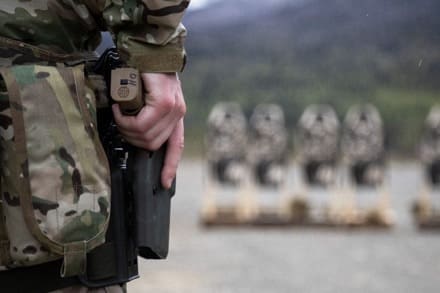
PICATINNY ARSENAL, NJ –
Despite public speculation and online misinformation regarding the pistol’s safety, Project Manager Soldier Lethality (PM SL), the Department of War’s official lead for the Modular Handgun System (MHS), confirms that there has never been a mechanically-caused accidental discharge. All investigated incidents of alleged “uncommanded discharges” have been traced back to the trigger being pulled.
Rigorous Testing and Safety by Design
The MHS, comprised of the M17 (full-size) and M18 (compact) 9mm striker-fired pistols, is a thoroughly tested, safe, and reliable weapon system for the modern Warfighter. Since the first systems were fielded to the 101st Airborne Division in 2017, the MHS has replaced the legacy M9 and M11 pistols and is now in service with over 400,000 pistols across the U.S. Army, Air Force, Marine Corps, and Navy.
The MHS was designed with four internal safety mechanisms (primary sear notch, secondary sear notch, striker safety lock, and a disconnector safety mechanism) and features an external ambidextrous manual safety, bringing the total number of safety mechanisms to five.
Before fielding, the MHS underwent extensive Production Verification Testing, where over 200 pistols fired more than 1.5 million rounds. This testing regimen included evaluations for reliability, durability, accuracy, rough handling, drop safety, and performance in extreme environmental conditions. Early in this process, engineering changes were implemented to address and rectify all initial drop-test concerns, and these updates were applied to every MHS pistol before it was fielded.
To ensure quality and safety during production, the government performs Lot Acceptance Testing (LAT) for each production lot. During LAT, Defense Contract Management Agency (DCMA) Quality Assurance Representatives (QARs) randomly selects a statistically significant number of samples from each production lot to undergo LAT. If any weapon fails LAT, the entire lot is rejected. All lots of weapons produced to date have passed LAT prior to being fielded to warfighters.
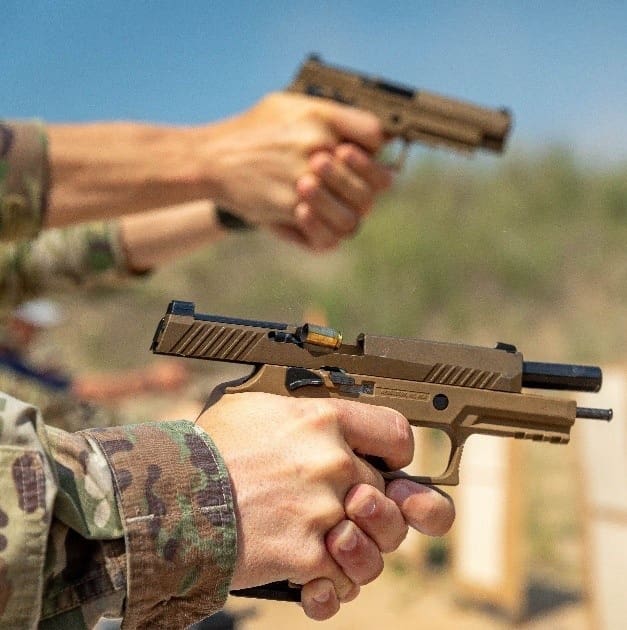
Investigating Field Incidents
When a potential uncommanded discharge is reported in the field, the Army follows a stringent investigation protocol to determine the cause. According to the Army Safety Management Information System 2.0 (ASMIS 2.0), reported firearms mishaps account for less than 0.006% of all MHS pistols issued.
When a report is filed within ASMIS, the weapon is promptly shipped to the contractor in the same configuration as it was when the incident occurred. Once the weapon arrives at the contractor’s facility, the Combat Capabilities Development Command (DEVCOM) Small/Medium Caliber Weapons Branch Chief is notified. DCMA will have the contractor open the box to verify the serial number. After the serial number is verified, the weapon is escorted and secured under U.S. Government property control pending the investigator’s arrival. Once the investigator is present, the weapon is brought out of the property cage and the investigation begins.
The investigation process is meticulous:
- Visual inspection of the weapon in its current state
- Examination of the weapon to check all safeties, internal and external, are functioning correctly
- The weapon is taken into the range where it is functionally tested with live ammunition. At least 1 (One) 21 round magazine is used to verify proper function of all safeties.
- After the range, the weapon is moved back to the armorer’s bench where the striker operation is thoroughly tested
- Finally, the weapon is broken down to each individual part to ensure all the parts look normal.
- After this, the weapon is cleaned and returned to the original unit.
To date, all investigated incidents of alleged “uncommanded discharges” have been traced back to the trigger being pulled, and not due to an issue with the firearm. Investigators have been unable to induce a discharge without disengaging the manual safety and pulling the trigger.
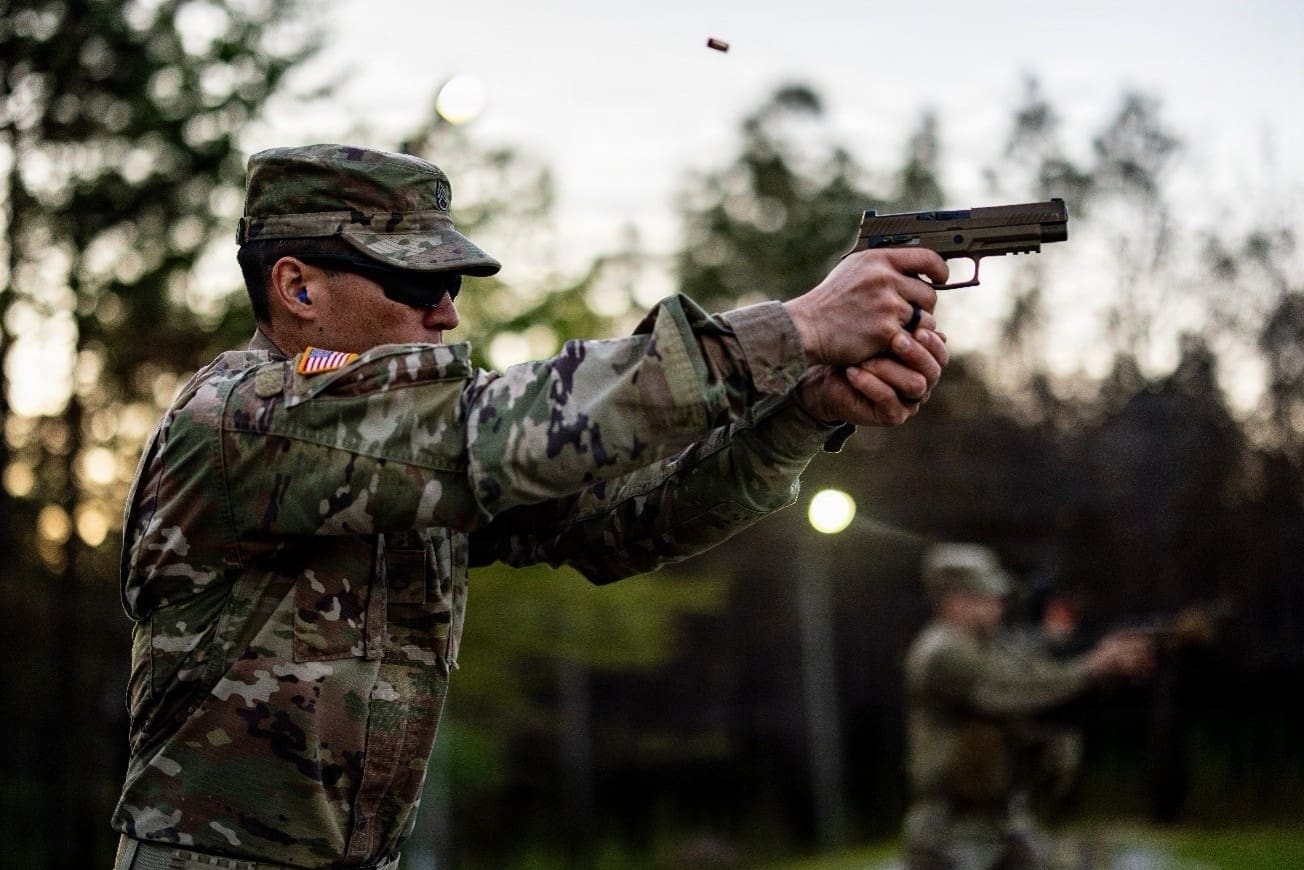
Joint Service Confidence
Most recently, a review of the MHS was initiated after the Air Force reported a potential “uncommanded discharge” involving the tragic loss of an Airman. As the lead for the MHS program, PM SL immediately engaged with our Air Force partners to assist in developing and implementing a Supplemental Inspection Criteria (SIC) as a precautionary action to investigate the incident and validate the weapon’s integrity.
The USAF’s SIC effort mandated a 100% inspection of the DAF’s “in-use” M18 inventory. It is confirmed that of the nearly 114,000 pistols inspected to date, none exhibited any conditions that could have led to an uncommanded discharge.
PM SL is confident that the MHS pistol continues to meet and exceed that standard for the entire Joint Force. The DAF’s Director of Security Forces, Brig. Gen. Brian Filler, affirmed this, stating, “It can now be stated that the M18 is safe and reliable for DAF missions.”
By CPE Ground Army
Both comments and pings are currently closed.
Read the full article here