




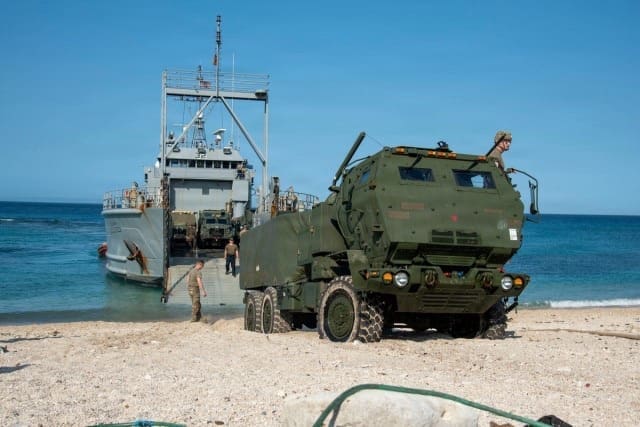
FORT BLISS, Texas — When it comes to defending the vast Pacific Ocean, the Army is usually going to take a back seat to the Navy, at least until the fight hits land. But in an effort to increase its advantage in the Joint fight in the Pacific, the Army has created the 7th Infantry Division Multi-Domain Command-Pacific.
Two exercises in June, Pacific Fury and Valiant Shield, in the U.S. Pacific Command area of operations has allowed the U.S. Army Futures and Concepts Command and two assessment teams from the U.S. Army Joint Modernization Command to look at the 7ID MDC-PAC and joint integration and capability improvements as they relate to the defense of Guam and other island chains in the Pacific.
The Army established 7ID MDC-PAC as a two-star operational headquarters out of Joint Base Lewis-McChord, Washington, and reached full operational capacity in mid-June. It merges the 7th Infantry Division and the 1st Multi-Domain Task Force to synchronize space, cyber, electronic warfare and precision fires efforts across the Indo-Pacific. The new formation brings capabilities, sensors and effects that will help the joint fight in the Pacific, according to Maj. Caleb Bloom, assessment planner in JMC’s Operations Group A.
“In the Pacific, the Army is never going to be the main effort until we hit mainland on potential conflict,” Bloom said. “However, there are things the Army can do to support the joint fight, and the MDC-PAC brings a lot of sensors and effects that will allow success at an operational strategic level. The formation is really aimed at how the Army can support the Joint fight by providing kinetic and non-kinetic effects and sensors.”
The criticality of 7ID MDC-PAC’s mission and its contributions to the joint force is what drove JMC to send a robust team to JBLM to assess developing concepts and capabilities as part of Pacific Fury, said Col. Joseph Mukes, chief of JMC’s Operations Group A.
“Our partnership with 7ID MDC-PAC here in Pacific Fury and in future exercises will afford the Army a great opportunity to learn from an elite formation as they progress,” Mukes said. “We expect to glean new and innovative ways the Army will contribute to the Joint Force as they provide protection and stability to the Pacific. We also look forward to our partnership with MDC-Europe, where we also expect to learn great deal under a very different operational and strategic problem set.”
One of the benefits JMC experimentation experts bring to exercises like Pacific Fury and Valiant Shield is the ability to give units and commands an external view of their capabilities and progress, shared Maj. Kyle Shea, lead planner for JMC’s participation in Valiant Shield. JMC assessors bring the knowledge of how other units are operating and taking advantage of new capabilities, so they can provide some real comparisons beyond, “Yeah, that works well.”
“The main thing we bring that the participating units don’t have is the assessors, the subject matter experts, who can give them an external look,” Shea said. “It’s easy for units to say, ‘We participated, check the block; We did the thing.’ To get an outside perspective to look at you and say, ‘You know what, here are your strengths; But, also, here’s where we see some opportunity for improvements.’ Yes, this capability works really well, but we see other capabilities and other exercises constantly, so how does it measure up against those others? We can give the outside perspective that the units may have a tougher time seeing. We’re just looking at it from a little different perspective.”
For Valiant Shield, JMC will have teams in Guam, Hawaii and JBLM. Lt. Col. Zachary Quintana, the assessments team lead for JMC’s Operations Group A, said the teams will be looking for progress in how the joint team defends the U.S. Pacific Command area of responsibility.
“We’ll be looking for improvement in the integration of the Joint kill web; the best sensor, best shooter methodology, in a defense of Guam scenario,” Quintana said. “We are looking at the Air Force, Navy, Army, how we all work together to address the same problem: closing any sensor-to-shooter gaps that USARPAC and USPACOM are trying to address in their [area of responsibility].”
Participating in exercises in the Pacific offers the chance to work naturally with our joint and coalition partners, Shea said.
“This has the advantage of being an USPACOM-driven exercise, so participation of our joint and coalition partners is inherently already there,” Shea said. “We’re not pulling people to the table to participate, they’re already there, so it makes for easier opportunities to see our Army capabilities integrated into the joint force and into that joint kill web.”
Shea noted that Project Convergence Capstone 5 started this chain of persistent experimentation that will continue through Pacific Fury and Valiant Shield and into Project Convergence-Capstone 6 in July in California.
“We gained a lot of insight into Joint integration in the defense of the Pacific during Capstone 5, and this will be a continuation of that progress,” Shea said. “What does it look like as they introduce new capabilities and continue to refine their processes? What’s awesome about it is it’s a Joint capability. They have the Aegis Combat System integrated from the Navy. The Air Force is involved because the defensive counter-air fight is part of that.
“Seeing that progress is both a material improvement, where they’re introducing new capabilities, but also a system improvement in how they integrate them, how the systems interact and overlap,” Shea said. “They all have semi-proprietary systems for how they target and what radar capabilities can be used with what effectors, so getting them to work more seamlessly together and be integrated in a continuous layered defense system is what they’re working toward. You can see that improvement happening in real time as we assess them year over year.”
As the teams return from Pacific Fury and Valiant Shield, FCC will turn its focus to PC-C6, using the insights gathered to feed into the broader framework of persistent experimentation. In that way, both experimentation and readiness work hand-in-hand to improve today’s Army as well as the future force.
By Jonathan Koester
You can skip to the end and leave a response. Pinging is currently not allowed.
Read the full article here