




During the 1950s and early 1960s, the Century series of fighter aircraft — the F-100 to F-106 — ruled the skies. The first in the series, the F-100 Super Sabre, also known as the “Hun,” was the first U.S.A.F. Fighter capable of supersonic speed in level flight, and was created as the successor to the F-86 Sabre. The F-86 was the Air Force’s first swept-wing fighter designed for air-to-air combat against the MiG-17 and was considered the best fighter during the Korean War.
The F-100 served in Vietnam as a fighter-bomber and close-air-support aircraft. It later flew as a reconnaissance / forward air controller aircraft during “Misty Fac” missions under the code name Commando Sabre.
Development
In 1953, North American began in-house studies of improving the F-100 for various missions. The U.S.A.F. was looking for a Mach 2 bomber capable of delivering a tactical nuclear weapon. The F-100B featured a recessed weapons bay, in addition to hardpoints under the wings, a single-point refueling capability, and a retractable tail skid. Another feature was the all-moving vertical fin, which, combined with the automated flight control system, allowed the aircraft to roll at supersonic speeds using spoilers.

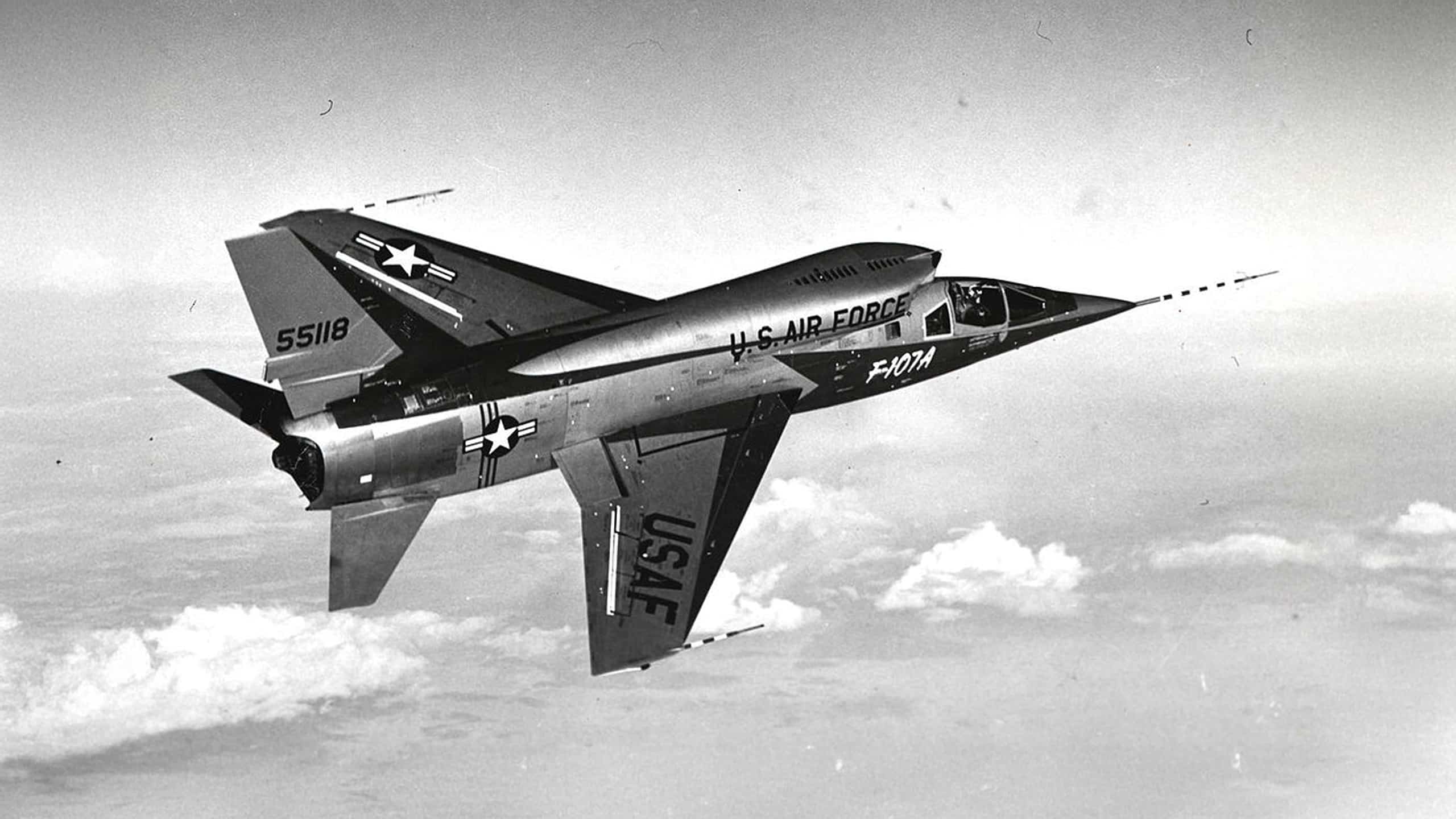
The most unique feature of the aircraft was the dorsal-mounted variable inlet duct, mounted directly above and behind the cockpit. The inlet automatically controlled the amount of air entering the engine. This early system proved very efficient. The intake was placed on top, as the U.S.A.F. required room on the centerline hardpoint to mount a semi-conformal nuclear weapon. Although the intake limited rear visibility, this was considered a non-issue, as it was assumed that true dogfights were outdated and enemy aircraft would be dealt with by air-to-air missiles at beyond-visual-range.

The J-75 engine would power the new fighter. With 24,500 pounds of thrust, the F-107 had twice as much power as the “Hun.” As the modifications mounted, the U.S.A.F. gave the F-100B the F-107A designation.

In August 1954, the U.S.A.F. signed a contract with North American for three prototypes and six additional airframes. On September 10, 1956, the F-107 made its maiden flight with chief test pilot Bob Baker. The flight went well, reaching a top speed of Mach 1.03. Still, the landing went awry when the brake parachute failed to deploy, resulting in a hot landing and nose-gear collapse. Two months later, in November, the prototype reached Mach 2.
As the program progressed, the aircraft designation was changed to F-107A. While it never received an official name, it was informally known as the “Super Super Sabre” and the “Ultra Sabre”; many North American employees referred to it as the “Maneater” due to the intake above the cockpit.
The Fly Off?
Since the U.S.A.F. had already given the go-ahead for production of the F-105 in March 1956, some 6 months before the first flight of the F-107, many wondered why have a fly-off, as the decision was preordained. The U.S.A.F.’s Tactical Air Command ordered a fly off between the Ultra Sabre and the Republic F-105 Thunderchief.

Both Jets were built for the same mission and were powered by the Pratt & Whitney YJ75 Turbojet engine. While the F-107 had a better rate of climb and a higher ceiling, the internal weapons bay required by the U.S.A.F. for nuclear weapons use had a 14,000-pound capacity, which was 40% larger than the F-107.
Another reason alleged for picking the F-105 was that Republic Aviation required contracts to stay afloat. They were in the final stages of production of their F-84 Thunderjet, with nothing else in the pipeline, while North American was extremely busy working on a plethora of designs.

Live The Armory Life. The latest content straight to your inbox plus an automatic entry to each of our monthly gun giveaways!
Another view was that the U.S.A.F. wanted a bomber designed to deliver a nuke — not a fighter that was modified for the mission. U.S.A.F. Gen. Otto Weyland stated that senior U.S.A.F. staff seemed to be obsessed with nuclear weapons.
Ultimately, the F-105 “won” the flyoff and went on to serve as the primary strike aircraft for the first few years of the Vietnam War, until it was replaced by the F-4 Phantom. Still, the big selling point about nuclear capability was moot. The bomb bay was fitted with a 400-gallon fuel tank to extend range, and all ordnance was fitted on external hardpoints.
Testing, Testing
In late 1957, prototypes #1 and #3 were leased to NACA (National Advisory Committee for Aeronautics), which was the predecessor to NASA, for high-speed flight testing. During testing, the variable inlet caused problems. The engineers couldn’t seem to get it dialed in, and ultimately, the intake was fixed into position, limiting top speed to Mach 1.2.

Another area of testing concerned the use of a right-side-mounted control stick. The side-mounted stick was used to test the system mounted in the North American X-15 rocket-powered aircraft, which was under development. The X-15 had the side stick installed to cradle the pilot’s arm and prevent any unintended control input when the rocket motor ignited. After burnout, the pilot would use the center stick to glide back for landing. Airframe #3 was configured this way.

In September 1959, NACA test pilot Scott Crossfield, who was slated to fly the X-15, was taking off when the plane ground-looped, blowing both main tires and causing a small brake fire. Although the airplane was not badly damaged, it was decided not to invest in repairs, and the prototype was used for firefighter training.
Where Are They Now?
Prototype #1 now resides at the Pima Air and Space Museum, located next to Davis Monthan AFB, aka “The Boneyard.” Prototype #3 is located at the Mecca of Aviation, the National Museum of the United States Air Force in Dayton, Ohio.
Legacy of the Ultra Sabre
The F-107 introduced several design innovations that are in use today. The VAID Variable Area Inlet Duct system is used on several aircraft types to control airflow into the engines. Positioning the inlet on top also minimized aerodynamic interference with the bomb bay, reduced overall drag, and improved shock-wave control at supersonic speeds.

The Ultra Sabre was a prime example of Cold War innovations in supersonic aircraft that influenced aircraft designs to this day.
Editor’s Note: Please be sure to check out The Armory Life Forum, where you can comment about our daily articles, as well as just talk guns and gear. Click the “Go To Forum Thread” link below to jump in and discuss this article and much more!
Join the Discussion
Read the full article here