



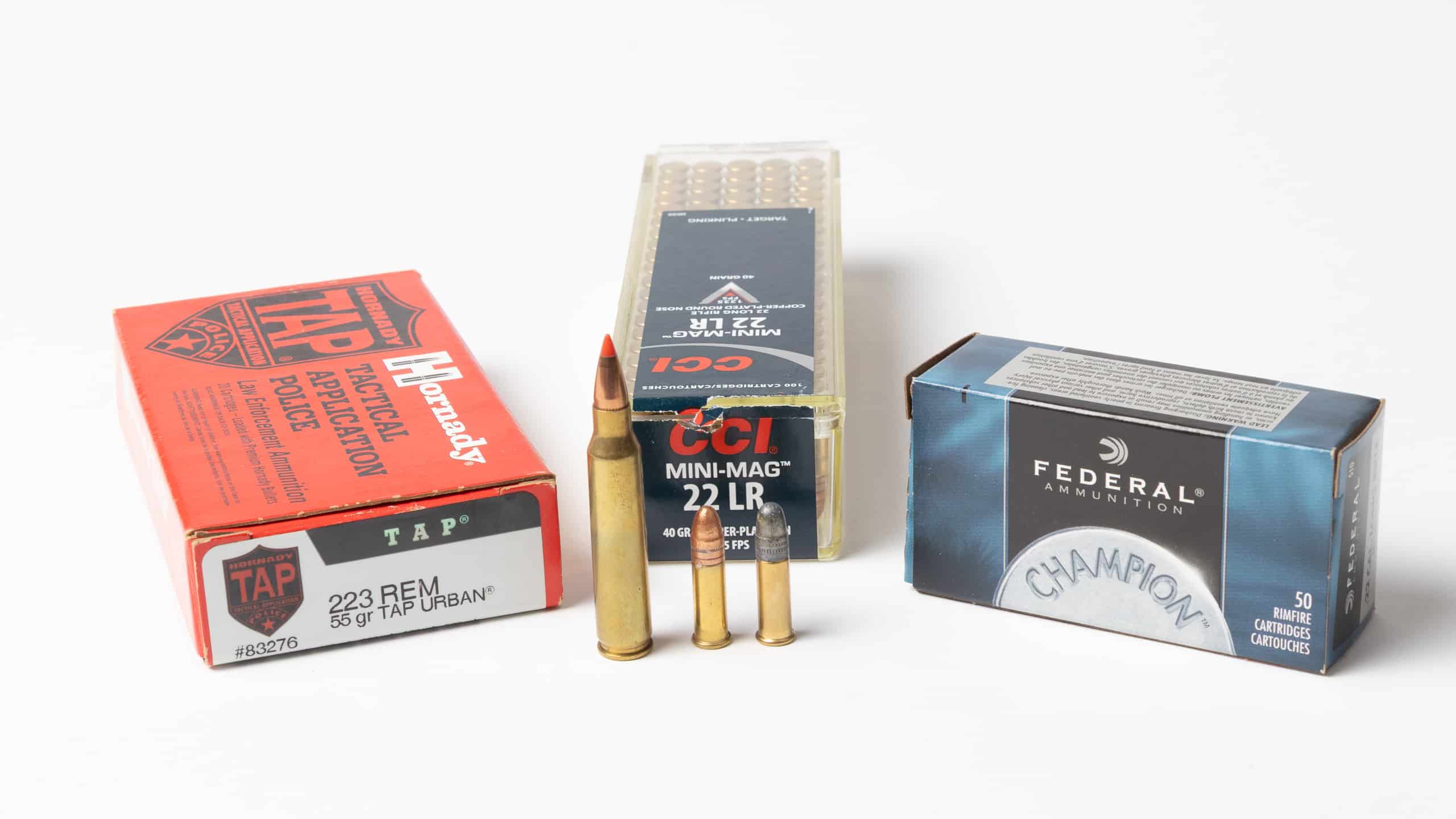
The main difference between rimfire and centerfire cartridges lies in where the primer is located and how the firing pin strikes it. Rimfire ammunition has a priming compound distributed around the inside rim of the cartridge base. Centerfire ammo has a separate primer component seated in the center of the case head.
This fundamental design difference affects everything from reliability to reloadability to what calibers are even possible to manufacture.
How Rimfire Ammunition Works
A rimfire cartridge gets its name from the simple fact that the firing pin strikes the rim. The case head has a folded rim that contains priming compound pressed into it during manufacturing. When the firing pin hits anywhere on that rim, it crushes the compound, creating the spark that ignites the powder.

This design is cheap to manufacture. Really cheap. That’s why .22 LR ammunition costs so little compared to centerfire rounds. The entire case can be drawn from soft brass in one operation, and the priming compound gets spun into the rim as part of the manufacturing process.
But that soft case creates limitations. You can’t reload rimfire cases. Once fired, the rim is deformed and the priming compound is gone. The case walls need to be thin enough that the firing pin can crush the rim reliably, which limits how much pressure the case can handle.
How Centerfire Ammunition Works
Centerfire cartridges use a completely different approach. The primer is a separate component — a small metal cup containing priming compound and an anvil — that gets pressed into a pocket machined in the center of the case head. The firing pin strikes this primer directly.

The case itself can be made from much thicker, stronger brass because it doesn’t need to deform during ignition. This allows centerfire ammunition to handle significantly higher pressures. We’re talking 35,000 PSI for some pistol cartridges, up to 60,000+ PSI for rifle cartridges. Rimfire typically operates around 24,000 PSI maximum.
These cases can also be reloaded. Shooters deprime the spent case, clean it, resize it, seat a new primer, add powder, and seat a new bullet. Some brass can be reloaded ten times or more if you’re careful about it.
Common Rimfire Calibers
The .22 Long Rifle dominates the rimfire market. It’s been around since 1887 and probably accounts for 95% of rimfire ammunition sold today. It’s cheap to shoot with low recoil.

Other rimfire calibers exist but they’re less common. The more popular ones are:
- .22 Short — even smaller and quieter than .22 LR, sometimes used in gallery guns
- .22 WMR (Winchester Magnum Rimfire) — more powerful than .22 LR, popular for small game hunting and varmints
- .17 HMR (Hornady Magnum Rimfire) — fast and flat-shooting, good for prairie dogs and similar pests out to 200 yards
- .17 WSM (Winchester Super Magnum) — the fastest rimfire available, though ammunition is expensive and not widely available
Historically, there were larger rimfire calibers. The .44 Henry Flat was used in the Henry rifle during the Civil War era. The .56-56 Spencer was another military rimfire. But those designs died out once centerfire technology became practical.
Common Centerfire Calibers
This is where the variety explodes. Centerfire cartridges range from tiny .17 caliber varmint rounds up to massive .50 BMG anti-material rifle cartridges.

Popular pistol calibers include 9mm Luger, .45 ACP, .40 S&W, .38 Special, .357 Magnum, 10mm Auto, and dozens more.
Rifle calibers cover everything from .223 Remington and 5.56 NATO for ARs up through .308 Winchester, .30-06 Springfield, 6.5 Creedmoor, .300 Winchester Magnum, and into dangerous game cartridges like .375 H&H and .458 Winchester Magnum.
The centerfire design makes all of this possible because the stronger case construction can handle the chamber pressures these calibers generate.
Reliability Differences
Centerfire ammunition is generally more reliable. The primer is protected inside its pocket and designed to ignite when struck with specific force. Quality control on centerfire primers is excellent — you’ll rarely get a dud.

Rimfire reliability depends on consistent priming compound distribution around the entire rim. Sometimes the compound isn’t evenly distributed. Sometimes there are voids. You might get a light strike that doesn’t crush enough compound to ignite. Rimfire ammunition has a higher failure rate — maybe 1 in 500 to 1 in 1000 rounds, depending on the manufacturer and lot.
This is why military forces and law enforcement agencies use centerfire cartridges. When reliability is critical, you can’t accept rimfire failure rates.
Cost Comparison
Rimfire wins on cost. No question. You can buy .22 LR for anywhere from 5 to 15 cents per round, depending on quality and market conditions. Bulk packs save you the most money per round.

Live The Armory Life. The latest content straight to your inbox plus an automatic entry to each of our monthly gun giveaways!
Centerfire ammunition costs significantly more. Cheap 9mm runs about 25 to 35 cents per round. Rifle ammunition starts around 50 cents per round for .223 and goes up from there. Premium hunting ammunition or match-grade ammo can cost $2, $3, even $5+ per round. Again, buying by the case can drop the cost per round a bit.
But if you reload your centerfire brass, you can cut costs substantially. Once you’ve got your initial brass, you’re just paying for primers, powder, and bullets.
Power and Performance
Centerfire cartridges deliver significantly more power. A .22 LR produces maybe 130-150 foot-pounds of energy. A 9mm generates around 350-400 ft-lbs. A .308 Winchester hunting load hits 2,600+ ft-lbs. A .300 Winchester Magnum exceeds 3,500 ft-lbs.

The thicker case construction and higher pressure capability of centerfire designs allow for larger powder charges, heavier bullets, and higher velocities. This translates to better terminal performance on game, longer effective range, and improved barrier penetration.
Rimfire cartridges top out around .17 WSM, which produces maybe 300 ft-lbs. Physics and metallurgy impose hard limits on what’s possible with the rimfire design.
Applications and Use Cases
Rimfire ammunition excels for training, plinking, and small game hunting. The low cost means you can shoot all day without emptying your wallet. The low recoil makes it perfect for teaching new shooters. A .22 LR will handle squirrels, rabbits, and pest control around the property.
Competitive shooters use rimfire extensively. Steel Challenge, NRL22, and various precision rimfire competitions let people develop skills without the cost of centerfire ammunition.
Centerfire is what you use when the job requires it. Self-defense. Law enforcement. Military applications. Hunting anything larger than a coyote. Long-range precision shooting. Competition disciplines like USPSA, IPSC, PRS, and 3-Gun.
You wouldn’t use .22 LR for harvesting a whitetail deer with it in most jurisdictions. The power just isn’t there for that. Nor would I recommend using it for home defense. While there are limited situations in which .22 LR might be ok for defensive use — such as someone with significant hand strength issues — there are far better options. I’d recommend checking out Fred Mastison’s article on which caliber is best for self defense.
Accuracy Potential
Both rimfire and centerfire ammunition can be extremely accurate in quality firearms. High-end match .22 LR ammunition like Eley Tenex or Lapua Center-X will shoot half-inch groups at 50 yards from a good rifle with a solid rest.
But centerfire ammunition has certain advantages. The separate primer component means more consistent ignition. Reloaders can tune their ammunition precisely to their specific firearm — adjusting powder charges, seating depths, and bullet selection to achieve optimal accuracy.
The higher velocities of centerfire cartridges also mean less wind drift and a flatter trajectory at longer ranges. A .22 LR drops like a rock past 100 yards and gets pushed around by any breeze. A 6.5 Creedmoor stays supersonic past 1,000 yards and bucks the wind far better.
Availability Considerations
.22 LR ammunition is nearly universal. Every gun store, sporting goods retailer, and big box store carries it. Even during shortage periods, you can usually find some if you’re willing to pay a bit more.
Centerfire ammunition availability varies by caliber. Common calibers like 9mm, .223, and .308 are widely available. More specialized cartridges might require ordering online or visiting shops that cater to serious shooters.
During panic buying periods, centerfire ammunition disappears first and prices spike dramatically. The 2020-2021 shortage saw some centerfire ammunition prices triple or quadruple. Rimfire was affected but not as severely.
Which One Should You Choose?
For most shooters, the answer is both.
A .22 LR pistol and rifle make sense for anyone who wants to shoot frequently without spending a fortune. They’re perfect training tools and excellent pest control options.
But you’ll also want centerfire firearms for serious purposes. A 9mm or other centerfire pistol for home defense. A centerfire rifle in an appropriate caliber for the game you hunt.
The two types of ammunition serve different roles. They complement each other rather than competing. Rimfire for practice and fun, centerfire when performance matters.
If you’re on a tight budget and can only afford one type initially, start with rimfire. Build your shooting skills with affordable ammunition, then add centerfire options as your budget allows.
If you need a firearm for protection or hunting medium to large game immediately, then centerfire is non-negotiable. You can add rimfire later for cost-effective practice. The designs emerged from different engineering constraints and they’ve each found their place in the shooting world. Understanding the fundamental differences helps you make informed decisions about what ammunition and firearms serve your specific needs.
Editor’s Note: Be sure to check out The Armory Life Forum, where you can comment about our daily articles, as well as just talk guns and gear. Click the “Go To Forum Thread” link below to jump in!
Join the Discussion
Read the full article here