




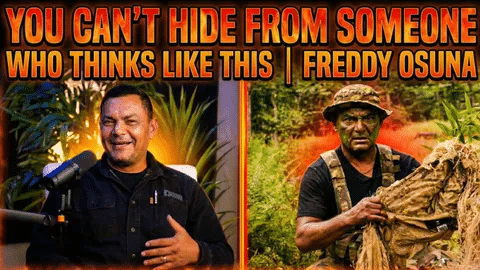
In this episode of the RECOIL Podcast, host Tom Marshall sits down with Freddy Osuna, founder and lead instructor of Green Side Training, for one of the most wide-ranging, thought-provoking conversations we’ve ever recorded.
Freddy’s story starts long before the military. Raised on the Pascua Yaqui Reservation in southern Arizona, his earliest lessons in tracking came from his grandmother and tribal elders, learning to read sign, behavior, and patterns in the desert as a way of life.
Those early foundations followed him into the United States Marine Corps, where he served as an infantryman, sniper, and combat veteran during the early years of the Global War on Terror.
From jungle warfare in Southeast Asia to urban combat in Iraq, Freddy explains how primitive fieldcraft, observation, and human behavior analysis became survival skills long before technology caught up. He breaks down how those same skills later shaped the Marine Corps’ Combat Hunter Program, a groundbreaking effort to teach Marines how to think like predators, read nonverbal cues, track human movement, and conduct pursuit operations after contact.
This conversation goes far beyond military applications.
Freddy explains how tracking is not just about footprints in the dirt, but about pattern recognition, emotional regulation, and understanding human behavior at a deep level.
We explore how Green Side Training evolved from teaching man tracking for combat into programs used by law enforcement, search and rescue teams, hunters, civilians, and even medical professionals. One of the most compelling parts of this episode dives into the modern world.
Freddy discusses how constant dopamine hits from phones, social media, and instant gratification are degrading attention, awareness, and emotional health, and how tracking is now being used as a tool for cognitive grounding, PTSD recovery, and mental resilience. He shares how Green Side is working with medical professionals, SOCOM-affiliated researchers, and educators to apply tracking principles to trauma recovery, youth development, and behavioral awareness.
You’ll also hear deep discussions on:
- The reality of combat tracking in Iraq and how it saved lives
- Why jungle warfare may be the hardest environment humans ever trained in • How drones, thermal optics, and AI are changing tracking and counter-tracking
- Integrating man trackers, canines, and modern technology into one system
- Urban tracking and situational awareness in everyday civilian environments
- Why observation and silence are becoming lost skills in modern society
- How tracking builds discipline, confidence, and long-term satisfaction rather than instant dopamine
This episode is part military history, part philosophy, part psychology, and part warning about where modern life is pulling our attention. If you care about awareness, personal development, real-world skills, or understanding how humans move, think, and behave under pressure, this is a conversation you do not want to miss.
Read the full article here