




![Best Guns For Home Defense [2026]](https://www.recoilweb.com/wp-content/uploads/2022/08/Facebook-Cover-1.png "Best Guns For Home Defense [2026]")
A PLETHORA OF OPTIONS, FROM SHOTGUNS TO HANDGUNS.
Narrowing down the best gun for home defense can feel overwhelming. Between the advice at the gun store, the people online, and your friend’s brother’s buddy who used to be a cop, it can feel like too much information.
To avoid adding to that noise, we’ll keep this short and simple. Covering the pros and cons of the major platforms while giving some recommendations for specific models to take a look at.
EVERYTHING DEPENDS ON YOUR SITUATION
There is no one-size-fits-all answer to defending your home. Differences in budget, local laws, personal ability, personal preferences, and what type of home you have are simply too diverse to recommend just one weapon for everyone.
Ultimately, you’ll have to decide what is best for you. Hopefully, this will give you a great place to start.
Research your local laws and be aware of any magazine or feature restrictions you might be under. While only you can choose what laws you obey, it is strongly recommend that you follow all relevant local firearm laws when choosing your home defense firearm.
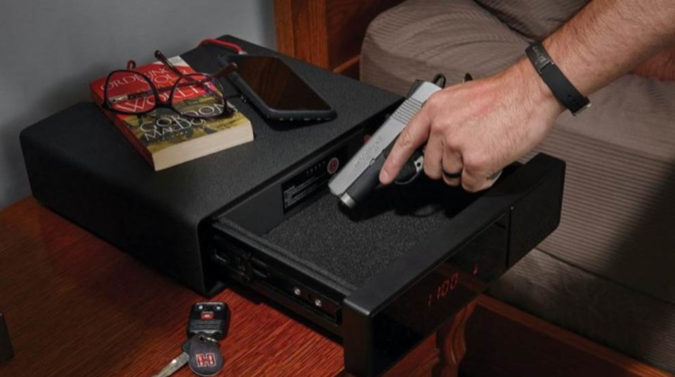
Even a legal shooting could land you in jail for a long time if the gun or magazines used were not legal.
You may also want to take a look at CCW Insurance, these plans usually cover the home as well.
AMMO CHOICE MATTERS ALMOST AS MUCH AS FIREARM
While the firearm is the platform, the ammo is what gets the job done. A 12-gauge shotgun with 15 shells in the tube doesn’t do much good if you’re shooting glorified nerf shot. On the other hand, if you’re in an apartment building and empty a 30-round magazine of 5.56 NATO M855 green tip, the odds of you hitting someone on the other side of those walls go way, way up.
Ideally, you want ammo that will get the job done in putting down the threat but will also over-penetrate as little as possible.
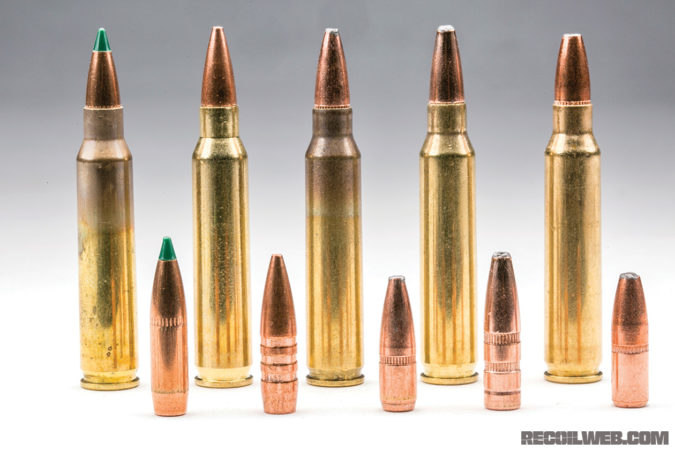
Just like there is no magic firearm, there is no magic ammo. However, investing in quality ammo designed for home defense will go a long way to mitigate the problem.
This ammo is often not cheap. Regardless of what caliber you choose, it’s likely to be $1 per round at least.
That might seem like way too much, but if it’s a box or two of expensive ammo a couple of times per year Vs. accidentally killing someone you love on the other side of a bedroom wall, it’s worth it.
Entire books can and have been written on what ammo is best for what use case, but here is our quick list for common home defense calibers:
TRAIN, TRAIN, TRAIN
No matter what gun and what ammo you choose, train with it. Never stop training. Get to the range and drill. Attend classes. Take a critical look at your home and see where the corners are, find the blind spots, and make a plan for you and your family in the event of an incident.
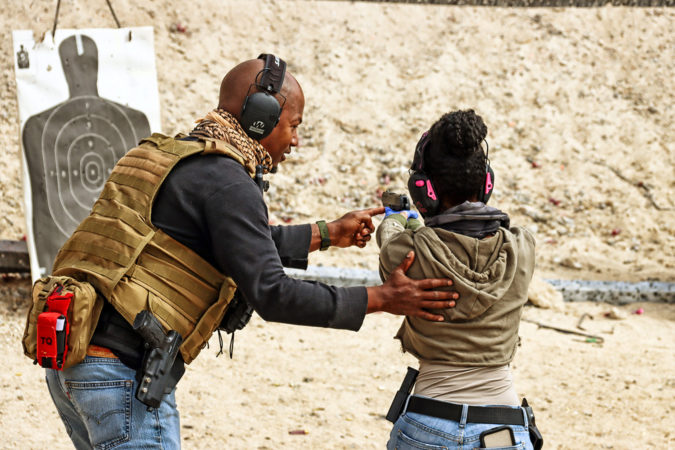
If you’re working on a budget, don’t forget to plan for classes and ammo to train with.
You’ll be a lot better off with a Maverick 88 ($200), a shotgun class, and 1,000 shells of ammo to practice with than you will be with a Beretta 1301 ($1,200), no class, and 2 boxes of shells.
BEST GUN FOR HOME DEFENSE
AR-15
PROS:
- Economical
- 30+ rounds per mag
- Highly effective on target
- Low over-penitration
- Easy to add extras (light, suppressor, red dot, etc)
CONS:
- Most likely to be regulated
There is a LOT can be said about the AR-15 and home defense, but let’s try to keep this concise.
First off, almost any brand and model of AR-15 is fine as long as you test the firearm with the ammo you want to use for HD, and you’re sticking to generally milspec-ish rifles – no race guns or skeletonized craziness.
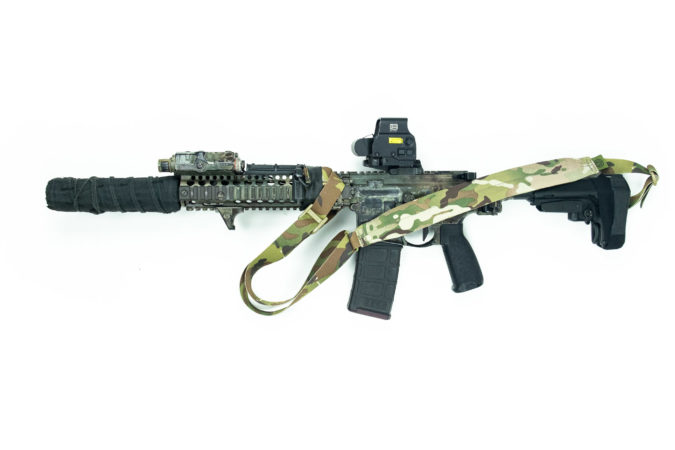
5.56 NATO and 300 Blackout are both great. 300 BLK is designed for suppressor use, but a suppressor on a 5.56 NATO gun is cheaper and more flexible.
But why do you want an AR-15? Because it is by far the best home defense firearm ever made, period.
The AR-15 is simple, reliable, easy to train with, customizable, able to be outfitted with every modern do-dad you can think of, lightweight, and very easy to use.
Even when it comes to overpenetration, 5.56 NATO goes through fewer layers of drywall than just about any other common option. 300 BLK subs go through almost as little.
AR-15s are inexpensive, common, and a true Goldilocks for home defense.
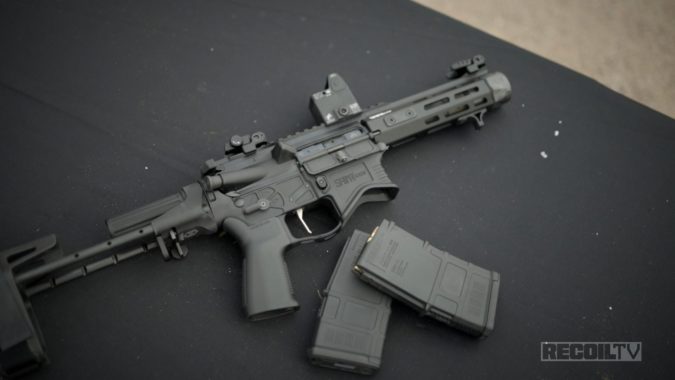
If you have the interest and time, building your own AR-15 will let you really take advantage of the strengths of the system.
Buying off the shelf is easier, faster, and gives you a warranty to fall back on.
For 300 BLK, take a look at a Palmetto State Armory PA-15.
In 5.56 NATO you could just pick up a PSA, or you might choose anything from a POF PA-15 BASE to a Daniel Defense M4A1.
Pistol Caliber Carbine
PROS:
- Great for suppression
- Smaller package
- Easy for people of small stature
- 30+ rounds per mag
- Easy to add extras (light, suppressor, red dot, etc)
CONS:
- Might fall victim to “assault weapon” regulations in some states
- 9mm is still a pistol caliber
There are a lot of people in the world that look down on Pistol Caliber Carbines for home defense. But for the right people in the right situations, PCCs make a lot of sense.
While you can find PCCs in .380 ACP, .45 ACP, 10mm Auto, and even 5.7×28 FN, the vast majority of PCCs are in 9mm.
The other calibers aren’t unviable, but they don’t really bring anything to the table we want. .380 ACP is very hard to find in a PCC, and do you really want to trust a Hi-Point with your life? .45 ACP and 10mm Auto over penetrates drywall a lot, and 5.7×28 FN is too expensive for most people to train with (roughly double the price of 9mm).

9mm penetrates more than 5.56 NATO or 300 BLK, but less than 00 Buckshot, it’s cheap to train with, easy to get, and the PCC options are super rich.
Aa PCC in 9mm is a solid option for anyone who wants an AR-15, but might not be able to physically handle an AR-15. While the recoil from 5.56/300 BLK isn’t much for most people, it still takes a decent amount of strength to run the charging handle effectively.
Those with arthritis or other physical issues might be unable to run an AR-15 well. For this, PCCs can help since they (normally) take less strength to operate.
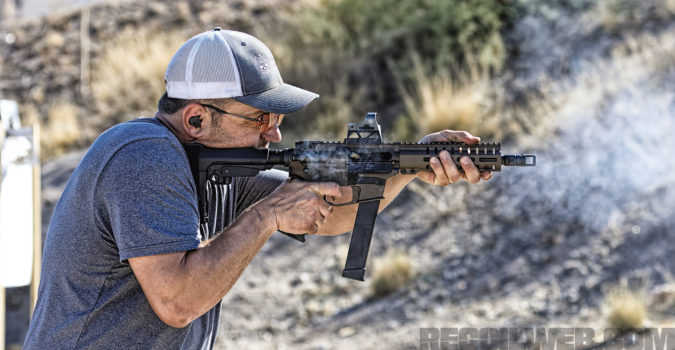
PCCs are also suitable for people that might not have a lot of firearm experience and want something almost as effective but less intimidating than an AR-15.
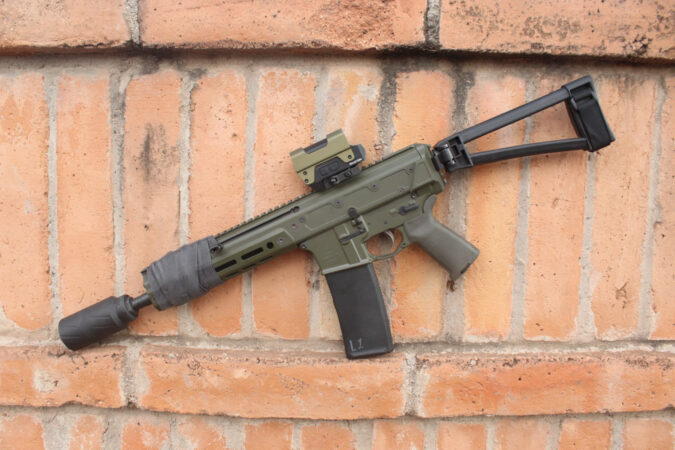
For a goldilocks choice, CZ Scorpion EVO series is a great pick-up. The carbine version is a little larger and out-of-the-box great. Add a red dot and a weapon light, and you’ll have a solid home defense set up. Or get the pistol version and throw a brace on it for a super compact package.
If you’re looking to really spend some money for a buy-once, cry-once – SIG Sauer MPX is the smoothest running PCC outside of custom-built competition guns.
Shotgun
PROS:
- Extremely high lethality
- Can be extremely budget-friendly
- Most versatile outside of home defense
- Many, many types of ammo
CONS:
- “Racking the gun will scare the bad guy away” is a complete lie
- Still needs to be aimed
- Harder to use for smaller people
- Low ammo capacity
- Can be hard to add light/red dot/suppressor
A classic option as the best gun for home defense and one that never goes out of style, a shotgun is about as close to a do-all gun as you can get. Pump action or semi-auto, both are great for defending the home with – but there are a lot of misconceptions and fudd lore.
To quickly cover the basics: You do need to aim a shotgun, pellet spread won’t turn a miss into a hit at HD ranges, 00 buck over penetrates drywall a lot – #4 buck is a better choice, 12ga and 20ga are perfectly fine, but 12ga is the standard. 20ga is not always better for smaller people since 20ga guns are normally smaller/lighter, thus making the recoil the same or worse than 12ga, depending on the exact model of shotgun.
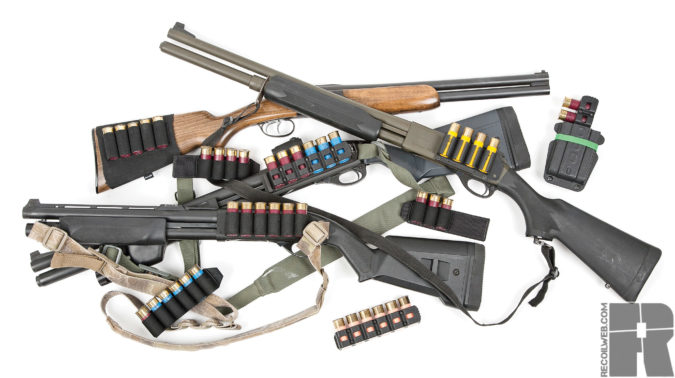
If you’re interested in using a shotgun for home defense, you should do some reading up about them first. There is a lot to talk about from what action to choose to what features are useful. Frankly, it’s more than what can be covered in this small section.
If you want the cheat code, the Mossberg 940 Pro Tactical is a great option. Semi-auto, super reliable, awesome gun.
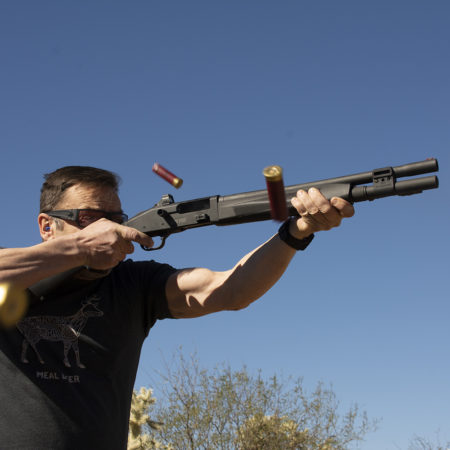
But if pump-action is what you’re looking for, the Mossberg 590A1 Magpul is an outstanding 9-shot option with upgraded furniture.
Handgun
PROS:
- Easy to find good training classes
- Easy to practice with
- Can serve double-duty as CCW and HD
- Lots of good options
CONS:
- Hardest to master
- Not super easy to suppress
While a simple handgun might be what many Americans have for their home defense weapon, it’s honestly kind of far from ideal for home defense.
Handguns require more training to be good with, they have more room for error, and they most often are lacking in terms of force multiplication.
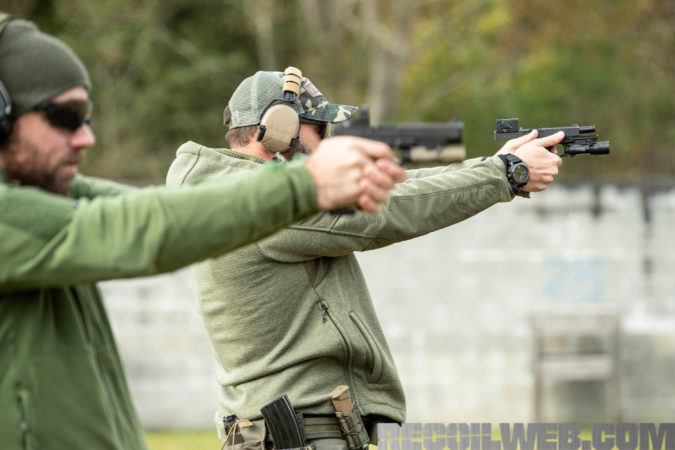
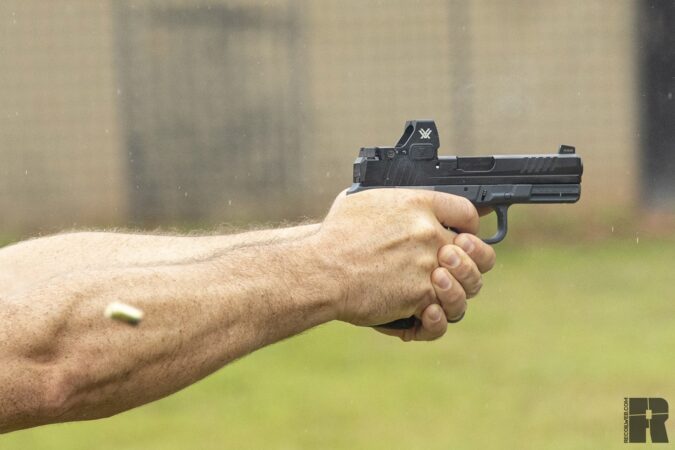
If you have a really tricked-out handgun, say a Glock 17 with red dot and extended magazines – that’s probably about 90% as effective as a PCC but still doesn’t win the gold for best gun for home defense.
But if your handgun is a J-Frame 6-shot revolver in .38 Special, odds are someone breaking into your home will outgun you.
Never settle for a fair fight.

That said, maybe this is your one and only gun, and you want to every day carry it also – in that case, a Glock 19 Gen 5 MOS gives you the option to add a red dot and white light and will give you a decent balance between home defense and concealed carry.
If you want to trim the budget down but not give up any features, Palmetto State Armory’s Dagger is a great option as is the new Ruger RxM.
RECOMMENDED HOME DEFENSE GUN ACCESSORIES
Adding more stuff to your gun is no substitute for good training, but there are force multipliers that make a difference.
Weapon Light
In my book, a weapon-mounted light is non-negotiable. Attacks on the home are most likely to occur at night, and you can’t hit what you can’t see. More importantly, you can’t identify what you can’t see. There are too many instances of people killing loved ones because they heard a bump in the night and didn’t identify their target before opening fire.
Relying on your home’s lighting isn’t a great plan. First, they might not work. Power outages happen, lights burn out, or just fumbling around for a light switch isn’t ideal.

A hand-held flashlight isn’t a bad option, but it’s not ideal. Using a light and a gun at the same time takes more practice, is easier to screw up, and makes shooting more difficult.
Even a cheap light is better than no light. Indoors, you don’t need 1,500 Lumens and 100,000 Candela. Anything over 500 Lumens is good enough. Don’t forget extra batteries and to change the batteries out (or recharge them) at least once a year.
Red Dot
A good red dot makes hitting what you want to hit a lot easier, and allows you to be target-focused while you do it. Plus, a red dot is the best night sight you can imagine. Especially if you’re pairing it with a white light.
Even budget-priced red dots are reliable and have battery life measured in years. It’s still a good idea to change the battery every year, but it’s less critical than ever before.
Suppressor
Guns are loud. Like, really loud. Gunshots indoors are very, very loud. And concussive. Frankly, if you fire a gun indoors without ear protection, you’re in for a bad time. Depending on the gun, ammo, and the room, you’re going to have hearing damage of some degree. It might not be too bad with symptoms lasting only a few hours, or it might be a lifetime supply of muffled sound and/or tinnitus (ringing in the ears).
New research also shows that the concussive force from shooting indoors can cause micro-TBIs (Traumatic Brain Injury) with every shot. Is shooting to defend yourself in a home invasion enough going to cause a lifelong problem? Probably not, but it isn’t nothing.
Suppressors help mitigate this. Even with a suppressor, most guns aren’t “hearing safe”, but they are at least a lot closer than without one. This not only protects you, but also everyone else in the home.
One often overlooked benefit of a suppressor is being able to communicate with people afterward. The first symptom of hearing damage is muffled hearing and ringing in the ears. Individually or combined, this can make speaking to people hard. If you and your family suddenly have problems communicating in a life or death sitiation, that’s not good. A suppressor helps.
With the NFA tax stamp fee removed, suppressors are more affordable than ever.
Sling
Assuming your weapon of choice is a long gun, a sling can make sense as an extra hand when you need it. Maybe you need to pick someone or something up, maybe you need to render first aid, maybe you need both hands to move something heavy in front of a door. A sling makes retaining the weapon easier and reacquiring it faster.
Required? Probably not, but it’s something worth thinking about.
LOOSE ROUNDS
My hands-down recommendation for home defense is always the AR-15. That’s what lives next to my bed, and that’s what is probably best for most people. But don’t let my decision dictate what is right for you, consider all the options and if you can give them a try at the range before buying.
READY FOR MORE?
Read the full article here