




Our Nation’s warfighters encounter many known and unknown hazards on the modern battlefield including chemical, biological, radiological, and nuclear (CBRN) threats. Hand-held detection and identification capabilities enhance situational awareness and enable early warning and mitigation, but they can also be time intensive and physiologically burdensome. Additionally, some environments pose too great a risk or are simply inaccessible to warfighters. This is where the use of critical integrated layered CBRN defense assets like autonomous systems comes in.
In CBRN defense, an autonomous system refers to a capability that can independently detect, identify, and/or mitigate CBRN threats by leveraging sensors, robotics, artificial intelligence (AI), and automated decision-making algorithms. The key feature lies in its ability to function independently, acting as an intelligent partner, and keeping the warfighter at a safe distance, therefore enhancing force protection.

Currently, the Capability Program Executive Chemical, Biological, Radiological and Nuclear Defense (CPE CBRND) manages autonomous system efforts including the CBRN Sensor Integration on Robotic Platforms (CSIRP) and the Autonomous Decontamination System (ADS).
CSIRP is a rapid prototyping and fielding effort led by the CPE CBRND’s Joint Project Manager for CBRN Sensors (JPM CBRN Sensors) that focuses on integrating modular CBRN sensor solutions to enhance Unmanned Aircraft Systems (UAS) and Unmanned Ground Vehicles. It exploits advances in sensing, AI, machine learning, autonomy, and communications to enable timely and accurate detection, early warning, and reporting of CBRN hazards, benefiting the warfighter by reducing response times and limiting risk of exposure to CBRN threats.
The CSIRP SkyRaider UAS CBRN Hazard Mapping system is an example of CSIRP in action. The CSIRP SkyRaider UAS is a drone with modular detection equipment or sensors attached that can display CBRN hazard information on mapping, targeting, and communication devices. Once launched from the ground or platform, it is capable of autonomous operation beyond line-of-sight and can complete the programmed mission even through loss of GPS or communications. It is capable of self-navigating to the target, maneuvering in tight spaces, and avoiding obstacles.
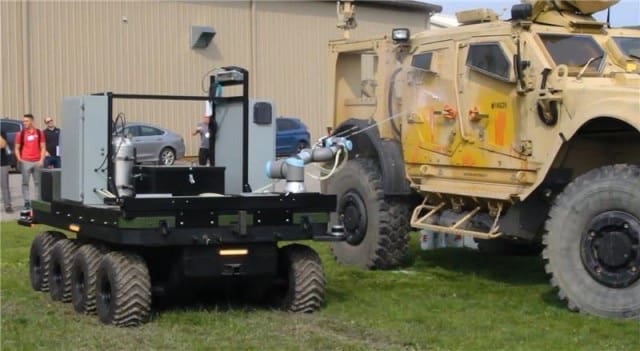
Likewise, the ADS program, led by the CPE CBRND’s Joint Project Manager for CBRN Protection (JPM CBRN Protection) will provide increased safety and efficiency of chemical and biological (CB) decontamination operations by utilizing automated, semi-autonomous, and/or autonomous processes to mitigate contamination on critical mission equipment, infrastructure, and terrain. ADS reduces reliance on warfighters’ manual labor and optimizes resource consumption.
To illustrate how these autonomous systems benefit the warfighter and Joint Force mission, imagine a platoon situated in a contested environment. The adversary launches a missile armed with a chemical warfare agent nearby and the dispersal pattern is unpredictable due to the terrain, wind conditions, and the missile’s detonation characteristics. Manned detection slows contamination mapping and poses risk to the Force, so rather than putting warfighters at risk, the platoon leader would deploy the SkyRaider UAS equipped with chemical sensors to quickly self-navigate and assess the broader area. This unmanned, rapid assessment minimizes personnel exposure and enhances force protection by communicating to leaders the timely information needed to make informed decisions. In this case, the platoon leader might deploy an ADS to decontaminate any equipment or areas the platoon will need to traverse, mitigating the risk of exposure to the warfighters through robotic means and reducing the time and logistical burden required to conduct decontamination operations.
Mark Colgan, CSIRP lead systems engineer for JPM CBRN Sensors, states, “Currently, warfighters have to suit up, do their mission, and then decontaminate their protective gear, equipment, vehicles, and more. We can now skip some of those steps by automating the process. They get the same results while remaining safe and completing the mission faster.”
The CSIRP effort is in constant pursuit of advanced sensing capabilities and improvements to leverage autonomy, specifically through its use of algorithms. To keep pace with advancing technologies, JPM CBRN Sensors and JPM CBRN Protection leverage CPE CBRND’s Joint Enterprise Technology Tool (JETT), a web-based platform designed to facilitate communication between the U.S. Government and industry members, for market research and to gain a better understanding of what industry is developing and their focus areas as they relate to program needs. The JPM CBRN Sensors team has utilized JETT to identify and engage with more than a dozen vendors with capabilities relevant to CSIRP. Colgan states, “JETT has proven valuable in answering the questions of ‘What else is out there?’ and ‘What’s coming next?”
This aligns with the Department of War’s Acquisition Transformation Strategy, which, in part, acknowledges that industry often outpaces the Defense Industrial Base and that the Department “must adopt an industry-driven environment for companies to share their product and service offerings to accelerate and scale capability delivery,” as well as “enable industry to better understand the Department’s needs and demonstrate mature products and services early in the acquisition process.”
To date, improvements have included software designed to operate with CPE CBRND’s CBRN Support to Command and Control (CSC2), which integrates CBRN sensor data and information into a common operating picture and provides actionable information to Commanders throughout the battlespace; flight software and sensor-driven algorithms that enable a number of unmanned systems to autonomously team up and relay messages among themselves and with their human counterparts; algorithms that synthesize data; and more.
As it stands, autonomous systems provide a decisive warfighter advantage by performing standoff detection of CBRN threats and critical decontamination functions so the warfighter can focus—at a safe distance—on the larger mission at hand. Looking ahead, AI and technology advancements will continue to optimize the role autonomous systems play in CBRN defense, enabling our warfighters to operate in a CBRN contested environment with more confidence.
By Vashelle Nino CPE CBRND Public Affairs
You can skip to the end and leave a response. Pinging is currently not allowed.
Read the full article here