




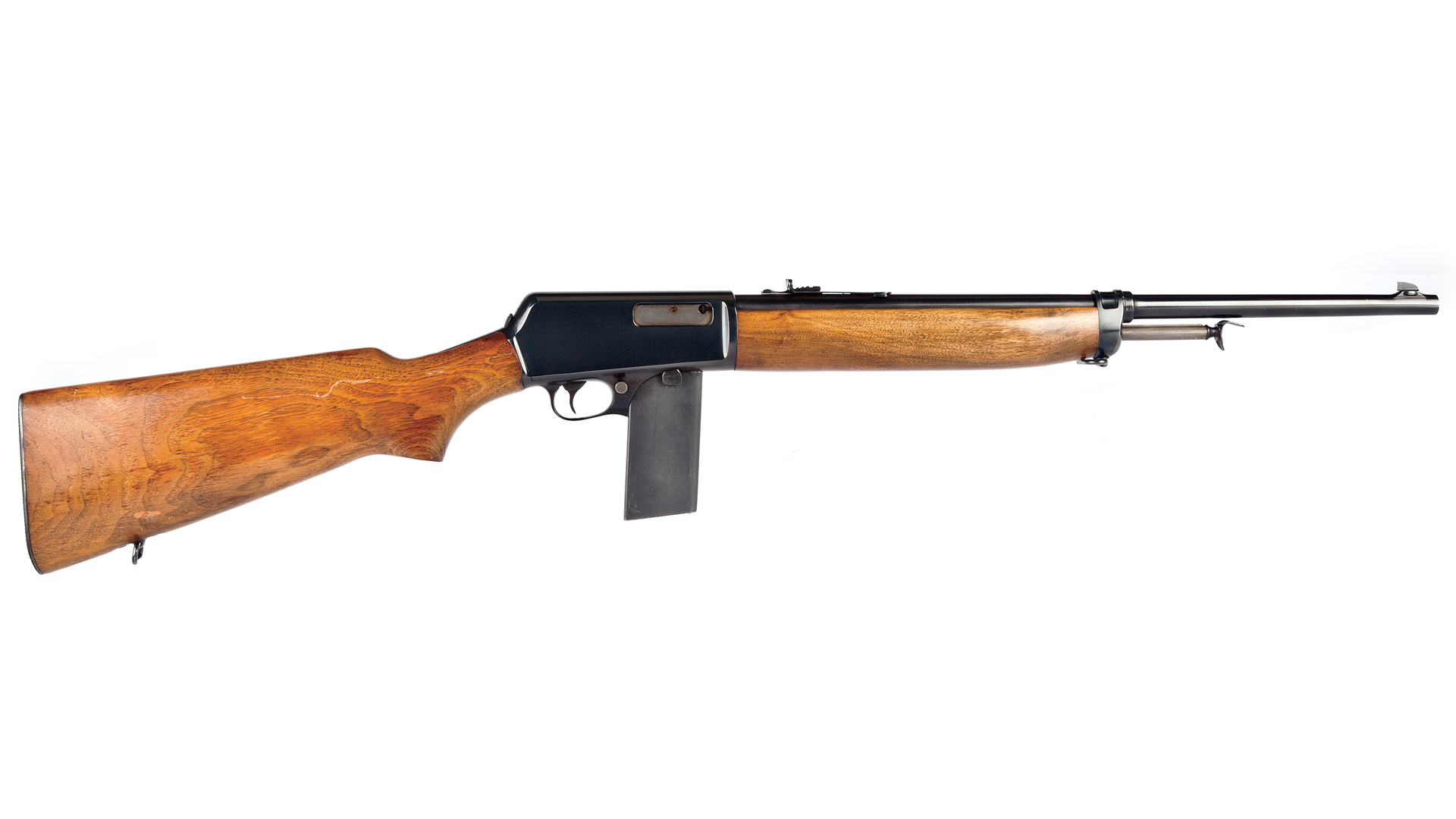
The Winchester Model 1907 firmly established the company as an innovator in semi-automatics shortly after it parted ways with John Browning.
In 1903, the Winchester Repeating Arms Company was trying to reinvent itself. The company that made a fortune, created a legend and helped shape our country’s history with its lever-action rifles designed by John Moses Browning now wanted people to think of it instead as a pioneer in the newest type of firearm: the semi-automatic rifle. The reason behind this change of direction was the sudden severing of relationships between Browning and the New Haven company he helped make famous.
It all began around 1901, when Browning first showed T.G. Bennet, Winchester’s president, two prototypes for a unique new shotgun—a semi-auto, blowback-operated longarm. Two years passed without word from Winchester, so Browning paid Bennett another visit and demanded an answer regarding his repeating shotgun. Unfortunately, Bennett gave it a thumbs-down. In hindsight, this was probably not a smart thing to do to the inventor who gave Winchester the 1885 High Wall, plus the Models 1886, 1892, 1894 and 1895 lever-actions as well as the Models 1887 and 1897 shotguns, among other things. Infuriated, Browning stormed out of Bennett’s office, thus ending his 19-year association with the company. Browning then took his shotgun to Fabrique Nationale in Herstal, Belgium, where the gun became the Browning Auto-5.
In the meantime, Winchester was left without the prospect of any more Browning-designed guns, a bad bit of timing, because in an effort to embrace the new technology of the 20th century, there was a race among various manufacturers to see who could be first with a marketable semi-automatic rifle. But, even though Winchester no longer had Browning, the company did have Thomas Crosley Johnson. He was a gifted designer-engineer who would subsequently be responsible for such classics as the Model 12 pump shotgun, the Model 21 side-by-side and the Model 54 bolt-action, which would eventually become the Model 70. But for now, Johnson was tasked with developing rifles that would get the shooting public to start thinking of Winchester as an innovator in semi-automatics.
His first entry into this untrampled field was the Winchester Model 1903 takedown, which not only became Winchester’s first semi-automatic rifle, but also the first truly successful semi-auto in America. It chambered a unique variation of the popular .22 rimfire, a proprietary .22 Winchester Automatic cartridge. It was the only firearm ever chambered for this round, which was loaded via a magazine tube inserted through an opening in the right side of the stock. Not as powerful as the .22 LR, this cartridge was also dimensionally different to prevent the use of blackpowder .22 rimfires—which were still quite common at the time—from being chambered in the Model 1903. Much later, the Model ’03 was redesigned as the Model 63, which could handle smokeless .22 LR rounds.
The Model 1903 was only a stopgap solution, however. What the sporting and law enforcement markets wanted was a centerfire version of Winchester’s new semi-auto. To meet this demand, Johnson and his team came up with the Model 1905. While similar in appearance and concept to the 1903, it had the distinction of being Winchester’s first rifle with a detachable-box magazine. A five-round version was standard, while a less aesthetically pleasing (to some) 10-round magazine was available as an option. Like its predecessor, this new rifle featured proprietary chamberings, with two options available: .32 Winchester Self Loading (WSL), which became the basis for the future M1 Carbine round, and the .35 WSL, which was comparable to today’s .357 Mag. Neither proved very popular.
A tube-shaped operating sleeve protruding from the Winchester Model 1907’s forearm was used to cock the rifle • To take down the rifle for maintenance, a screw located at the rear of the receiver was removed to separate the receiver from the stock and trigger group • The .351 WSL is ballistically similar to the .357 Mag.
Two years later, Johnson hit pay dirt with the Winchester Model 1907. Similar in appearance to the 1905, but with its own serial number range, this new version was chambered for the beefed-up and slightly elongated .351 WSL cartridge—for which this rifle was the only option—and fired a 180-grain bullet with a muzzle velocity of 1,850 fps. While that hardly qualified it as a big-game cartridge, it proved remarkably effective on soft-skinned medium game such as mountain lions, bobcats and coyotes, where the Model 1907’s rapid-fire capabilities made up for its subpar accuracy. With its handy 20-inch, round-profile barrel, the rifle also found its calling during World War I, where U.S. and Allied pilots often slipped a Model 1907 into the open cockpits of their biplanes for occasional, impromptu air-to-air firefights with the enemy.
Like its immediate predecessor, the Model 1907 came with a five-round detachable-box magazine that clicked in place and was flush with the trigger guard, making for a handsome, but very businesslike appearance. An optional 10-round magazine was also available. A thick, semi-beavertail forearm was necessary in order to encase the breech bolt’s inertia-block extension that was carefully calibrated to equal the forward velocity of the cartridge in order for the semi-auto action of the Model ’07 to function. Thus, the forearm, in spite of its bulky appearance, was actually quite fragile, as it was hollow in order to contain the recoil mechanism.
Like the Model 1905, the 1907 featured a takedown lock and screw at the rear of the receiver and was cocked by pushing in on a polished tubular “operating sleeve” that protruded out from the fore-end underneath the barrel. Also, by pushing in and then twisting the operating sleeve either left or right, the bolt could be locked open. The rifles came with fixed rear sights, but tangs were drilled and tapped, and later in production, tang sights could be substituted at no extra cost. Initially there were no sling swivels, but by serial number 23,171 they became standard. Weighing almost 8 pounds, it is hard to imagine anyone carrying the rifle without a sling.
An even weightier Model 1910 chambered in .401 WSL came later, but the Model 1907 proved to be the most popular and longest lasting of Winchester’s earliest semi-autos. In fact, due to its almost-immediate adoption by law enforcement agencies, a special Police Rifle variation was offered in 1908. Starting around serial number 9,000, it featured a bayonet attachment, thicker stocks, checkered-steel buttplate (instead of the standard, hard-rubber shotgun buttplate) and weighed almost 11 pounds. These Model 1907 Police Rifles proved to be of immense aid in combating crime during the “Roaring ’20s” and brought many a gangster to justice, including Bonnie and Clyde.
Finally, with more than 59,000 units produced, the Winchester Model 1907 was discontinued in 1957. This ended a half-century legacy of a novel semi-automatic rifle that might never have come into existence had Winchester decided to produce Browning’s semi-automatic shotgun.
Read the full article here